 BIS Certification
 CDSCO
CDSCO
 PESO
PESO
 CPCB
CPCB
 LMPC
LMPC
 WPC Approval
 Global Approvals
 TEC
TEC
 ARAI
ARAI
 BEE
BEE
 ISO Certification
 DGCA Certification
 NOC For Steel
 APEDA Registration























 Business Registration
 FSSAI Mark Certification












 (32).jpg)
 Legal Services
 Trademark Registration
 Copyright Registration
 Patent Registration
 By
By - Welded low carbon steel cylinders of more than 5 L containing toxic and corrosive gases require mandatory certification.
- It involves standards for design, welding, testing, and marking as per IS 3196 (Part 4).
- The certification steps entail filing a BIS application, a factory audit, product testing, and issuing the license.
- Frequently encountered problems are insufficient documentation, absence of traceability, or errors in marking.
- Certification is a prerequisite for the legal sale of the product, safety compliance, and enhanced market trustworthiness.
Introduction
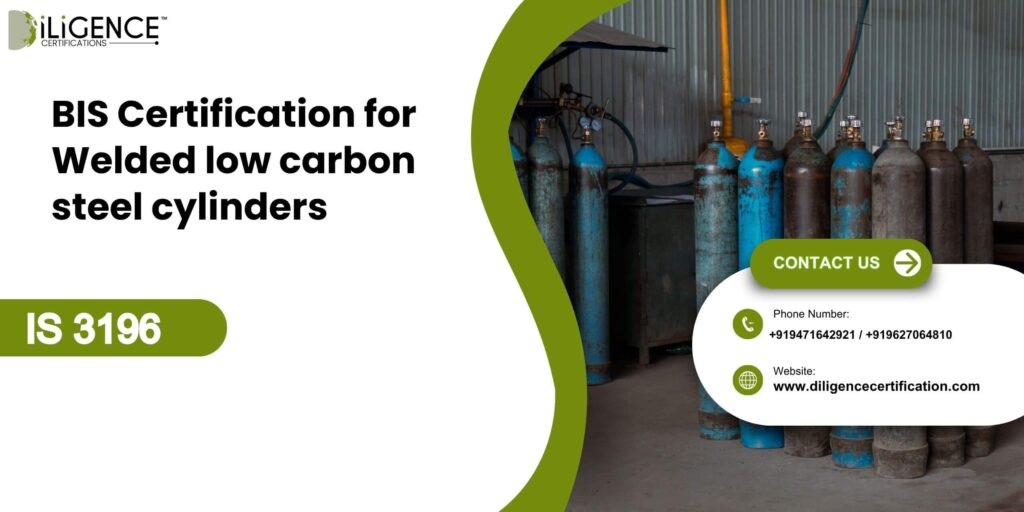
A fuel supplier in Gujarat experienced a situation where their chlorine cylinders were delayed at customs due to the absence of a certificate. These are welded low carbon steel cylinders with a capacity of more than 5 litres and are intended for toxic or corrosive gases. Such cylinders need to have a BIS certification under IS 3196 (Part 4) to be sold or transported in India legally. Quite a number of manufacturers make the mistake of not fully understanding the detailed requirements which results in their shipments being delayed and causing problems with compliance. The standard is aimed at the safety aspects of the product and, therefore, it specifies the design, material, welding, testing and marking.
What is BIS Certification for Welded low carbon steel cylinders
BIS Certification for welded low carbon steel cylinders is a formal record that the Bureau of Indian Standards (BIS) has under the ISI Mark Scheme given to the product/material. It is a sign of high security/quality for the liquefied low-pressure gas steel cylinders made from low carbon steel that are specifically those with a water capacity (WC) of more than 5 L and used for toxic, the explosive, or corrosive gases such as, etc.
A certified standard under IS 3196 (Part 4) to that extent means that the steel gas cylinders are:
- Made from good quality steel and proper raw materials
- Possess the design calculations for the pressure and the thickness of the wall
- Are done with the proper welding and production methods
- Have undergone the full range of tests and inspections such as the hydrostatic, burst, stretch, and leak tests
- Have been correctly marked and contain the stamps for traceability
What is IS 3196?

IS 3196 is an Indian standard released by the Bureau of Indian Standards (BIS), which prescribes the requirements for welded low carbon steel cylinders of liquefied low-pressure gases. It is segmented into different parts that refer to the type of gas and the capacity of the cylinder. ISI MARK
IS 3196 (Part 4) is a detailed specification for the cylinders of toxic and corrosive gases with a water capacity of more than 5 liters. The standard describes:
- The material aspects such as steel grade and chemical composition
- Design and construction aspects, e.g., wall thickness and welding procedure
- Testing is to be done according to hydrostatic, pneumatic, burst, and leak tests
- The marking, stamping, and identification requirements
- Manufacturing and despatch rules for the safety during the handling and transport
Why BIS Certification is Mandatory for Welded low carbon steel cylinders
- Conformance to the Law: As per Indian legislation, cylinders need to comply with IS 3196 (Part 4) standards prior to their manufacturing, selling, or transporting. It is not allowed for cylinders without BIS approval to be in the market.
- Protection to Users: These kinds of cylinders are meant to hold gases that may be dangerous. So, BIS certification is needed to make sure they go through strict rules concerning design, material, welding, and testing to be safe and less likely to cause accidents due to leaks, bursts, etc.
- Assurance of Quality: The whole certification process is opened to inspection-in-factory, product-testing, traceability-checks-which results in unbroken quality and the reliability of the products.
- Trustworthiness in the Market: The certified cylinders become trustworthy for the buyers, the regulators, and the end-users, this being very important for the industrial and commercial applications.
- Regulatory Compliance: Pharmaceutical cylinders that have obtained BIS certification are accepted without hesitation by government agencies, transport authorities, and industrial clients, thereby avoiding the risk of seizures or compliance penalties.
Key features of BIS Certification
- It is a must for cylinders with a volume of more than 5 litres that are intended to be used for toxic and corrosive gases.
- It makes sure that the product meets very strict standards in terms of materials, design, and welding.
- It also requires very thorough testing methods to be carried out such as hydrostatic, burst, and leakage tests.
- Besides that, it includes factory audits and checks of the quality system to ensure that production is running smoothly and consistently.
- It is a guarantee for marking, traceability, legal sanction, and market trustworthiness.

Step by Step process of BIS Certification for Welded low carbon steel cylinders
Step1: Documentation
- Acquire details of the company and factory.
- Make product drawings, WPS/WPQR, and material test reports.
- Prepare a quality manual, inspection plan, and marking details.
Step2: Product Testing
- Test the product in a BIS approved lab.
- Conduct hydrostatic, burst, leak, and weld tests.
- Get test reports certifying that the product meets IS 3196 (Part 4).
Step3: Application Submission
- Submit an application online through the BIS Manak Portal.
- Upload documents and test reports.
- Make the payment of the fees, if any, and get an application number.
Step4: Scrutiny and Inspection
- BIS examines the submitted documents and conducts a factory inspection.
- Material, welding, quality control, and marking are verified.
- If non-conformities are present, correct them.
Step5: Grant of License
- After the license is granted, BIS issues the ISI license.
- The cylinders are then allowed to be marked and sold legally.
- Keep records for regular surveillance audits and renewals.
Importance and Benefits of BIS Certification
Importance
- Legal Requirement: According to IS 3196 (Part 4), it is necessary for welded low carbon steel cylinders (more than 5 L) that carry toxic or corrosive gases.
- Safety Assurance: It is the guarantee that the devices are designed, fabricated, and tested not to release gases or cause an explosion, or accidents of any kind.
- Quality Compliance: It gives the confirmation of adherence to the material, welding, and testing specifications laid down by BIS.
- Market Authorization: In India, uncertified cylinders cannot be manufactured, imported, or sold.
- Regulatory Acceptance: Certified products get support from government, transport, and industrial authorities without any hassle.
Benefits
- Consumer & Worker Safety: The chance of gas leaks and accidents has been reduced.
- Enhanced Market Credibility: The firm gets recognition from customers, regulators, and industrial clients.
- Smooth Customs Clearance: The case of imports/exports is without any delays or seizures.
- Quality Consistency: The manufacturers are provided the incentive to keep the strict control over their production processes.
- Competitive Advantage: The products that have been certified are most likely to be chosen in tendering and government contracts.
- Brand Reputation: The company receives the credit for safety and compliance from their stakeholders.
Why choose Diligence Certifications
- Expert in BIS Standards - Deep knowledge of IS 3196 (Part 4) and gas cylinder standards.
- End-to-End Support - Support right from paperwork till the final BIS license.
- Fast & Hassle-Free Process - Less waiting time due to efficient coordination of approvals.
- Accurate Documentation - Providing it by giving the correct guidance and avoiding mistakes and rejections.
- Recognized Lab Network - Testing facilities that are BIS-approved to carry out the testing.
- Post-Certification Help - Help and support with repeat, surveillance audits, and regulations.
Conclusion
Obtaining a BIS certification as per IS 3196 (Part 4) is mandatory for the manufacturers of welded low carbon steel gas cylinders for toxic and corrosive gases. It is a measure of safety compliance with the national standards, increases product reliability, and makes it possible to sell in the Indian market legally.By adhering to the certification steps closely and engaging an expert like Diligence Certifications, manufacturers can get their approvals quicker, keep the quality of their products uniform, and create trustful relationships with their customers and the regulatory authorities which will last for a long time.
Frequently Ask Questions
What is BIS Certification for welded low carbon steel cylinders?
BIS Certification is a certification awarded by the Bureau of Indian Standards (BIS) that indicates that the safety, quality, and design specified standards of the welded low carbon steel cylinders as per IS 3196 (Part 4) have been complied with.
Is BIS Certification mandatory for all gas cylinders?
Not quite. It is only mandatory for welded low carbon steel cylinders having a volume of more than 5 liters which are used for toxic and corrosive gases, as per IS 3196 (Part 4), that is why.
What are the testing procedures to be done for getting BIS Certification?
Those tests shall be hydrostatic, burst, and leak; accompanied by pneumatic and non-destructive testing (NDT) of welds as well as material composition and mechanical tests.
How long is the BIS certification process?
Typically 6-8 weeks are needed and the period depends on the documentation, product testing, and factory inspection.
Are there any BIS Certifications for the cylinders that are produced in other countries?
Yes. Before they are allowed in India to be sold or used, the CIS FMCS (Foreign Manufacturers Certification Scheme) must certify the imported welded cylinders.
What if a manufacturer offers the cylinders that do not have BIS Certification?
It is illegal to sell or transport unverified cylinders and thus, the officials have the power to confiscate products, impose fines, or take legal actions.
What is the term of the BIS license?
Generally, a BIS license is only good for a few years and the holder of the license can renew it by presenting the documents, test reports, and fees.
What are the significant causes for a BIS application to be rejected?
Incorrect or incomplete documentation
Phony or invalid test reports
Non-compliance with the design or welding standards
Incorrect marking or no traceability
Is it possible for Diligence Certifications to accelerate the process of BIS registration?
Yes, indeed. Antona Diligence Certifications provides complete support to the client - from documentation, testing, to inspection, and licensing - thus, offering a stress-free and timely certification process.


