



 BIS Certification
 CDSCO
CDSCO
 CPCB
CPCB
 LMPC
LMPC
 WPC Approval
 Global Approvals
 TEC
TEC
 ARAI
ARAI
 BEE
BEE
 ISO Certification
 DGCA Certification
 NOC For Steel
 APEDA Registration














 Business Registration
 FSSAI Mark Certification










 Legal Services
 Trademark Registration
 Copyright Registration
 Patent Registration
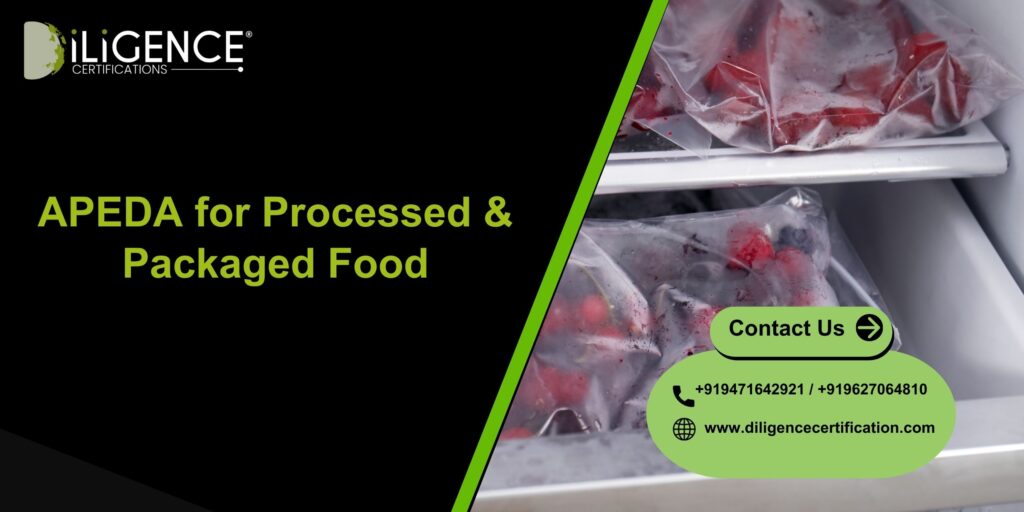
- APEDA APEDA for Processed & Packaged Food enrollment is obligatory for exporting reused and packaged food products from India.
- Reused food exports differ significantly from raw food exports in compliance, shelf- life, and value addition.
- Labeling, packaging, and shelf- life norms must misbehave with importing country regulations.
- Exporters must maintain complete attestation to clear customs easily.
- Global demand for ready- to- eat, organic, and ethnical Indian foods is increasing .

Introduction | APEDA for Processed & Packaged Food
Processed and packaged food exports represent one of India’s fastest-growing export segments. From ready-to-eat meals and frozen foods to spices, snacks, and beverages, Indian products are gaining popularity worldwide due to affordability, taste, and quality.
To regulate and promote these exports, the Indian government mandates APEDA registration. Without it, exporters cannot legally ship notified processed food items. Beyond compliance, APEDA registration opens doors to financial assistance, international exposure, and market intelligence.
What is APEDA Registration?
APEDA (Agricultural and Processed Food Products Export Development Authority) is a statutory body under the Ministry of Commerce & Industry.
- Mandatory for exporters of notified agricultural and processed food products
- Valid for lifetime once issued
- Enables access to government export incentives
- Helps maintain quality and safety standards
- Required for customs clearance of processed food consignments
Difference Between Raw & Processed Food Exports
| Aspect | Raw Food Exports | Processed & Packaged Food Exports |
| Value Addition | Minimal | High |
| Shelf Life | Short | Extended |
| Packaging | Basic | Advanced & protective |
| Compliance | Limited | Extensive |
| Profit Margins | Lower | Higher |
Why APEDA Registration is Required
- Obligatory under Indian import regulations
- Ensures food safety and quality assurance
- Enables traceability of food products
- Subventions access to import subventions and schemes
- Builds trust with transnational buyers
Without APEDA enrollment , exporters face payload rejection, penalties, or complete import bans.
Shelf-Life & Quality Standards
Reused food products must maintain quality throughout transportation and storehouse.
- Defined shelf- life supported by testing reports
- Stability studies for temperature and moisture
- Compliance with transnational food safety morals
- No dangerous preservatives beyond permitted limits
Poor shelf- life operation frequently leads to payload rejection at foreign anchorages.
Export Documentation Requirements
For processed and packaged food exports, documentation accuracy is critical.
- APEDA Registration Certificate
- IEC (Import Export Code)
- Commercial Invoice
- Packing List
- Certificate of Origin
- Health & Phytosanitary Certificates
- Bill of Lading / Airway Bill
Incomplete or incorrect documents can delay shipments and increase costs.
Market Trends in Processed Food Exports
- Global demand for reused food is rising rapidly.
- High demand for ready- to- eat and firmed foods
- Growth in organic and preservative-free products
- Increased exports to Middle East, Europe, USA, and ASEAN
- Preference for Indian ethnical and factory- grounded foods
- Rising focus oneco-friendly packaging
Indian exporters with proper instruments and compliance are gaining a strong competitive edge.
Why Choose Diligence Certification
Diligence Certification offers end-to-end compliance support for food exporters.
- Expert handling of APEDA & BIS registration
- Accurate documentation & faster approvals
- Guidance on labeling, packaging, and shelf-life norms
- Liaison with testing labs and authorities
- Reduced risk of rejection
- Time and cost efficiency
With professional support, exporters can focus on scaling their business instead of dealing with regulatory hurdles.
Conclusion
APEDA enrollment is the foundation of reused and packaged food exports from India. From icing compliance and quality to unleashing transnational requests, it plays a vital part in import success.
Still, the process involves multiple regulations, attestation, and specialized conditions. Partnering with a trusted adviser like industriousness instrument ensures smooth enrollment , nonsupervisory compliance, and briskly request entry — helping your brand grow encyclopedically with confidence.
Frequently Asked Questions (FAQs)
Is APEDA registration mandatory for processed food exports?
Yes, it is mandatory for exporting notified processed food products.
What is the validity of APEDA registration?
APEDA registration is valid for a lifetime.
Can startups apply for APEDA registration?
Yes, startups and MSMEs can apply.
Is BIS certification required for all processed foods?
Only specific products require BIS certification.
How long does APEDA registration take?
Typically 7–10 working days with correct documentation.
What happens if labeling norms are not followed?
Shipments may be rejected or penalized.
Does APEDA help with export incentives?
Yes, registered exporters can access government schemes.
Is testing mandatory for shelf-life declaration?
Yes, shelf-life must be supported by test reports.
Can one APEDA registration cover multiple products?
Yes, as long as products fall under APEDA’s scope.
Why hire a consultant for APEDA registration?
To avoid errors, delays, and compliance risks.