



 BIS Certification
 CDSCO
CDSCO
 CPCB
CPCB
 LMPC
LMPC
 WPC Approval
 Global Approvals
 TEC
TEC
 ARAI
ARAI
 BEE
BEE
 ISO Certification
 DGCA Certification
 NOC For Steel
 APEDA Registration












 Business Registration
 FSSAI Mark Certification










 Legal Services
 Trademark Registration
 Copyright Registration
 Patent Registration
- Ensures Quality and Safety: BIS Certification for Aluminium ensures that the aluminium and aluminium alloy wires comply with the quality, safety, and performance requirements as laid down in IS 739:1992.
- Applicable for General Engineering Purposes:This standard applies to aluminium and aluminium alloy wires used for general engineering purposes like manufacturing, electrical, and industrial applications.
- Mandatory Compliance for Manufacturers :The BIS certification and ISI mark are mandatory for manufacturers to manufacture, sell, or distribute aluminium wires in the Indian market where it is mandatory.
- Verification Through Testing and Inspection: The certification BIS Certification for Aluminium and Aluminium Alloy Wire involves testing the product in BIS-accredited laboratories and inspection of the manufacturing units to ensure the quality of the product.
- Enhances Market Credibility and Trust:BIS-certified aluminium wires have greater acceptance in government and private projects, which enhances brand reputation and customer trust.
Introduction | BIS Certification for Aluminium
BIS Certification for Aluminium and Aluminium Alloy Wire IS 739:1992 is a certification that ensures the aluminium wires used for general engineering applications meet the laid-down standards of quality and safety as defined by the Bureau of Indian Standards (BIS). The standard includes requirements concerning chemical composition, mechanical properties, dimensions, and performance.
What is IS 739:1992?
IS 739:1992 is an Indian Standard that has been published by the Bureau of Indian Standards (BIS). The standard specifies the requirements for the use of aluminium and aluminium alloy wire in general engineering applications. The standard provides for the wire to have specified quality, strength, and performance characteristics.
Key Points:
- Determines Material Composition:This defines the chemical composition of aluminium and aluminium alloys to provide adequate quality and strength.
- Includes Mechanical and Physical Properties:The specification contains details regarding tensile strength, elongation, and other mechanical properties to provide adequate performance.
- Specifies Dimensions and Tolerances:It gives recommendations regarding wire diameter, dimensions, and tolerances for proper manufacturing.
- Provides Quality Testing and Inspection:IS 739:1992 describes the testing procedure to check the strength and quality of aluminium wires.
- Used for General Engineering Purposes:These wires are widely used in engineering, electrical, and industrial applications.
Why is BIS Certification Mandatory
BIS Certification is required to ensure that the quality, safety, and performance requirements of aluminium and aluminium alloy wires are met as specified in IS 739:1992. Aluminium and aluminium alloy wires are commonly used in engineering, electrical, and industrial applications where strength, durability, and reliability are of utmost importance. BIS Certification ensures that the manufacturing process is standardized and the product is tested before it is released in the market.
Key Reasons:
- Ensures Product Quality Compliance:The BIS certification ensures that the quality of the aluminium and aluminium alloy wires is in accordance with the specified standards mentioned in IS 739:1992.
- Protects Safety and Performance:The certification ensures that the wires possess the correct strength, performance, and durability for safe use in engineering and industries.
- Prevents Use of Substandard Products:The certification process prevents the use of substandard products in the market.
- Required for Legal Manufacturing and Sale:The BIS certification is required by the manufacturers to sell the certified aluminium wires in India.
- Builds Customer and Market Trust:The ISI mark on the product ensures that the product is in accordance with reliable and approved Indian standards.
Importance and Benefits of BIS Certification
| Importance | Benefits |
| Compliance with Indian Standard IS 739:1992:The certification guarantees that the aluminium and aluminium alloy wires conform to the BIS standards regarding quality, composition, and performance. | Enhances Product Credibility:BIS certification increases the credibility of the product in the market. |
| ISI Mark Certification :The manufacturers are allowed to use the ISI mark, which is an assurance that the product is BIS standards compliant. | Ensures Uniform Quality of the Product:Testing and inspection of the product ensure that it meets uniform standards of quality. |
| Mandatory Testing in BIS-Approved Labs:The wires have to be tested in BIS-approved labs to check the mechanical properties, size, and quality of the material. | Increases Acceptability in the Market:BIS certification of products increases their acceptability in government contracts and large-scale engineering projects. |
| Factory Inspection and Quality Control:BIS inspects the factories to ensure that the wires are produced following proper manufacturing processes and maintaining quality control. | Enhances Customer Trust:The ISI mark on the product ensures that the product is safe and meets Indian standards. |
| Applicable to Manufacturers and Importers :The BIS certification is mandatory for Indian manufacturers as well as importers before they can sell aluminium alloy wires in the Indian market. | Facilitates Legal Sale of Products:Certification of products facilitates the sale of products in the Indian market. |
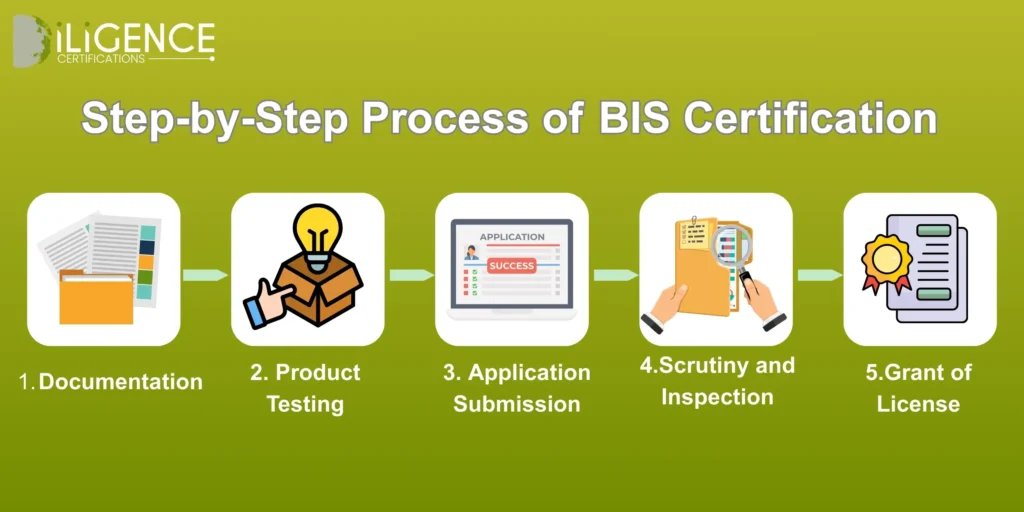
Step-by-Step Process of BIS Certification
Step1:Documentation
- Collect required technical documents
- Prepare product specifications
- Gather company registration details
- Ensure documents follow BIS format
Step2:Product Testing
- Send samples to a BIS-approved lab
- Conduct safety and quality tests
- Receive test reports
- Confirm compliance with BIS standards
Step3:Application Submission
- Fill out the BIS application form
- Upload all required documents
- Attach valid test reports
- Pay the necessary BIS fees
Step4:Scrutiny and Inspection
- BIS reviews submitted documents
- Authority verifies test results
- Factory/product inspection may occur
- Clarifications requested if needed
Step5:Grant of License
- BIS approves the application
- License number is issued
- Product can carry BIS mark
- Renewal required before expiry
Documents Required for BIS Certification
| Category | Documents Required |
| Business Documents | Business license/registration, ISO certificate, organizational details |
| Manufacturer Details | Factory layout, process flow chart, machinery list, production details |
| Product Documents | Product specifications, component list, user manual, model details |
| Testing Documents | Test report from BIS-recognized lab, sample details, test request form |
| Legal & Compliance | Authorization letter, brand ownership proof, trademark certificate (if any) |
| Import/Foreign Manufacturer (If applicable) | AIR (Authorized Indian Representative) details, contract agreement, overseas manufacturer documents |
Timelines, Costs, Validity & Renewal
- Timelines: Usually from 20 to 30 days, with only 7-15 days for the testing.
- Costs: The cost of the government and the test varies depending on the product. There can be some additional charges though.
- Validity: The validity period is 2 years in most situations.
- Renewal: The renewal is done before the expiration; there should be updated documents/tests; the renewal
Why Choose Diligence Certifications
Diligence Certifications is a reliable consultancy service that offers full support for acquiring BIS Certification for Aluminium and Aluminium Alloy Wire as per IS 739:1992. The professionals at Diligence Certifications assist producers and importers in the BIS certification process with ease. They also provide support in documentation, testing, inspection, and submission of applications for BIS certification.
Conclusion
BIS Certification for Aluminium and Aluminium Alloy Wire, as per IS 739:1992, is a crucial requirement to check the quality and safety of the product. The certification ensures that the wires are in accordance with the specified requirements of chemical composition, mechanical strength, and performance. This makes the wires suitable for general engineering purposes.The BIS certification and ISI mark help in establishing the reliability of the manufacturers.
Frequently Asked Questions (FAQs)
What is IS 739:1992?
It is an Indian Standard that outlines requirements for aluminium and aluminium alloy wires used in general engineering applications.
What is BIS Certification for aluminium alloy wire?
It is a certification given by BIS to ensure that the wire satisfies the quality and safety requirements of IS 739:1992.
Is BIS certification mandatory for aluminium wire?
Yes, it is mandatory if the product satisfies BIS compulsory certification schemes.
What is the ISI mark?
ISI mark is a quality certification mark given by BIS to ensure that the product satisfies the Indian Standards.
Who can apply for BIS certification?
Manufacturers and importers of aluminium and aluminium alloy wires can apply for BIS certification.
What is the purpose of BIS certification?
It ensures the quality, safety, and Indian regulatory standards of the product.
How is the product tested for BIS certification?
The product is tested in BIS-approved testing laboratories to check its quality and performance.
How long does it take to get BIS certification?
It takes a few weeks to a few months to get BIS certification.
What are the benefits of BIS certification?
It enhances the authenticity of the product, and its quality is ensured.
Can a product be sold without BIS certification?
No, if a product requires mandatory BIS certification, it cannot be sold without it.