

 BIS Certification
 CDSCO
CDSCO
 CPCB
CPCB
 LMPC
LMPC
 WPC Approval
 Global Approvals
 TEC
TEC
 ARAI
ARAI
 BEE
BEE
 ISO Certification
 DGCA Certification
 NOC For Steel
 APEDA Registration




 Business Registration
 FSSAI Mark Certification
 Legal Services
 Trademark Registration
 Copyright Registration
 Patent Registration
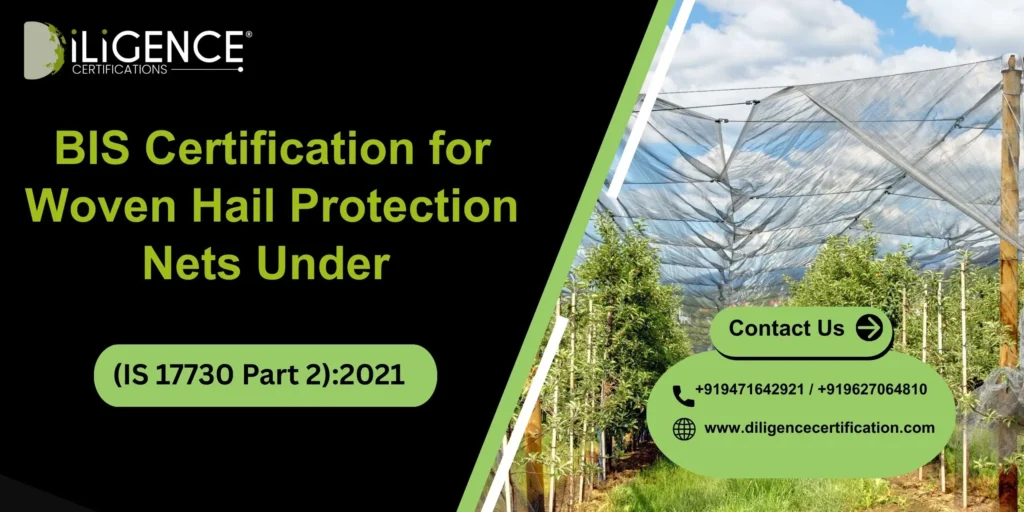
- Obligatory Compliance – Woven hail protection nets used in husbandry and horticulture must misbehave with IS 17730( Part 2) under the BIS for Woven Hail Protection Nets instrument frame.
- Product Quality Assurance – BIS instrument ensures continuity, UV stability, tensile strength, and rainfall resistance of hail protection nets.
- Market Access – pukka products gain trust, wider acceptance, and eligibility for government and institutional tenders.
- Threat Reduction – instrument minimizes crop loss pitfalls caused by hailstorms and extreme rainfall.
- Legal & marketable Advantage – BIS- marked nets help manufacturers avoid penalties, product rejection, and reputational damage.
Introduction | BIS for Woven Hail Protection Nets
India’s agricultural sector is increasingly exposed to climate uncertainties, especially hailstorms that cause sudden and severe crop damage. To mitigate these risks, hail protection nets have emerged as a vital agro-textile solution, widely used in orchards, vineyards, vegetable farms, and nurseries.
However, not all nets offer the same level of protection. Variations in raw materials, weaving techniques, and UV resistance can significantly impact performance. To standardize quality and ensure farmer safety, the Bureau of Indian Standards introduced IS 17730 (Part 2), covering woven hail protection nets for agriculture and horticulture purposes.
What Is BIS for Woven Hail Protection Nets?
BIS for Woven Hail Protection Nets Certification is a conformity assessment scheme that allows manufacturers to use the ISI Mark, signifying compliance with relevant Indian Standards.
For woven hail protection nets, IS 17730 (Part 2) specifies requirements related to:
- Material composition
- Construction and weaving
- Physical and mechanical properties
- Resistance to environmental factors
- Testing methods and marking
Once certified, manufacturers can legally manufacture, store, sell, and distribute these nets across India with assured quality and regulatory acceptance.
Key Features of IS 17730 (Part 2)
1. Material Specifications The standard authorizes the use of high- quality polymer accoutrements , generally HDPE or analogous, with defined complements for UV stabilization.
2. Woven Construction Unlike knitted nets, Part 2 specifically applies to woven hail protection nets, icing invariant structure and enhanced impact resistance.
3. Mechanical Strength Parameters similar as Tensile strength extension Tear resistance are rigorously defined to insure nets repel hail impact and wind cargo.
4. UV & Weather Resistance Nets must perform reliably under dragged sun exposure, rain, temperature variation, and out-of-door conditions.
5. Testing & Marking Conditions Each pukka product must suffer laboratory testing and be duly marked with ISI mark
- Manufacturer details
- Standard reference
- Batch or lot identification
Why BIS for Woven Hail Protection Nets Certification Is Required – Key Reasons
- Farmer Protection Certified nets reduce crop damage, icing growers’ investments are shielded against changeable rainfall.
- Quality Standardization BIS for Woven Hail Protection Nets eliminates unacceptable and low- quality nets from the request.
- Government Compliance numerous state agrarian schemes and subventions bear BIS- certifiedagro-textiles.
- Fair Trade Practices Ensures invariant competition by administering the same quality marks for all manufacturers.
- Long- Term Cost Savings High- quality certified nets have longer service life, reducing relief frequency.
Importance and Benefits
| Aspect | Importance | Benefits |
| Product Quality | Ensures uniform performance | Reduces failure during hailstorms |
| Farmer Safety | Protects crops & income | Builds confidence in agro-solutions |
| Regulatory Compliance | Meets legal requirements | Avoids penalties & seizure |
| Market Credibility | Enhances brand image | Easier dealer & distributor onboarding |
| Longevity | Higher durability standards | Lower lifecycle cost |
BIS for Woven Hail Protection Nets Process
Step1:Documentation
- Collect required technical documents
- Prepare product specifications
- Gather company registration details
- Ensure documents follow BIS format
Step2:Product Testing
- Send samples to a BIS-approved lab
- Conduct safety and quality tests
- Receive test reports
- Confirm compliance with BIS standards
Step3:Application Submission
- Fill out the BIS application form
- Upload all required documents
- Attach valid test reports
- Pay the necessary BIS fees
Step4:Scrutiny and Inspection
- BIS reviews submitted documents
- Authority verifies test results
- Factory/product inspection may occur
- Clarifications requested if needed
Step5:Grant of License
- BIS approves the application
- License number is issued
- Product can carry BIS mark
- Renewal required before expiry
Documents Required for BIS Certification
| Category | Documents Required |
| Business Documents | Business license/registration, ISO certificate, organizational details |
| Manufacturer Details | Factory layout, process flow chart, machinery list, production details |
| Product Documents | Product specifications, component list, user manual, model details |
| Testing Documents | Test report from BIS-recognized lab, sample details, test request form |
| Legal & Compliance | Authorization letter, brand ownership proof, trademark certificate (if any) |
| Import/Foreign Manufacturer (If applicable) | AIR (Authorized Indian Representative) details, contract agreement, overseas manufacturer documents |
Timelines, Costs, Validity & Renewal
- Timelines: Usually from 20 to 30 days, with only 7-15 days for the testing.
- Costs: The cost of the government and the test varies depending on the product. There can be some additional charges though.
- Validity: The validity period is 2 years in most situations.
- Renewal: The renewal is done before the expiration; there should be updated documents/tests the renewal
Challenges of Obtaining BIS Certification Without a Consultant
Applying for a BIS for Woven Hail Protection Nets instrument singly can be complex, especially for first- time aspirants. Common challenges include
1. Specialized Attestation crimes Incorrect product details, mismatched specifications, or deficient test reports frequently lead to operation rejection.
2. Standard Interpretation Issues Understanding specialized clauses of IS 17730( Part 2) requires nonsupervisory moxie.
3. Testing Detainments opting the wrong BIS for Woven Hail Protection Nets honored lab or failing tests increases costs and time.
4. plant examination Readiness BIS examinations assess
- Manufacturing capability
- Quality control systems
- In- house testing installations
5. Extended blessing Timelines Without proper guidance, instrument timelines can stretch from months to over a time.
Why Choose a Diligence Certificate Consultant?
Diligence Certificate BIS for Woven Hail Protection Nets adviser streamlines the instrument trip by offering end- to- end nonsupervisory support.
- Expert Standard Mapping – Ensures exact compliance with IS 17730 Part 2
- Error-Free Attestation – Prevents rejection and repeated cessions
- Lab Collaboration – Faster sample testing and affect interpretation
- Inspection Preparation – Factory readiness and inspection support
- Time & Cost effectiveness – Faster blessings with minimum rework
With expert running, manufacturers can concentrate on product and request expansion while compliance is managed professionally.
Conclusion
BIS for Woven Hail Protection Nets under IS 17730( Part 2) is n’t just a nonsupervisory formality it is a quality assurance medium that protects growers, strengthens agrarian adaptability, and promotes responsible manufacturing.
With adding climate volatility and rising demand foragro-textile results, BIS- certified hail protection nets play a pivotal part in sustainable husbandry. While the instrument process can be technically demanding, the long- term benefits include legal compliance, request credibility, and client trust far outweigh the trouble.
Frequently Asked Questions (FAQs)
S
Is BIS instrument obligatory for woven hail protection nets?
Yes, when notified or needed by government schemes and procurement programs.
Which standard applies to woven hail protection nets?
IS 17730( Part 2).
Does this standard cover knitted nets?
No, Part 2 applies specifically to woven nets.
Who can apply for BIS instrument?
Manufacturers with in- house product installations.
How long does BIS instrument take?
generally 3 – 6 months with proper attestation.
Is product testing obligatory?
Yes, testing at BIS- honored laboratories is mandatory.
Can uncertified nets be vended in India?
They may face rejection in government tenders and nonsupervisory conduct.
What's the validity of BIS license?
Generally valid for 2 times, subject to renewal.
Can foreign manufacturers apply?
Yes, under BIS FMCS scheme if applicable.
Why use a BIS adviser ?
To reduce detainments, avoid rejection, and insure briskly blessing.