



 BIS Certification
 CDSCO
CDSCO
 CPCB
CPCB
 LMPC
LMPC
 WPC Approval
 Global Approvals
 TEC
TEC
 ARAI
ARAI
 BEE
BEE
 ISO Certification
 DGCA Certification
 NOC For Steel
 APEDA Registration












 Business Registration
 FSSAI Mark Certification











 Legal Services
 Trademark Registration
 Copyright Registration
 Patent Registration
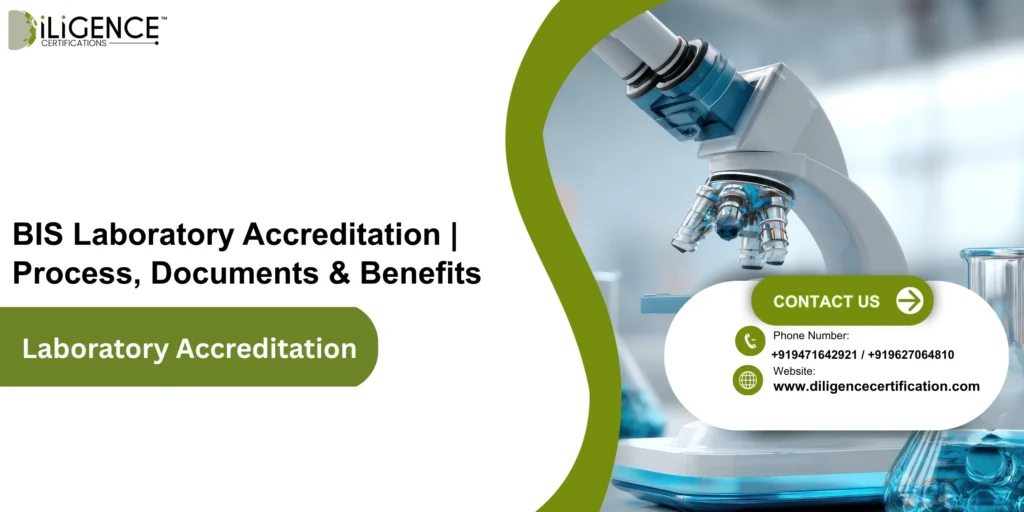
- BIS Laboratory Accreditation confirms the capability of a laboratory to perform testing in compliance with Indian Standards.
- BIS Accreditation is run by the Bureau of Indian Standards and provides quality, accuracy, and trust in testing.
- BIS Accreditation is important for manufacturers pursuing BIS certification in India, or seeking to use the ISI mark on products according to Indian Standards.
Introduction
The evolving industrial and manufacturing landscape in India has created an urgent demand for a reliable, accurate, and standardized testing process. BIS Laboratory Accreditation is a formal recognition of a laboratory’s technical competence, impartiality, and consistent performance based on the Bureau of Indian Standards (BIS) framework.
Accreditation confirms that the laboratory is operating in accordance with internationally recognized standards like ISO/IEC 17025, thereby generating valid and traceable results that form the basis for its BIS Certification. It serves as the infrastructure for quality in India and instills public confidence in products that have gone through testing at accredited laboratories.
Laboratory Accreditation contributes to this quality assurance by establishing clear standards for the accuracy of tests, management systems and calibration of equipment. It gives manufacturers, regulators, and consumers assurance that every test report provided reflects true compliance with the Indian Standards and is therefore fundamental for any organization that is attempting to show quality assurance or technical merit.
What is BIS Laboratory Accreditation?
The Bureau of Indian Standards (BIS) grants BIS Laboratory Certification to testing laboratories that meet technical competence, impartiality, and consistency. This establishes that the laboratory is following an internationally recognized quality management system—ISO/IEC 17025:2017.
An accredited laboratory can provide evidence that it has validated test results, can generate repeatable test results, and that its test reports will be accepted by regulatory agencies, government departments, and clients. An accredited laboratory will also be eligible to test for BIS Certification for products carrying the ISI Mark and under the Compulsory Registration Scheme (CRS).
Why Laboratory Accreditation is Crucial?
- Trust and Credibility: Accredited laboratories instill a sense of trust in clients, consumers, and regulatory authorities with regard to testing results.
- Regulatory Acceptability: The Bureau of Indian Standards (BIS) only recognizes accredited laboratories for testing and certification of a product.
- Reduced Re-testing Costs: Approved and validated reports will allow the product to avoid the risk of re-testing.
- International Trade Acceptance: Accreditation corresponds with testing protocols internationally, which reduces problems with shipping exported goods.
- Process Improvement: Accreditation through regular audits and internal controls increases process consistency.
Role of Bureau of Indian Standards (BIS)
India’s national standards body, the Bureau of Indian Standards, which is under the Ministry of Consumer Affairs, oversees all of the product certification and laboratory accreditation programs. BIS makes the standards, conducts all the inspections, and has a list of approved laboratories that can test various products, such as electrical appliances, steel products, and food contact materials.
With its Laboratory Recognition Scheme (LRS), BIS recognizes laboratories that have demonstrated their competence to perform testing on products within mandatory certification programs. These laboratories are the backbone of the quality ecosystem in India so that any listed or certified product meets the relevant standard (IS).
Eligibility Criteria for BIS Laboratory Accreditation
To be eligible for accreditation, laboratories must show:
- Conformance to all ISO/IEC 17025 standards.
- Adequate infrastructure, and this includes calibrated testing devices and environmental controls.
- Qualified technical personnel, with documented training and competency records.
- Documented quality management system, with procedures being traceable.
- A solid history of internal audits and corrections.
- Laboratories that fulfill these criteria can apply for accreditation against the BIS Laboratory Recognition Scheme (LRS).
Types of BIS-Recognized Laboratories
- Product Testing Laboratories: Conduct testing for items covered under ISI mark or CRS schemes.
- Calibration Laboratories: Execute calibration of equipment and instruments to confirm accurate measurement.
- Specialty Laboratories: Execute niche testing—potentially chemical, mechanical, electrical or environmental.
- Each lab must demonstrate unit level expertise and equipment readiness during the BIS audit.
Process of BIS Laboratory Accreditation
- Application Submission: The laboratory applies to BIS, submitting all necessary details on testing facilities, staff qualifications, and infrastructure.
- Preliminary Document Review: The quality manual, the calibration certificates, and the list of equipment are reviewed by BIS to verify that the lab meets the requirements of ISO/IEC 17025.
- On-Site Assessment: A BIS assessment team completes an on-site assessment of the facility, views demonstrations of testing capabilities, and interacts with lab personnel to verify competence.
- Non-Conformity Closure: All gaps or observations raised during the audit must be addressed by implementing corrective actions.
- Final Evaluation and Approval: A Laboratory Accreditation Certificate will be issued by the BIS when all requirements are met.
- Listing on BIS Website:
Accredited laboratories will be added to the official list of BIS-recognized laboratories and will be able to conduct product testing.
Documents Required for BIS Laboratory Accreditation
- Application form and payment receipt
- Quality Manual (as per ISO/IEC 17025)
- Equipment list and calibration certificates
- Test method validation reports
- Personnel qualification and training records
- Internal audit and management review records
- Environmental monitoring data
- Previous test results and proficiency testing evidence
Validity and Renewal of Accreditation
The BIS Laboratory Accreditation is typically valid for two years. Before expiry, the laboratory must apply for renewal, submitting updated documentation and participating in a surveillance or re-assessment audit.
Renewal ensures continuous compliance with quality systems and updated Indian Standards. Labs failing to maintain compliance risk suspension or withdrawal of accreditation.
Scope of BIS Laboratory Accreditation
The accreditation covers a defined scope—specific products or test parameters approved by BIS. For example:
- Electrical safety testing (IS 13252)
- Mechanical properties testing (IS 2062 for steel)
- Chemical composition analysis
- Plastic material evaluation
- Food contact surface testing
The laboratory cannot test or issue reports for products beyond its approved scope unless extended through a formal application.
Difference Between BIS Laboratory Accreditation and NABL Accreditation
There are numerous NABL (National Accreditation Board for Testing and Calibration Laboratories) accredited laboratories in India, which represents a broader recognition of technical competency.
BIS Laboratory Accreditation relates to a specific product and is directly tied to BIS Certification schemes. There are many situations where BIS recognizes NABL accredited labs for the purposes of their laboratory Accreditation, as long as the NABL accreditation scope aligns with the responsibilities of BIS, but BIS ultimately has the final authority.
| Aspect | BIS Laboratory Accreditation | NABL Accreditation |
| Governing Body | Bureau of Indian Standards | Quality Council of India |
| Purpose | Product testing for BIS Certification | General testing & calibration competence |
| Standard | ISO/IEC 17025 | ISO/IEC 17025 |
| Recognition Scope | Specific to BIS product categories | Broader technical domains |
| Acceptance | Mandatory for BIS product testing | Voluntary for industry clients |
Challenges Laboratories Face During Accreditation
- Lack of calibration or traceability of instruments
- Inadequate documentation and record control
- Insufficient technical staff or training gaps
- Delays in closing audit non-conformities
- Misalignment between NABL scope and BIS testing requirements
Many labs engage consultants to navigate these hurdles efficiently, ensuring documentation accuracy and timely approval.
Benefits of BIS Laboratory Accreditation
- Recognition by BIS and other regulatory authorities
- Enhanced credibility with manufacturers and consumers
- Increased business opportunities for testing and certification
- Consistent testing results and improved quality management
- Eligibility for participation in government and PSU projects
- International recognition through equivalence agreements
How Diligence Certifications Helps Laboratories
Diligence Certifications specializes in assisting testing and calibration laboratories with BIS Laboratory Accreditation and related compliance services. The team provides:
- Gap assessment and readiness evaluation
- Preparation of ISO/IEC 17025 documentation
- Liaison with BIS during application and assessment
- Staff training and audit support
- Scope extension and renewal assistance
Their expertise spans electronics, automotive, chemical, textile, and construction materials laboratories, ensuring full BIS compliance from start to finish.
BIS Laboratory Accreditation and BIS Certification Connection
For a product to get BIS Certification, either ISI or CRS Certification, the test must occur in a laboratory accredited by BIS to ensure that the test results reflect true conformance to the applicable Indian Standards.
Therefore, without accredited laboratories, BIS Certification cannot take place. The joint processes of laboratory accreditation and the certification process help ensure that only quality, compliant, and safe products enter the Indian market.
Future of Laboratory Accreditation in India
With India’s rapid industrial growth and export orientation, the demand for accredited laboratories is expanding. BIS is now integrating digital reporting, AI-based audit tracking, and international recognition under mutual recognition arrangements (MRAs).
Emerging sectors such as electric vehicles, renewable energy, medical devices, and green materials are opening new avenues for laboratory accreditation in India.
Conclusion
BIS Laboratory Accreditations issued by the Bureau of Indian Standards is not just an accreditation but is a national mark of competence and reliability. Accredited laboratories are essential in providing secure trusted BIS Certifications that allow industries to deliver products that comply with safety and quality standards.
If you are a Laboratory or Manufacturer seeking guidance on Laboratory Accreditation or BIS Certification, Diligence Certifications is here to help. We offer end-to-end professional services that ensure compliance, reliability, and confidence in every test.
Frequently Asked Questions
BIS Laboratory Accreditation: What is it?
It's when BIS informs you that your lab complies with the ISO/IEC 17025 standards for reliable and accurate product testing.
Why is it important?
It provides assurance of credibility, regulatory acceptance, reduces the costs associated with re-testing products, and provides a framework to improve lab processes.
Who can apply?
A laboratory, and its staff, which are qualified, have calibrated instruments, documented quality systems, and are compliant with ISO/IEC 17025.
Types of accredited labs:
1. Product Testing Labs
2. Calibration Labs
3. Specialty/Niche Testing Labs
How do I get accredited?
Submit an application → Review documents → On-site audit → Close gaps as needed → Receive your accreditation → Listed on the BIS website.
How long is it valid, and how do I renew?
Accreditation is valid for 2 years, after which you need to submit your updated documents and be reassessed.
What documents will I need to submit?
You will need a quality manual, equipment lists and calibrations, validation reports regarding your tests, staff qualifications, results of internal audits, and monitoring environmental data.
BIS vs NABL Accreditation?
BIS is for a set of products, and there is a requirement for BIS Certification (either ISI or CRS), whereas NABL is broader and voluntary → BIS may accept NABL accredited labs for labs that are also compliant with NABL standards.
Common issues we see with labs:
Instruments not calibrated, evidence of compliance / paperwork incomplete, quality systems related to staff training, and delays in taking corrective actions.
All products must be sent to a BIS accredited lab for them to obtain BIS Certification (either ISI or CRS), which will indicate they are in compliance with Indian Standards.