



 BIS Certification
 CDSCO
CDSCO
 CPCB
CPCB
 LMPC
LMPC
 WPC Approval
 Global Approvals
 TEC
TEC
 ARAI
ARAI
 BEE
BEE
 ISO Certification
 DGCA Certification
 NOC For Steel
 APEDA Registration
















 Business Registration
 FSSAI Mark Certification



 Legal Services
 Trademark Registration
 Copyright Registration
 Patent Registration
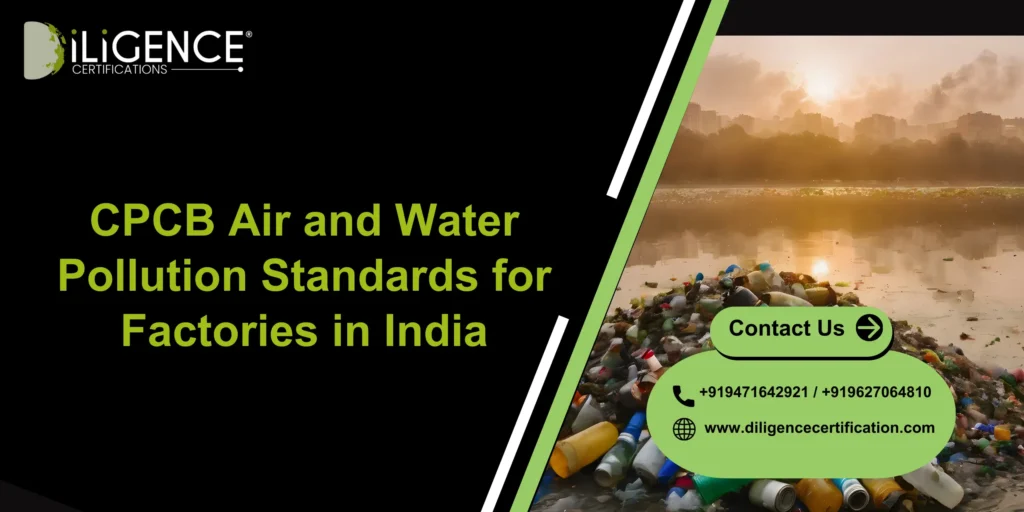
- CPCB Air and Water Pollution Standards for Factories in India define the obligatory emigration and effluent limits that artificial units must follow to operate fairly and sustainably.
- Ensures compliance with CPCB and State Pollution Control Board( SPCB) regulations
- Controls air emigrations and wastewater discharge from manufactories
- Prevents environmental damage and public health pitfalls
- Avoids penalties, factory closures, and legal action
- Supports sustainable and responsible artificial operations

Introduction
Artificial growth plays a vital part in India’s profitable development, but it also contributes significantly to air and water pollution. To control environmental damage and cover public health, the Central Pollution Control Board( CPCB) has established strict air and water pollution Standards for Factories in India.
All manufacturing units, recycling shops, and artificial installations are needed to misbehave with these norms under the Water( Prevention and Control of Pollution) Act, 1974, the Air( Prevention and Control of Pollution) Act, 1981, and related environmental rules. Non-compliance can lead to heavy penalties, check notices, or cancellation of environmental warrants.
This blog explains the CPCB Air and Water Pollution Standards for Factories in India, their connection, compliance conditions, and the significance of clinging to these morals.
What Are CPCB Air and Water Pollution Standards?
CPCB Air and Water Pollution norms are fairly specified limits for adulterants released into the terrain by Factories. These norms regulate
- Emigrations released into the air from chimneys, heaps, and reflections
- Backwaters discharged into water bodies, rainspouts, or land
- Treatment and monitoring of artificial waste
The norms aim to minimize artificial pollution while promoting environmentally responsible manufacturing.
CPCB Air Pollution norms for Manufactories
Air pollution norms regulate emigrations from artificial processes, energy combustion, and manufacturing conditioning.
Key Air Adulterants Regulated
- Particulate Matter( PM10, PM 2.5)
- Sulphur Dioxide( SO ₂)
- Nitrogen Oxides( NOx)
- Carbon Monoxide( CO)
- unpredictable Organic composites( VOCs)
Compliance Conditions
- Installation of air pollution control bias( scrubbers, bag pollutants, ESPs)
- mound height compliance as per CPCB morals
- Regular emigration monitoring and reporting
- concurrence to Operate( CTO) from SPCB
Manufactures must ensure emigrations remain within CPCB- specified limits grounded on assiduity type.
CPCB Water Pollution norms for Manufactories
Water pollution norms control the quality of wastewater discharged by artificial units.
Crucial Effluent Parameters
- pH value
- Biochemical Oxygen Demand( duck)
- Chemical Oxygen Demand( COD)
- Total Suspended Solids( TSS)
- Oil & Grease
- Heavy essence( lead, mercury, chromium, etc.)
Compliance Conditions
- Installation of Effluent Treatment shops( ETP) or Sewage Treatment shops( STP)
- Zero Liquid Discharge( ZLD) compliance for specified diligence
- Regular effluent testing through approved laboratories
- Safe disposal or exercise of treated water
Discharging undressed effluent is rigorously banned under CPCB regulations.
diligence Covered Under CPCB Pollution norms
CPCB Air and Water Pollution norms apply to a wide range of manufactories, including
- Manufacturing and recycling units
- Chemical and pharmaceutical diligence
- Textile and dyeing units
- Food processing manufactories
- Power shops and boilers
- Essence, cement, and paper diligence
Each assiduity order has specific emigration and effluent limits.
Why Compliance with CPCB norms Is Important
Following CPCB Air and Water Pollution norms for Manufactories in India helps businesses
- Operate fairly without nonsupervisory interruptions
- Avoid penalties, execution, and plant shutdowns
- cover natural coffers and public health
- Ameliorate brand image and environmental credibility
- Qualify for environmental concurrences and renewals
Environmental compliance is n’t voluntary, it is a legal and ethical responsibility.
Common Compliance Challenges Faced by Manufactories
- Lack of mindfulness of streamlined CPCB morals
- shy pollution control structure
- Irregular monitoring and reporting
- Failure to renew environmental warrants on time
- Non-compliance during examinations
Professional environmental compliance support can help manufacturers overcome these challenges efficiently.
Benefits of Following CPCB Air and Water Pollution norms
| Aspect | Benefit |
| Legal Compliance | Ensures adherence to CPCB air and water pollution standards |
| Risk Reduction | Avoids penalties, legal notices, and factory shutdowns |
| Operational Continuity | Enables uninterrupted manufacturing and production |
| Environmental Protection | Reduces air emissions and wastewater pollution |
| Regulatory Approvals | Supports smooth consent, renewal, and inspection processes |
| Business Credibility | Builds trust with regulators, investors, and the public |
Conclusion
The CPCB Air and Water Pollution norms for Manufactories in India are critical for controlling artificial pollution and icing sustainable development. By complying with specified emigration and effluent limits, manufactories can operate responsibly while guarding the terrain and public health. CPCB Certification
Timely monitoring, proper treatment systems, and adherence to CPCB guidelines help diligence avoid legal pitfalls and maintain smooth operations. Environmental compliance is n’t just a nonsupervisory demand, it is a foundation for long- term, sustainable artificial growth in India.
Frequently Asked for Questions
What are CPCB air and water pollution norms for manufactories?
They're legal limits set by CPCB to control artificial air emigrations and wastewater discharge.
Which manufactories must follow CPCB pollution norms in India?
All manufacturing, processing, recycling, and artificial units generating pollution.
Are CPCB norms obligatory for small manufactories?
Yes, norms apply grounded on assiduity type and pollution eventuality.
What laws govern CPCB pollution norms in India?
The Air Act, 1981 and the Water Act, 1974.
What happens if a plant violates CPCB pollution morals?
Penalties, legal notices, suspense of operations, or plant check may do.
Is SPCB blessing needed on with CPCB compliance?
Yes, manufactories must gain Consent to Establish and Consent to Operate from SPCB.
How frequently should manufactories cover emigrations and backwaters?
Regular monitoring as specified by CPCB and SPCB authorities.
Are Effluent Treatment shops obligatory for manufactories?
Yes, for diligence discharging wastewater into the terrain.
Do CPCB norms differ by assiduity type?
Yes, limits vary depending on the nature of artificial exertion.
How can manufactories insure nonstop CPCB compliance?
By installing pollution control systems, regular monitoring, and timely renewals.