

 BIS Certification
 CDSCO
CDSCO
 CPCB
CPCB
 LMPC
LMPC
 WPC Approval
 Global Approvals
 TEC
TEC
 ARAI
ARAI
 BEE
BEE
 ISO Certification
 Drone Registration
 NOC For Steel









 Business Registration




 Legal Services
 Trademark Registration
 Copyright Registration
 Patent Registration
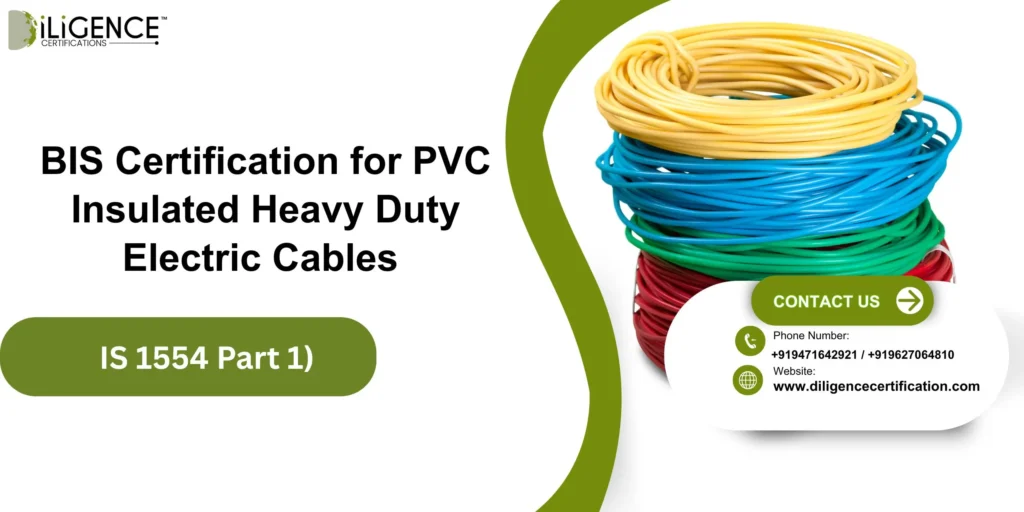
Mandatory ISI Mark Compliance: It is compulsory for a BIS certification under IS 1554 (Part 1) to be there in case of manufacturing and selling PVC insulated heavy-duty electric cables in India.
Ensures Electrical Safety: The certified cables are quite safe as they meet standards set for insulation, voltage endurance, and fire resistance, thus, cutting down the chances of short circuits and electrical hazards.
Quality & Performance Assurance: The BIS-certified cables ensure good quality of the conductor, even thickness of the insulation, and quite durable for a long time.
Regulatory & Market Acceptance: Compliance enables the manufacturers to stay away from legal penalties and also assures a hassle-free market entry in the sectors like residential, commercial, and industrial ones.
Enhances Brand Trust: The BIS certification is a source of customer confidence and a means of brand credibility as it signifies that the brand conforms to the national quality standards.
Introduction
Where ‟ safety, current-carrying capacity, and long service life are three of the main conditions, PVC insulated heavy-duty electric cables are the must-have elements in the wiring systems of such places. These cables are common in homes, buildings, power distribution networks, and industrial installations.
The insulation by Polyvinyl Chloride (PVC) is a safe cover against electrical leakage, heat, moisture, and mechanical impacts. Being in accordance with IS 1554 (Part 1) means that the cables meet the standards set for electrical, mechanical, and thermal aspects by the Bureau of Indian Standards (BIS).
What Are PVC Insulated Heavy-Duty Electric Cables – IS 1554 (Part 1)?
IS 1554 (Part 1) refers to the Indian standard that outlines the technical and safety specifications of PVC insulated heavy-duty electric cables for nominal voltages up to 1100 V and less.
The standard specifies:
Conductor quality –The best copper or aluminium conductors with the least energy loss in the current path are recommended
Electrical properties – The standard covers voltage rating, insulation resistance, dielectric strength, etc.
Mechanical strength – The standard measures the tensile strength and elongation of the insulation
Thermal properties – The Standard specifies a temperature range and aging of the insulation
Insulation thickness – The uniform thickness of PVC insulation led to safety and longer life
Testing and inspection methods – Different testing techniques are used to ensure the quality from one batch to another
Electric wires that follow IS 1554 (Part 1) are capable of maintaining insulation integrity, electrical performance, safety, etc., throughout their service lifetime.
ISI Mark Certification Scheme for PVC Insulated Heavy-Duty Electric Cables
Under the ISI Mark Certification Scheme, PVC insulated heavy-duty electric cables need to comply with IS 1554 (Part 1) in order to be sold in India legally.
This certification ensures:
- electrical safety of the product
- product performance in regard to heat, moisture, and mechanical stress
- consistency of the insulation thickness and of the conductor
- quality rigor at the factory stage
The ISI mark can only be put on the product by the manufacturers after they have obtained a valid BIS licence.
Why BIS Certification is a Must for PVC Insulated Heavy Duty Copper Electric Cables?
Cheap or substandard electric cables might become the root of serious dangers to the consumer such as:
- Electrical short circuits and fire hazards
- Failure of the insulation and electric shock
- Rising of the maintenance and replacement costs
- Shortening of the lifespan of the electrical installations
BIS certification is a kind of guarantee for the following:
- The product meets the requirements of IS 1554 (Part 1)
- The product can endure electrical and environmental stress
- Safety of the consumer and fulfillment of the regulations
- Enhanced image and trust of the product in the market
Importance and Benefits of BIS Certification
| Importance | Benefits |
| Compliance with IS 1554 (Part 1) | Ensures electrical safety and reliability |
| Standardized manufacturing | Consistent cable quality and performance |
| Electrical and mechanical safety | Reduces risk of fire and electrical failure |
| Regulatory compliance | Avoids penalties and product rejection |
| Brand credibility | Enhances customer trust and market value |
Step-by-Step BIS Certification Process
Step 1: Documentation
Collect company profile, manufacturing data, and write technical specifications of PVC insulated heavy-duty electric cables compatible with BIS standards.
Step 2: Product Testing
Samples of the cable are tested in different labs recognized by BIS for the electrical, mechanical, and insulation properties.
Step 3: Application Submission
Filing of application along with the test report and other necessary documents is done on the BIS online portal.
Step 4: Scrutiny & Factory Inspection
BIS officers visit the production unit to check out the manufacturing processes and quality control systems.
Step 5: Grant of Licence
Once the inspection and evaluation have been successful, BIS issues the license which allows the manufacturer to put the ISI mark on the certified cables.
Documents Required for BIS Certification
- Company registration certificates
- Details of the manufacturing unit
- Technical specifications of the electric cables
- Test reports of the laboratory recognized by BIS
- Brand authorization (if applicable)
Timeline, Validity & Renewal
Certification Timeline: 20–30 working days
License Validity: 1–2 years
Renewal: It involves the submission of updated documents and the proof of continued compliance before the
Conclusion
BIS certification is a hallmark of safety, quality, and reliability for PVC Insulated Heavy Duty Electric Cables (IS 1554 Part 1). Such cables provide good electrical performance, long-lasting insulation, and safety from the fire and electrical hazards.
In industries where electrical safety is of paramount importance, the use of BIS-certified cables is a safety assurance instrument. Also, it elevates the brand esteem and customer trust. Along with being a mandatory requirement, compliance with IS 1554 (Part 1) is a wise safety, performance, and business longevity investment.
Frequently Asked for Questions
What is IS 1554 (Part 1)?
IS 1554 (Part 1) refers to a standard that defines the safety and performance features for electrically heavy-duty, PVC insulated, and a voltage rating of up to 1100 V cables.
Is BIS certification necessary for PVC insulated electric cables?
Yes, a BIS certification along with an ISI mark is definitely necessary if one is to manufacture and sell such cables in India.
Who releases BIS certification for electric cables?
The Bureau of Indian Standards (BIS) is the organization that issues certification under the ISI Mark Scheme.
What are the main tests in IS 1554 (Part 1)?
Among the tests the standard prescribes are electrical, mechanical, thermal, and insulation resistance ones.
Are the markets of India open to electric cables without certification?
Definitely no. Marketing of PVC insulated heavy-duty cables without certification is strictly prohibited.
How long does the BIS certification process take?
The certification time is normally somewhere between 20 and 30 working days.
What is the duration of a BIS licence for electric cables?
The license duration is around 1–2 years and it must be renewed before expiration.
Does cable safety get improved by BIS certification?
Yes, definitely. This is a major step as it provides several safety measures in case of fire, electric shock, and insulation deterioration.
Are factory inspections mandatory for BIS certification?
Indeed. BIS inspects the factory of the license applicant physically.
Who can apply for BIS certification as per IS 1554 (Part 1)?
The producer of PVC insulated heavy-duty electric cable is to file an application.