 BIS Certification
 CDSCO
CDSCO
 PESO
PESO
 CPCB
CPCB
 LMPC
LMPC
 WPC Approval
 Global Approvals
 TEC
TEC
 ARAI
ARAI
 BEE
BEE
 ISO Certification
 DGCA Certification
 NOC For Steel
 APEDA Registration























 Business Registration
 FSSAI Mark Certification












 (32).jpg)
 Legal Services
 Trademark Registration
 Copyright Registration
 Patent Registration
 By
By - BIS Certification for Chairs and Stools ensures safety, durability, and market acceptance in India.
- Compliant with IS 17632:2022, it’s mandatory for institutional furniture manufacturers.
- Gaining certification boosts brand trust and enables bulk supply to government tenders.
- Real-life Indian examples prove how timely certification avoids shipment holds.
- Learn how to get BIS Certification for Chairs and Stools and simplify your approval journey.
Introduction
A well-known institutional furniture manufacturer in Bengaluru recently shared a cautionary tale. After winning a substantial government supply tender, they faced a roadblock - their chairs failed to carry the mandatory BIS Registration under IS 17632. The entire shipment was held at the warehouse, and the penalty clock began ticking. This isn’t a one-off scenario. Increasingly, Indian government tenders, school procurement boards, and large corporates insist on BIS-marked furniture. Chairs and stools are no longer just aesthetic pieces; they are governed by stringent Indian Standards for structural safety and longevity.
For any furniture manufacturer in India, especially those targeting institutions, getting BIS Certification for Chairs and Stools is no longer optional - it’s business-critical.
What is BIS Certification for Chairs and Stools?
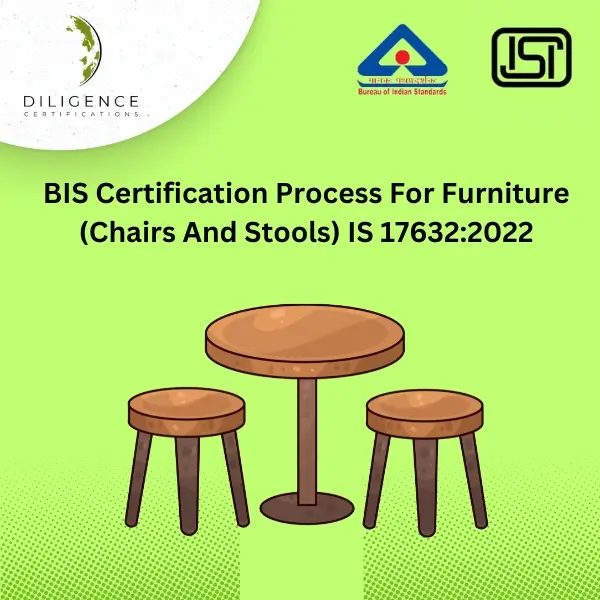
BIS (Bureau of Indian Standards) certification is a third-party assurance that your product meets the required safety, structural, and performance benchmarks under Indian regulations. For chairs and stools, the applicable standard is IS 17632:2022 - an Indian Standard tailored specifically for institutional seating.
“BIS Certification for Chairs and Stools validates structural integrity, performance, and long-term safety under IS 17632.”
Applicable Products:
- Office chairs
- Institutional and school furniture
- Laboratory stools
- Visitor and cafeteria seating
Overview of BIS Certification for Chair and Stools
Furniture has a vital effect in our lives either in homes, offices, educational institutions, public places like restaurants, among many. Among all kinds of furniture, the two most relied upon forms of sitting arrangements are chairs and stools. For the users’ comfort and health, design, strength, and safety are critical factors.
To ensure quality furniture, there are regulatory bodies like the Bureau of Indian Standards (BIS), which have put guidelines for the safety and durability of general-purpose chairs and stools. The IS 17632:2022 standard is brought out for laying down safety, structural stability, and quality parameters to be complied with by the manufacturers before marketing a product in the Indian market.
Certification from BIS under IS 17632 assures the consumers that the products are as per national standards for safety and performance. Since the certification gives the brand more credibility, it also helps in gaining a competitive advantage in the furniture sector.
This article dwells on highlighting the importance of BIS certification on chairs and stools, why it is beneficial, the need for testing, documents, and ways manufacturers can get certification. Also, it will discuss how Diligence Certifications can make this process less complicated for businesses.
What IS 17632:2022 Covers: Scope & Requirements

IS 17632:2022 is the specific Indian Standard governing institutional chairs and stools. It outlines test parameters for:
- Load-bearing strength
- Durability under repetitive use
- Flammability resistance
- Finish, design tolerances, and safety edges
Many manufacturers fail the drop or cyclic durability test. This results from inconsistent raw material quality, often from unverified suppliers.
Who Needs BIS Certification for Chairs and Stools?
Educational Institutions Suppliers
If you’re supplying to schools or universities, certification is mandatory.
Corporate and Government Contractors
Public sector units and MNCs are increasingly filtering out non-BIS products.
Online Marketplaces
Platforms like GeM, Amazon B2B, and industry expos now ask for BIS registration before onboarding your product.
Startups & Small Manufacturers
Don’t assume BIS is only for big brands. In fact, several MSMEs in Gujarat and Tamil Nadu are leveraging certification to scale fast and gain credibility.
How to Get BIS Certification for Chairs and Stools

Step-by-Step Compliance Process:
- Identify Applicable Standard: IS 17632:2022.
- Register Your Manufacturing Unit with BIS.
- Submit Product Samples for Type Testing at BIS-approved Labs.
- Arrange a Factory Inspection.
- Implement QMS (Quality Management System) & Marking Scheme.
- Get Your BIS License Number & Apply the Standard Mark.
BIS inspections are often delayed due to incomplete documents. Keep raw material traceability and vendor certificates ready in advance.
What is BIS Certification?
The Bureau of Indian Standards (BIS) is the national standardization body of India mandated to formulate and regulate the standards for quality, safety, and performance in different sectors. Originally constituted under the BIS Act, 1986 and subsequently amended through the BIS Act, 2016, it is required that all products sold in the Indian market conform to these rigorous safety and quality parameters.
Understanding BIS Certification For Chairs and Tools IS 17632:2022
IS 17632:2022 lays down minimum requirements for BIS Certification for chairs and stools in order to provide the users with stability, strength, durability, and comfort.
Key Specifications in IS 17632:2022
1. Material Specification
- Chairs and stools must be made from good quality materials like wood, metal, plastic, etc., or a combination thereof.
- The materials shall be free of defects and corrosion and have no sharp edges capable of causing injury.
- All coatings, paints, or finishes should have no toxicity and should not harm the environment.
2. Structure Security and Stability
- This should not just topple over when used under normal conditions.
- The design should ensure even weight distribution to prevent an unbalanced state.
3. Dimensions and Load Capacity
- This has to be standardized height, seat width, and seat depth for comfort and usage.
- Load bearing should not have to break under the specified load.
4. Safety Features
- The edges and the corners must round off or smoothen to avoid injury.
- A backrest should be able to support long sittings.
5. Surface Finish & Aesthetics
- It should be smooth, uniform, and free from cracks and splinters or uneven textures.
- Color and appearance ought to be aesthetically pleasing and should not fade over time.
Benefits of BIS Certification For Chairs and Stools
1. Offers Safety and Durability of the Product
BIS-certified furniture goes through rigorous tests before it is certified so that it follows all the standards of quality and minimizes accidents and breakage or injuries.
2. Communicates Credibility to Consumers
Increased confidence for consumers is brought around in the case of a chair or stool bearing an ISI mark as that denotes the product has followed all the national safety regulations.
3. Compliance to All Statutes
BIS certification offers a legal roadblock to manufacturers meeting Indian requirements and creates issues in the way of legal litigation.
4. Makes the Competitive Market Edge for Manufacturers
Certified products are favored in the government organizations, corporates, and institutions, thereby creating great big business opportunities.
5. Increases Chances of Exports
Internationally, many countries do have a head of state, and some of them recognize BIS standards; hence, this becomes easier for them to sell their products abroad.
6. Cuts Down on Rejections and Returns of Products
Quality checks are stricter for certified products. Thus, they see less customer complaints, warranty claims, or rejection rates compared to others.
Testing Requirements For BIS Certification
Chairs and stools, in order to be certified under the BIS for standards specified in IS 17632:2022, are required to undergo many tests in a laboratory accredited by the BIS. These are:
- Dimensional & Design Verification- To ensure the chair or stool meets the measurements and ergonomic design as required.
- Static Load Test- Confirming the maximum weight that the furniture can withstand without damaging itself.
- Impact Strength Test- It speaks to the product’s ability to withstand sudden impacts and falls.
- Stability Test- Determines whether a chair/stool remains stable with varying user movements.
- Material Strength Test- Certifies the material shall remain strong enough to avoid premature wear and tear.
- Surface Finish & Coating Test- To check that the finish does not contain any toxic materials and that it is free from harmful chemicals.
Required Documents for BIS Certification
Manufacturers must provide the following documents for certification:
- Application Form (with product and manufacturer details)
- Manufacturing Process Flowchart
- Product Specifications and Design Drawings
- Test Reports from a BIS-Approved Lab
- Quality Control & Inspection Reports
- Factory Layout and Machinery Details
- Business Registration Proof
- Declaration of Conformity to IS 17632:2022
How Diligence Certifications Can Helps:
Achieving BIS certification is a tedious and strenuous process. Diligence Certifications offers consultation services, where our experts will ensure that certification becomes a seamless process.
Our Services Include:
BIS Compliance Consulting - A guide to understand compliance to BIS standards.
Application & Documentation Support - Support to prepare and submit documents.
Testing Coordination - Coordination for test in BIS recognized laboratories.
Factory Inspection Preparation - Preparation of the manufacturer for passing the BIS audit.
Post-Certification Compliance - Certification for continued compliance to BIS standards.
Diligence Certifications, with its years of experience in compliance consulting, guarantees to secure BIS certification in a very quick and hassle-free manner.
Conclusion
If you manufacture institutional furniture, securing BIS Certification for Chairs and Stools isn’t just about compliance - it’s your passport to credibility, scale, and market access in India. With IS 17632:2022 at the centre of regulation, it pays to treat certification seriously. Whether you’re a startup or seasoned exporter, use BIS as a strategic advantage.
Ready to certify your chairs and stools? Let’s get it done - the right way.
Get your free consultation with Diligence Certifications today and move forward with confidence.
Frequently Asked Questions
Is BIS certification mandatory for all types of chairs?
Only chairs falling under institutional or commercial use as per IS 17632:2022 require BIS certification. Domestic furniture isn’t covered yet, but may be soon.
How long does it take to get BIS certification for stools?
Typically 30-45 working days, assuming complete documentation and lab availability.
What is the testing standard for BIS certification of chairs?
IS 17632:2022 outlines the structural and durability tests required.
Can imported chairs be BIS certified?
Yes, if the manufacturer agrees to BIS inspection in their country and testing is done in Indian labs.
Can I use one certificate for different chair models?
Only if the models have the same structure and material composition. Each variation might need fresh testing.
What if my chair fails the lab test?
You’ll need to redesign or improve the weak component and re-submit for testing.
Does BIS certification expire?
Yes, the initial license is valid for one year and is renewable annually.
Is there a way to fast-track BIS approval?
Using a consultant and submitting all documents upfront often reduces processing time.
Can I sell uncertified chairs to private buyers?
Yes, but B2B clients may refuse non-BIS products due to liability or procurement norms.
How do I add the BIS mark on my chairs?
Once certified, you must use the BIS logo and license number on the product permanently.


