BIS Certification
 CDSCO
CDSCO
 PESO
PESO
 CPCB
CPCB
 LMPC
LMPC
 WPC Approval
 Global Approvals
 TEC
TEC
 ARAI
ARAI
 BEE
BEE
 ISO Certification
 DGCA Certification
 NOC For Steel
 APEDA Registration























 Business Registration
 FSSAI Mark Certification












 (32).jpg)
 Legal Services
 Trademark Registration
 Copyright Registration
 Patent Registration
 By
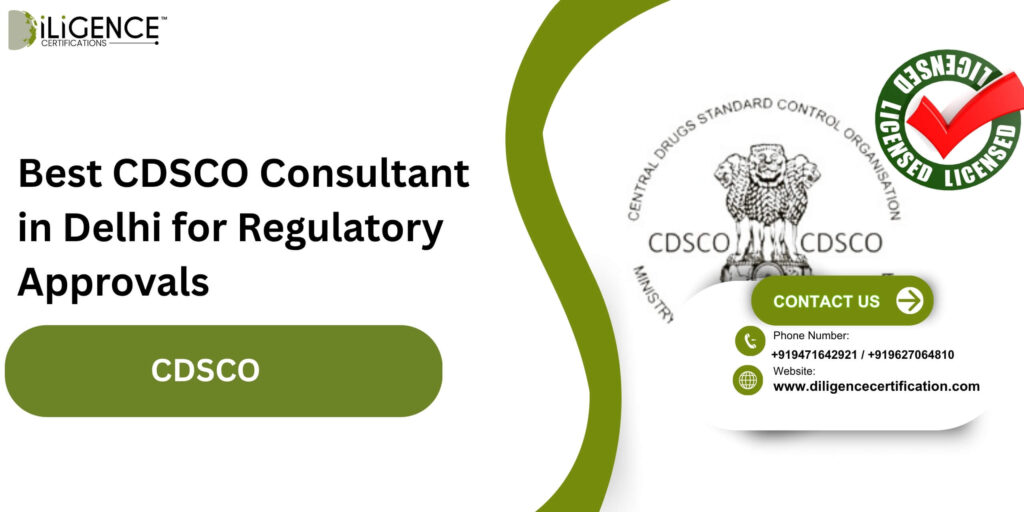
By - A CDSCO consultant in Delhi is a professional who assists manufacturers, importers, and distributors in obtaining the necessary marketing approvals for medical devices, drugs, and cosmetics from India’s Central Drugs Standard Control Organisation (CDSCO).
- The nuances of CDSCO’s regulatory structure necessitate an understanding of the forms used to obtain a license (MD-3, MD-5, MD-9, MD-41, etc.), device classification, and accompanying documentation requirements.
- Delhi is the regulatory capital of India, the majority of consultants will defer to the central licensing authorities and have clients all over the country.
- Choosing the correct CDSCO consultant should allow you to have a timely submission process with the least risk of non-compliance, thus reduced risk for market access or re-submission product stays on the market.
- For life-sciences organizations, you will want to work with a trusted CDSCO Consultant in Delhi that will not only fulfill a regulatory compliance agent but will become a “go to” regulatory partner.
Introduction
A Gurgaon-based medical device startup had just finalised its first prototype for a minimally invasive surgical device. Investors were ready, doctors had tested the prototype, and marketing was underway. But their first shipment got held at customs. The reason was simple - they didn’t have CDSCO registration for the product. The founders had read the Medical Devices Rules 2017, but every step seemed ambiguous.
After weeks of confusion, they engaged a CDSCO Consultant in Delhi. Within 45 days, the consultant had mapped the correct device classification, filed Form MD-5, and coordinated directly with the licensing authority. Their product cleared, and the company entered the market without another hitch.
That story reflects the reality many Indian and foreign manufacturers face. The regulatory path is technical, procedural, and time-sensitive. For medical devices, drugs, or cosmetics, CDSCO compliance is the gatekeeper to the Indian healthcare market. And having a reliable CDSCO consultant in Delhi isn’t a luxury - it’s an operational necessity.
What Does a CDSCO Consultant in Delhi Do?
A CDSCO Consultant in Delhi helps organisations obtain required licences, approvals, and registrations under the Central Drugs Standard Control Organisation, India’s national regulatory authority for medical devices, pharmaceuticals, and cosmetics.
Key Functions of a CDSCO Consultant
- Classification of medical devices based on risk category (Class A, B, C, D).
- Filling out and submitting regulatory forms including MD-3, MD-5, MD-9, MD-41.
- Communicating with the State Licensing Authority (SLA) or Central Licensing Authority (CLA).
- Preparing technical dossiers, document review, and approval.
- Replying to questions and coordinating audits or inspections.
In effect, a good consultant translates CDSCO rules into business-friendly action items - making regulatory language into pragmatic guidance that alleviates compliance time and financial exposure.
Reasons Delhi is India’s Regulatory Nerve Centre
Delhi is home to the CDSCO headquarters, which includes the Drug Controller General of India (DCGI) office, which makes it the strategic hub of interactions with regulators or authorities.
A CDSCO Consultant in Delhi has typically spent years building relationships within the Directorate which allows for quicker clarifications, follow-ups in person (if needed), and proper handling of files. Since the majority of importers and national distribution companies are also located in the NCR, having them nearby makes coordination simpler.
For example, Diligence Certifications is a compliance advisor located in Delhi and provides services, including medical device registration, manufacturing licenses, and regulatory training to clients throughout India. Because of their presence in the market, their updates are incorporated into current CDSCO circulars and guidance notes.
The Regulatory Framework: How CDSCO Governs Medical Devices and Drugs
Under the Medical Devices Rules, 2017 and Drugs & Cosmetics Act, 1940, CDSCO regulates:
- Manufacture, import, sale, and distribution of medical devices.
- Approval of new drugs, vaccines, and cosmetics.
- Inspection and post-market surveillance.
CDSCO divides medical devices into four risk-based classes:
| Class | Risk Level | Examples | Regulatory Authority |
| A | Low | Surgical dressings, thermometers | State Licensing Authority |
| B | Low-moderate | Hypodermic needles, suction equipment | State Licensing Authority |
| C | Moderate-high | Ultrasound scanners, infusion pumps | Central Licensing Authority |
| D | High | Cardiac stents, pacemakers | Central Licensing Authority |
Each category demands distinct forms and documentation. Here, a consultant interprets the requirements precisely and ensures compliance with CDSCO’s standards.
When Should You Hire a CDSCO Consultant in Delhi?
Many companies bring consultants only after a problem occurs - shipment delays, rejection of application, or regulatory notices. However, proactive engagement prevents 80% of such issues.
Ideal Scenarios for Engaging a CDSCO Consultant
- Before manufacturing medical devices or cosmetics.
- While importing regulated products into India.
- For license renewals, amendments, or change in constitution.
- During audits or post-market compliance reviews.
- When classifying new technology or hybrid devices not clearly defined in the rules.
Early consultation allows you to map your entire product lifecycle with compliance checkpoints, avoiding costly errors later.
Step-by-Step Guide: How a CDSCO Consultant Streamlines Licensing
A professional consultant doesn’t just fill out forms; they architect your compliance plan. Here’s how:
Stage 1: Evaluation of Gaps
The consultant reviews existing documentation, product specifications, and business model to determine missing aspects according to the requirements of the CDSCO.
Stage 2: Device Classification and Regulatory Pathway
The consultant will classify each product within the appropriate risk category and then determine the licensing form that is applicable (usually MD-5 for manufacturing, MD-14 for import, MD-41 for distribution, etc.).
Stage 3: Preparing Documentation & Dossier
Consultants prepare the Device Master File (DMF) and Plant Master File (PMF) products, which describe the safety, quality control, and manufacturing practices for the product.
Stage 4: Submission to the Portal
Applications are submitted through the CDSCO online portal using a digital signature to apply for a new license or new license type, and the applicant is responsible for the fee (challan).
Stage 5: Liaisons & Queries
If the CDSCO contacts the consultants with queries, they will respond with scientific clarifications, the amended documents if needed, or documents to justify the technical details.
Stage 6: Renewal process post-licensing
Once the license is issued, the prospective client will continue to liaise with the consultants about the renewal timeframe, reporting requirements, and continued compliance with licensure (for example, read the regulations).
Each stage requires accuracy - a single mismatch between your uploaded document and physical record can trigger weeks of delay.
Documents Required for CDSCO Licensing
While the exact list varies by licence type, core documents include:
- Constitution of the firm (Partnership deed, MOA, AOA).
- Manufacturing site plan and layout.
- Details of technical staff or competent persons.
- ISO 13485 certification (for device manufacturers).
- Equipment list and quality management records.
- Undertaking for compliance with Good Manufacturing Practices (GMP).
- Proof of ownership or lease of premises.
Having these pre-validated by your CDSCO Consultant in Delhi prevents back-and-forth corrections.
Common Mistakes Businesses Make Without a Consultant
- Incorrect Device Classification - treating a Class C device as Class B often leads to rejection.
- Incomplete Dossiers - missing ISO or stability data can halt approval.
- Portal Submission Errors - wrong form type (MD-5 instead of MD-9).
- Lack of Local Liaison - overseas applicants struggle with DCGI communications.
- Ignoring Post-Approval Conditions - failing to maintain records, report adverse events, or renew licences on time.
A competent CDSCO consultant pre-empts these pitfalls by integrating compliance management with your business process.
How a Delhi Consultant Rescued an Importer’s Delayed Shipment
An American manufacturer importing orthopaedic implants into India faced detention at Mumbai Port. Their import licence (Form MD-15) was pending due to missing stability data. After four months of back-and-forth with no progress, they approached a CDSCO Consultant in Delhi.
The consultant reviewed the case, reformatted the dossier, added device test data aligned with CDSCO’s Annexure A requirements, and resubmitted the file. Within 30 days, the licence was granted, and the importer recovered lost market time worth nearly ₹50 lakhs.
Such examples underline how local regulatory insight can directly influence business outcomes.
Benefits of Hiring a CDSCO Consultant in Delhi
- Time Efficiency: Faster document validation and submission.
- Cost Saving: Avoid penalties, re-filing fees, and shipment losses.
- Accuracy: 100% compliant documentation and classification.
- Regulatory Updates: Consultants stay informed on CDSCO circulars and notifications.
- Strategic Support: They help build internal SOPs for continuous compliance.
In short, a consultant transforms compliance from an obstacle into a competitive advantage.
How to Choose the Right CDSCO Consultant
- Experience & Track Record: Verify number of successful licence approvals.
- Sector Expertise: Choose consultants specialising in your product category (medical devices, cosmetics, or drugs).
- Transparency: Ensure clear cost structures and deliverable timelines.
- Accessibility: On-ground presence in Delhi is crucial for liaison with DCGI.
- Post-Licensing Support: Ongoing compliance tracking and training.
Reputed firms like Diligence Certifications combine regulatory experience with technology-enabled monitoring - offering clients dashboards to track file progress in real time.
Latest Regulatory Trends You Should Know
CDSCO continually refines its framework to align with international best practices. Current developments include:
- Introduction of online audit management systems.
- Mandatory registration of all medical devices (even low-risk) from 2025.
- Integration of BIS and CDSCO norms for quality control.
- Stricter enforcement of post-market surveillance.
Keeping up with these changes is challenging without an expert consultant tracking updates daily.
Conclusion
Securing and maintaining CDSCO approval is a challenging hurdle-technical documents/crafting, regulatory reading and interpretation, and precision in procedural compliance. A qualified CDSCO Consultant in Delhi can help secure a line of connection to your operations and India’s health-regulatory system.
When you believe in and work with an experienced and professional consultancy like Diligence Certifications, you gain both compliance assurance and competitive advantage. They independently understand how regulators think, which documents persuade and convince, and how to navigate through India’s evolving medical-device ecosystem.
If your organization is planning to manufacture, import, and distribute medical devices or pharmaceuticals in India-don’t leave your compliance to luck or chance. Talk to a professional CDSCO Consultant in Delhi today and turn regulatory compliance into business strength!
Frequently Asked Questions
What is the job of a CDSCO Consultant in Delhi?
A CDSCO Consultant in Delhi provides advisory assistance to companies engaged in seeking medical device, drug, and cosmetic license from the Indian CDSCO authority.
What is the advantage of hiring a CDSCO Consultant in Delhi?
The applicant is guided through the regulatory process, approval review times are reduced, and documentation is delivered in a form that complies with the regulations of the CDSCO authority.
Who grants the CDSCO licenses and where are they registered in India?
Licenses are granted by the Central Drugs Standard Control Organisation (CDSCO) through the Ministry of Health and Family Welfare.
How long does it take to obtain a CDSCO approval?
The time to obtain approval through the CDSCO is contingent upon product type but generally takes anywhere from 30-90 days with adequate documentation and the advice of a licensed consultant.
What type of documents are needed for a CDSCO license?
The minimum documents required can include but is not limited to ISO 13485, technical dossier, manufacturing layout, personnel, quality certifications.
Are foreign manufacturers able to work with a CDSCO Consultant in Delhi?
Yes. Many Consultants in Delhi assist overseas companies that are looking to enter into the regulated medical device and pharma markets in India.
Is a CDSCO license required for all medical devices in India?
Yes. All medical devices that are sold or imported in India are required to be registered and approved by the CDSCO authority.
What type of forms are required for CDSCO licensing?
Forms can include MD-3, MD-5, MD-9, and MD-41 based upon the intention of whether they manufacture, import, or sell the devices.