 BIS Certification
 CDSCO
CDSCO
 PESO
PESO
 CPCB
CPCB
 LMPC
LMPC
 WPC Approval
 Global Approvals
 TEC
TEC
 ARAI
ARAI
 BEE
BEE
 ISO Certification
 DGCA Certification
 NOC For Steel
 APEDA Registration























 Business Registration
 FSSAI Mark Certification












 (32).jpg)
 Legal Services
 Trademark Registration
 Copyright Registration
 Patent Registration
 By
By - BIS Certification is the guarantee that products are in compliance with the necessary safety and quality standards in India.
- The procedure involves testing in a lab, submitting documents, and inspecting the factory.
- Various schemes have been put in place for different cases: ISI, CRS, and FMCS.
- If a product does not meet the standards, it may be held up at customs or face a fine.
- Diligence in obtaining certification will be instrumental in making the process of getting approvals easy and free from rejections.
Introduction | BIS Certification
In most instances, manufacturers bring their products to us after their products have been detained-either at a BIS-recognised lab, at customs, or in front of a buyer insisting on compliance before concluding the deal. A client, a local electronics brand from Noida, had tried to get BIS certification on their own for four months. These kinds of situations are very frequent because obtaining BIS certification is more than just going through the formalities; it is a well-organized compliance process which requires the utmost precision at every stage. If done correctly, it safeguards the brand, allows for a quicker obtaining of the approval, and avoids the redoing of the work at a high cost. Diligence Certification is the company that offers these solutions-clarity, technical know-how and end-to-end service being the features that enable businesses to get BIS approval without disrupting their operations. Bureau of Indian Standards
What is BIS Certification
BIS Certification is an obligatory green light given by the Bureau of Indian Standards which demonstrates that a product complies with the safety, quality, and performance standards set by India. The certificate is valid for products made in India as well as those that are imported and is a prerequisite for a legal market entry, customs clearance, and a security guarantee for consumers.
Key Points
- Mandatory for Specific Products
Electronics, appliances, steel, automotive parts, and many regulated items require BIS Certification before they can be sold in India. - Three Main Schemes
BIS approvals are granted under the ISI Mark, CRS (Compulsory Registration Scheme), or FMCS (for foreign manufacturers). - Involves Testing & Factory Audit
Products must be tested in BIS-recognised laboratories, and manufacturing sites may undergo inspections to ensure consistent quality. - Ensures Market Access
Without BIS Certification, imported goods may be held at customs, and domestic manufacturers may face legal penalties. - Improves Brand Trust
Certified products carry a standard mark that helps build credibility with distributors, government buyers, and consumers.
Why is BIS Certification Mandatory
BIS Certification is necessary, as per the Government of India, for various products that need to comply with safety and quality standards before making their way into the market. This is done to assure the safety of the consumers, remove the chance of substandard products from being imported and regulate the quality of products across all the industries.
Key Points
- Consumer Safety
In case of products that may cause electrical, mechanical, or health risks, they have to go through BIS testing before being put on sale. - Regulatory Requirement
A large number of items, e.g., electronics, steel products, and construction materials, cannot be produced or imported without BIS clearance. - Control of Substandard Imports
Compulsory certification is a step towards the relief of the Indian markets from the influx of low-quality or unsafe products of foreign origin. - Uniform Quality Standards
BIS is the organization that makes sure all the manufacturers are following the same Indian Standards (IS codes), thus, they are consistent at the industry level. - Legal Protection for Businesses
Non-certified products are subject to seizure, imposition of fines, and prohibition from customs; obtaining a BIS Certification exempts one from such compliance risks.
Importance and Benefits of BIS Certification
BIS Certification is one of the essential instruments in the market to product trust. It is a must-have that establishes the compliance of a product with the Indian safety standards laid by the Bureau of Indian Standards. Only those manufacturers and importers who have secured a BIS license are allowed to sell their products in the Indian market.
Importance of BIS Certification
BIS Certification plays a vital role in product market safety in India. It is the first step to making the products safe, reliable, and of good quality. In the case of regulated categories, it is a legal requirement and is directly related to the protection of consumers and quality control at the industry level.
Key Points
- A Mandatory Regulatory Requirement for a large number of electronics, appliances, steel products, and safety-related goods.
- Helps Consumer Safety by testing the products against Indian Standards.
- Maintains Uniform Quality from manufacturers by using standardised specifications.
- Eliminates Substandard Imports through the compulsory compliance at customs.
- Facilitates Government and Corporate Procurement, where BIS compliance is usually mandatory.
Benefits of BIS Certification
BIS Certification, in addition to being a legal requirement, provides a wide range of commercial and operational benefits for manufacturers, importers, and brand owners. It helps to gain market acceptance and keeps away the risks that are related to the law or quality.
Key Points
- Improved Market Credibility by using a well-known quality mark that is accepted and trusted by the buyers.
- Easy Customs Clearance for products that are brought in from other countries, thus saving the waiting time at ports and the demurrage charges.
- Reduction of Product Failure Cases because of the conducting of rigorous tests before the approval.
- Expanded Business Prospects, mainly in the areas of retail chains and government tenders.
- Enhanced Quality Control via inspections and frequent visits by BIS.
Types of BIS Certification
BIS has varying certification plans subject to product groups, place of production, and degrees of control. Getting familiar with these categories assists companies in selecting the right way and thus saving time they would have used waiting for their application to be processed or thinking up if it will be rejected.
1. ISI Mark Certification (Scheme-I)
The ISI Mark is the most recognised BIS scheme used for products that require mandatory safety and quality assurance under specific Indian Standards.
It applies mainly to items manufactured within India.
Key Highlights
- It is a must for commodities such as cement, steel bars, switches, tyres, and LPG appliances.
- need a check at the factory, picking a sample from the product, and always watching.
- The license holders should be in a position to keep the production quality and testing records uniform.
2. Compulsory Registration Scheme (CRS)
The CRS mostly targets electronics and IT products, a large part of which is India-bound imports. Once the testing is done in a BIS-recognised lab, manufacturers are required to register their products.
Key Highlights
- Besides the non-factory inspection feature at the time of the first approval, it is a must for LEDs, laptops, mobile phones, adapters, and smart speakers, etc.
- Mainly focused on electrical safety and performance under the applicable IS standards.
3. Foreign Manufacturers Certification Scheme (FMCS)
This scheme is designed for manufacturers located outside India who wish to export regulated products to the Indian market under the ISI Mark.
Key Highlights
- BIS officials physically inspect overseas factories.
- Applicable for high-risk and safety-related products like electrical appliances, food containers, or steel products.
- Requires a factory audit, product testing, and continuous surveillance.
4. ECO Mark Certification
Moreover, products fulfilling both quality and eco-friendly standards can be marked with a combination of the ECO Mark and the ISI Mark.
Key Highlights
- It is thereof applicable to soaps, detergents, paints, paper, and packaging materials besides other eco-sensitive products.
- Assures the adherence to the environment-friendly safety measures.
5. Hallmarking Certification (Jewellery & Precious Metals)
BIS also is in charge of hallmarking faceted gold and silver and platinum jewellery.This is the most trusted certification of purity and authenticity.
Key Highlights
- It is a must for jewellers in the districts that have been notified.
- Needs registration and compliance with the purity standards set by BIS.
- Places where jewellery is hallmarked have to be audited by BIS and checked for technical compliance.
6. BIS Standard Mark for Packaged Drinking Water & Mineral Water
These classes of products have distinctive certification requirements because they affect the health of the public.
Key Highlights
- It is compulsory for producers of packaged drinking water and mineral water.
- The procedure includes a visit to the factory, evaluation of hygiene, and testing of water according to IS standards.
- Regular monitoring is the guarantee of cleanliness and safety.
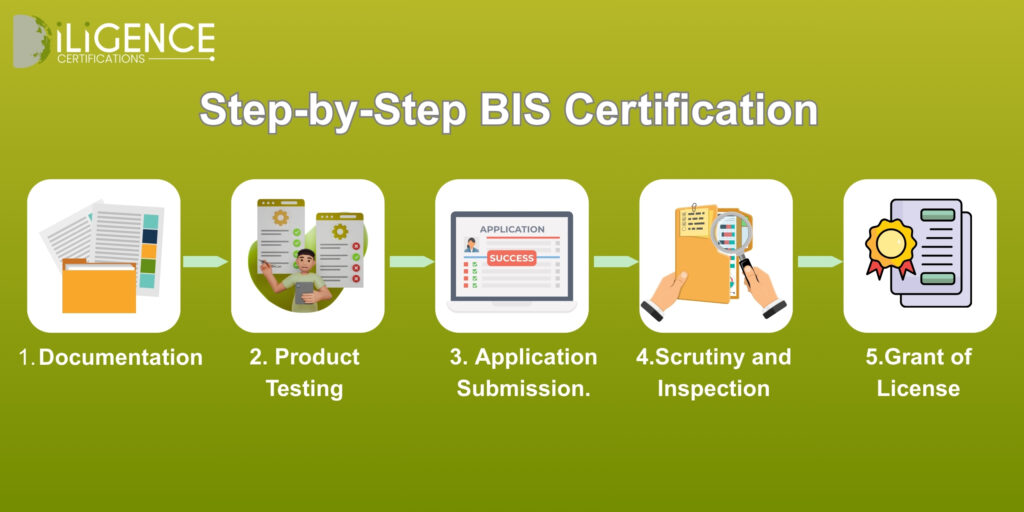
Step-by-Step Process of BIS Certification
Step1:Documentation
- Collect required technical documents
- Prepare product specifications
- Gather company registration details
- Ensure documents follow BIS format
Step2:Product Testing
- Send samples to a BIS-approved lab
- Conduct safety and quality tests
- Receive test reports
- Confirm compliance with BIS standards
Step3:Application Submission
- Fill out the BIS application form
- Upload all required documents
- Attach valid test reports
- Pay the necessary BIS fees
Step4:Scrutiny and Inspection
- BIS reviews submitted documents
- Authority verifies test results
- Factory/product inspection may occur
- Clarifications requested if needed
Step5:Grant of License
- BIS approves the application
- License number is issued
- Product can carry BIS mark
- Renewal required before expiry
Documents Required for BIS Certification
| Category | Documents Required |
| Business Documents | Business license/registration, ISO certificate, organizational details |
| Manufacturer Details | Factory layout, process flow chart, machinery list, production details |
| Product Documents | Product specifications, component list, user manual, model details |
| Testing Documents | Test report from BIS-recognized lab, sample details, test request form |
| Legal & Compliance | Authorization letter, brand ownership proof, trademark certificate (if any) |
| Import/Foreign Manufacturer (If applicable) | AIR (Authorized Indian Representative) details, contract agreement, overseas manufacturer documents |
Timelines, Costs, Validity & Renewal
- Timelines: Usually from 20 to 30 days, with only 7-15 days for the testing.
- Costs: The cost of the government and the test varies depending on the product. There can be some additional charges though.
- Validity: The validity period is 2 years in most situations.
- Renewal: The renewal is done before the expiration; there should be updated documents/tests; the renewal
Why Choose Diligence Certifications
- Expert team with strong BIS and regulatory knowledge
- Fast, streamlined processing to reduce approval delays
- Accurate documentation and testing coordination
- Transparent guidance with clear communication
- High success rate and complete end-to-end support
Conclusion
For any company that is about to enter product categories subject to regulations in India, acquiring BIS Certification is definitely more than a mere compliance exercise; it is a consequential direct investment in product safety, acceptance in the market, and brand credibility over time.Every step of the process calls for absolute precision-documents perfectly in line, correct IS standards, trustworthy test reports, and submissions made on time. This is the point where the collaboration between BIS Certification and Diligence Certification really makes a difference and is measurable in terms of value. By having a well-organized plan, receiving the needed support in documentation, and coordinating with BIS-recognized laboratories, the time for getting the approval becomes not only efficient but also very much predictable.
Frequently Asked Questions
What is BIS Certification?
BIS Certification is a point of reference for a product that indicates its observance of Indian safety and quality standards.
Is BIS Certification mandatory for all products?
Not at all. Only for regulated products such as electronics, appliances, steel, cement, and safety-related items.
What are the main BIS schemes?
ISI Mark, CRS (Compulsory Registration Scheme), FMCS for foreign manufacturer.
How long does BIS Certification take?
It is usually 20-30 days and depends on the testing and the accuracy of the documentation.
What documents are required for BIS?
A business license, product specifications, a lab test report, factory details, and compliance records are required.
Can imported products get BIS Certification?
Definitely. Imported products also need to get BIS Certification before customs clearance.
What if a product is not BIS certified?
Products may be held up at customs, the owner may be fined, or the products may be banned from the Indian market.
Does the BIS involve product testing?
Yes, products are required to be tested in a laboratory recognized by the BIS before getting the approval.
For how long is a BIS license valid?
It is generally valid for 2 years and after that, renewal is necessary.
Why choose professional consultants for BIS?
Experts through precise compliance management reduce the risk of rejection, delay, and repeated testing.


