 BIS Certification
 CDSCO
CDSCO
 PESO
PESO
 CPCB
CPCB
 LMPC
LMPC
 WPC Approval
 Global Approvals
 TEC
TEC
 ARAI
ARAI
 BEE
BEE
 ISO Certification
 DGCA Certification
 NOC For Steel
 APEDA Registration









 Business Registration
 FSSAI Mark Certification
 (32).jpg)
 Legal Services
 Trademark Registration
 Copyright Registration
 Patent Registration
 By
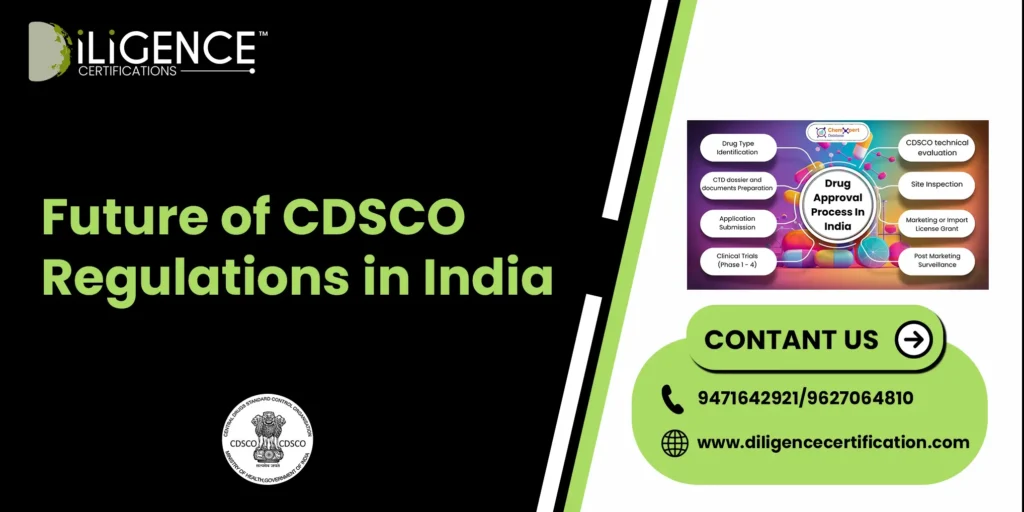
By - Digital & Faster Approaches to Approvals: The Future of CDSCO Regulations is expected to use online platforms (for example, SUGAM) for faster, transparent approvals involving fewer human elements.
- Stricter Medical Device Oversight: The insurance coverage of medical devices with respect to risk, based on classification, post, and market surveillance, as well as quality audits, is being implemented.
- Greater alignment with international standards such as IMDRF, WHO, and GMP is in progress to facilitate exporting and acceptance of Indian products on the global platform.
- The higher levels of enforcement, harsher penalties, and increased number of inspections are targeted at discouraging violators and the production of low, quality products.
- While balanced regulations are enabling innovation in areas like AI, digital health, and new drugs, these issues have been consistently raised in the public safety context.
Introduction
The Future of CDSCO Regulations in India will herald a sea change with greater emphasis on protection of public health, more transparency in the regulatory aspects, and encouragement to innovation in drugs, medical devices, and cosmetics. Technologically advanced approaches in regulations, alignment with global regulations, and strict compliance will be adopted by the CDSCO in the Future of CDSCO Regulations.
What is CDSCO License
It is a legal certificate provided by the Central Drugs Standard Control Organization that allows the manufacturing, importing, sale, or distribution of drugs, devices, cosmetics, and notified products in the Indian market.It is conferred by Drugs & Cosmetics Act, 1940 and Medical Device Rules, 2017, which ensures that products offered for sale in Indian market are meeting required Standards for safety, Quality and Performance.
Key Points:
- Published by the Central Drugs Standard Control Organization, the national regulator in the country of India.
- Compulsory to manufacture, import, sale, and distribution of drugs, medical devices, and cosmetics in India.
- Empanelled under Drugs & Cosmetics Act, 1940 & Medical Device Rules, 2017.
- Products need to meet the standards of safety, quality, and efficacy and have to keep up with compliance.
- Available via the online SUGAM system accessible after submission of documents to DGCA.
Why is CDSCO Certification Mandatory
CDSCO certification is a guarantee that the drugs, medical devices, and cosmetics supplied in India will qualify in terms of defined safety, quality, and efficacy standards. It is issued by the Central Drug Standards Control Organization. It will help ensure that there are no substandard and unsafe products in the country, and no unapproved products are manufactured, imported, and marketed in India.
Key Reasons:
- The Drugs and Cosmetics Act and Rules lay down proper and particular laws and regulations for the manufacturing, selling, and distribution of drugs and cosmetics in India so that such products offered to consumers are safe, efficacious, and of good quality.
- It ensures that the market is not filled with low-quality products and prohibits any form of sale of such products.
- The Act aims at uniformity and regulating the medical pharmaceutical industry of the country in a constructive manner with a view to ensure public health safety.
- The act also provides the legal framework for the manufacturing, importing, and marketing of these regulated products.
- It is implemented by the Central Drugs Standard Control Organisation under the Drugs & Cosmetics Act, 1940.
Importance and Benefits of CDSCO Certification
| Importance | Benefits |
| Assures the safety, quality, and performance of the product as per the standards followed in India. | Ensures that safety, quality, and effectiveness of a high standard are maintained for products that are regulated. |
| It safeguards public health against unsafe and substandard drugs, as well as medical devices. | Gives the necessary legal permission to produce, import, and distribute in the Indian market. |
| Offers legal approval for the production, importation, and marketing of regulated products within India. | It also helps the marketplace to become more credible and gives the consumers more confidence in the certified products. |
| Increases trust and credibility with customers. | Minimizes the regulatory exposure risks, penalties, and even product recalls that result from non, compliance with regulations. |
| Enforced by Central Drug Standard Control Organization as per the Drugs & Cosmetics Act, 1940 | Enables business expansion and access to a larger market while being regulated by the Central Drugs Standard Control Organization. |
Step-by-Step Process of CDSCO Certification
Step1:Documentation
- Define product category (drug, medical device, cosmetic, IVD)
- Technical dossier and product information preparation
- Obtain company registration documents and manufacturing/import licenses
- Compliance with CDSCO documentation requirements
Step2:Product Testing
- Send product samples to NABL-accredited/BIS-recognized
- Perform safety, performance, and quality tests
- Collect valid test reports
- Ensure adherence to CDSCO requirements
Step3:Application Submission
- Register yourself on the CDSCO SUGAM portal
- Submissions of Applications by CDSCO
- As mentioned in various
- All necessary documents and test reports have been uploaded
- Pay the mandated CDSCO government fees
Step4:Scrutiny and Inspection
- CDSCO evaluates submitted documentation
- Technical assessment: Product details
- Manufacturing site inspection can be performed
- Queries/ Clarifications raised, if any
Step5:Grant of License
- Application approved by Central Drugs Standard Control Organization
- CDSCO License / Registration Certificate issued
- Approved product for manufacturing/import and sale in India
- Validity of the license renewable as per regulatory terms
Documents Required for CDSCO Certification
| Category | Documents Required |
| Business Documents | Business license/registration, ISO certificate, organizational details |
| Manufacturer Details | Factory layout, process flow chart, machinery list, production details |
| Product Documents | Product specifications, component list, user manual, model details |
| Testing Documents | Test report from BIS-recognized lab, sample details, test request form |
| Legal & Compliance | Authorization letter, brand ownership proof, trademark certificate (if any) |
| Import/Foreign Manufacturer (If applicable) | AIR (Authorized Indian Representative) details, contract agreement, overseas manufacturer documents |
Timelines, Costs, Validity & Renewal
- Timelines: Processing of CDSCO certification typically consumes 20-30 working days, of which 7-15 days are required for product testing, subject to the nature of the product and resolution of inquiries.
- Expenses: Fees charged by the government differ according to product types, whether it be a drug, medical device, cosmetic, or import product. Other costs can also be incurred depending on inspection, retesting, or changing documentation.
- Validity:In most cases, a CDSCO license/registration certificate is issued with a validity period of 2 years, depending on several regulatory conditions.
- Renewal: The process of renewing a license has to be carried out before its expiry date to prevent a suspension or lapse in the license.
- Renewal Requirements:A set of updated documents, formatted test reports (if needed), and the payment of predetermined fees are the necessities for successful renewal under the Central Drugs Standard Control Organization.
Why Choose Diligence Certifications
Diligence Certifications provides skilled regulatory advice with comprehensive assistance in CDSCO and BIS regulatory compliance and related requirements in India. Being highly focused on accuracy and approval efficiency as well as client-specific solutions, Diligence Certifications assists enterprises in reducing compliance risks and facilitating approval and certification with minimal hassles.
Conclusion
Complying with the CDSCO is therefore critical to ensure the safety and quality of any form of drugs or devices within the Indian market. In addition to the above aim, the CDSCO ensures that the necessary cosmetics within the country meet the relevant laws and standards. It is therefore vital to follow the CDSCO rules and regulations to avoid legal or financial consequences.
Frequently Asked Questions (FAQs)
‘What Is CDSCO?
In India, the Central Drugs Standard Control Organization regulates all pharmaceuticals and therapeutic products (medical device, cosmetics, and in vitro diagnostics/IVD) at the national level.
Who Has to Obtain a CDSCO License?
A CDSCO license is required for anyone engaged in the manufacture, import, distribution or marketing of drugs and their associated products (medical devices, cosmetic products, IVDs).
Is it Compulsory to Obtain a CDSCO License in India ?
Yes, It is Mandatory to Obtain a CDSCO License Before you Can Legally Manufacture, Import, Sell or Distribute Regulated Products in the Indian Market.
Under Which Statutes Would I Have To Obtain A CDSCO License?
Licences For The CDSCO Are Issued In Accordance With The Provisions Of The Drugs & Cosmetics Act, 1940 And The Statutory Instrument To The Medical Devices Rules, 2017.
How do I apply for a CDSCO certificate?
Applications are required to be submitted online on CDSCO's SUGAM Portal along with all documents and government fees.
What is the general time frame required by CDSCO for drug approval?
The approval process ordinarily takes 20-30 working days, subject to the product category, the testing process, and the resolution process of any queries.
What documents are necessary for certification by CDSCO?
The required documents cover various aspects of business registration, licenses for manufacturing or import, product descriptions, test reports, certificates of quality, and letters of authorization.
How long is a CDSCO license valid?
Typically, a CDSCO license will be valid for a period of 2 years maximum, depending on the fulfillment of regulatory conditions and compliance.
Can a CDSCO license be renewed?
Renewal of licenses is mandatory before their expiry and is done through the submission of the updated documents, test reports (if applicable), and payment of the renewal fees.
What happens if CDSCO compliance is not followed?
Failure to comply with the requirements can expose a person or an entity to the imposition of fines, confiscation of products, suspension or cancellation of the license, and the filing of a legal case under Indian law.