 BIS Certification
 CDSCO
CDSCO
 PESO
PESO
 CPCB
CPCB
 LMPC
LMPC
 WPC Approval
 Global Approvals
 TEC
TEC
 ARAI
ARAI
 BEE
BEE
 ISO Certification
 DGCA Certification
 NOC For Steel
 APEDA Registration




















 Business Registration
 FSSAI Mark Certification











 (32).jpg)
 Legal Services
 Trademark Registration
 Copyright Registration
 Patent Registration
 By
By - Guarantees that hazardous waste is handled, stored, and disposed of in a safe manner in manufacturing plants.
- Avoids legal actions, high fines, and suspension of the factory operation.
- Verifies that CPCB Certification for Factories and environmental protection laws are followed.
- Provides safety for employees, nearby people, and nature bordering the factory.
- Favors eco-friendly factory operations and gradual business development.

Introduction
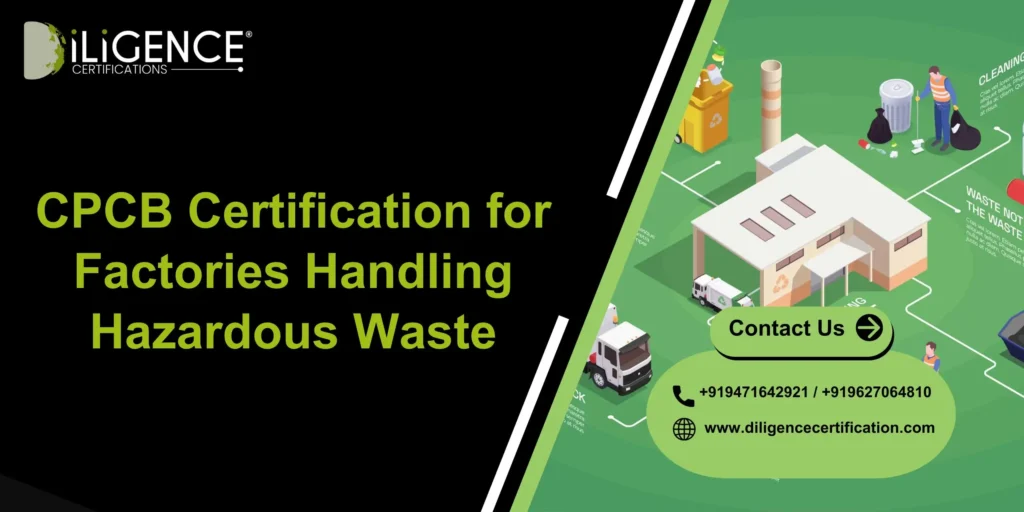
CPCB Certification for Factories responsible for hazardous waste management are vital to India’s industrial ecosystem, but at the same time, they pose environmental and safety risks. Although production efficiency and volume still take precedence, adherence to environmental laws is just as important. Central Pollution Control Board
A lot of factories ignore the CPCB Certification for Factories for Factories Handling Hazardous Waste, which might result in inspections, legal notices, shutdowns, and the imposition of heavy fines. Not only that, but the inappropriate handling of hazardous waste can also pose serious risks to both human health and the environment.
The main goal of this article is to provide an overview of the significance, requirements, and procedure of CPCB Certification for Factories , thereby facilitating factories to realize how compliance with hazardous waste regulations sustains the legality of operations and the ecological industrial growth in India.
What is CPCB Certification for Factories Handling Hazardous Waste?
CPCB Certification (Central Pollution Control Board) is a conformity assessment that is granted according to the environment-related laws like the Environment (Protection) Act, 1986 and the Hazardous Waste (Management and Transboundary Movement) Rules, 2016.
It is for those organizations that produce hazardous waste as a result of their production processes, use of chemicals, or industrial treatment activities.
CPCB Certifying means:
- The odoriferous refuse is managed safely (giving rise to no pollution) and correctly disposed of.
- The needed measures for control of pollution are not only installed but also in good working condition.
- The norms for the safety of the environment as well as of workers are observed.
- Legal requirements for waste management are fulfilled.
- The activities in the factory are both authorized and legal.
If the factories lack the CPCB Certification, they might undergo legal action, enforced closure, or limits on production.
Why CPCB Certification is Important for Hazardous Waste Handling Factories
With no proper authorization, the management of hazardous waste will be a great environmental concern and a legal risk as well. Not acquiring CPCB Certification might lead to the following consequences:
- Legal notices and penalties that could be very high
- Factory operations being at least temporarily paused or totally shutdown
- Hazardous materials being confiscated
- Damage done to the company’s reputation and loss of trust from stakeholders
- Increased financial responsibility in case of environmental disasters
CPCB Certification for Factories Handling Hazardous Waste indicates the factory’s determination to keep things safe, comply, and practice industrial ways that are responsible and good.
CPCB Certification for Factories That Require
CPCB Certification is essential for factories engaged in:
- Chemical and pharmaceutical production
- Manufacture of Paints, Dyes, and Pigments
- Metal processing and electroplating units
- Battery, plastic, and e-waste making
- Oil refining and Petrochemical processes
- Any unit producing hazardous or toxic waste
In case a factory has more than one of the activities listed, such as producing, storing, and/or disposing of hazardous waste, compliance with CPCB is mandatory.
Benefits of CPCB Certification for Factories
| Importance | Benefits |
| Legal compliance | Avoids fines, legal notices, and shutdowns |
| Environmental safety | Reduces pollution and hazardous exposure |
| Regulatory approval | Smooth coordination with pollution control authorities |
| Brand credibility | Builds trust with regulators and stakeholders |
| Sustainable operations | Enables long-term and responsible growth |
Step-by-Step CPCB Certification Process
First Step: Hazardous Waste Assessment
The type of hazardous waste, the amount, and the characterization of the waste generated from the production process should be determined.
Second Step: Document Preparation
Prepare documents consisting of plans for waste management, technical reports, and safety measures.
Third Step: Application Filing
Submit the application through the CPCB or the concerned State Pollution Control Board’s online portal.
Fourth Step: Document Review & Inspection
The authorities responsible for issuing the certificate review the documents and may also inspect the site.
Fifth Step: CPCB Certification Issuance
A certificate is issued after confirming the accuracy of compliance.
Sixth Step: Renewal & Continuous Compliance
The compliance will be by continuous monitoring, timely reporting, and renewals, hence no lapse.
Documents Required for CPCB Certification
- Certificate of Incorporation
- PAN and GST Registration
- Factory layout and process flow diagram
- Hazardous waste management plan
- Consent to Establish / Operate
- Authorization letters (if applicable)
Timeline, Validity & Renewal
- Processing Time: 30-60 working days
- Validity: Depends on factory type and waste category
- Renewal: Mandatory before expiry
- Amendments: Required for changes in process, capacity, or waste type
Common Hazardous Waste Compliance Requirements
- The safe and proper storage of hazardous waste was done and each was labeled properly.
- The transportation and disposal methods were authorized for getting waste and its final treatment done.
- The pollution control equipment was installed.
- Environmental monitoring was done regularly.
- Reports to authorities about compliance were submitted.
Non-compliance could bring about penalties, closure orders, or revocation of the certification.
Conclusion
The CPCB Certification for Factories Handling Hazardous Waste is not only a market requirement but also a promise to mother earth, the workers, and the industry.
Prioritizing CPCB Certification for Factories means less risk of lawsuits, safe disposal of waste, and better relations with the regulators.
Factories can then easily and without doubts operate, lower their impact on the environment, and be part of the growth of the Indian market which is becoming more and more regulated.
Frequenlty Asked for Questions
CPCB Certification for a hazardous waste factory is what?
This is a factory’s expression of having the backing of the authorities that it is handling hazardous waste safely and, therefore, legally.
Is CPCB Certification for the hazardous waste units a must?
It is indeed a necessity according to the Indian environmental laws.
What law is ruling hazardous waste CPCB certification?
Hazardous Waste (Management and Transboundary Movement) Rules, 2016.
Who is the issuer of a CPCB hazardous waste authorization?
Either the CPCB or the respective State Pollution Control Board.
What are the consequences of a factory not having CPCB certification and operating?
It will surely incur fines, shutdowns, and lawsuits.
How long is CPCB certification valid?
Typically, 30 to 60 working days.
Is the renewal of CPCB certification necessary?
Indeed, the renewal must be done prior to the expiry to circumvent fines.
Which sectors require hazardous waste CPCB certification?
Chemical, pharmaceutical, metals, battery, plastics, and oil processing industries.
Does certification from CPCB elevate brand trustworthiness?
For sure, it is a way of gaining trust from the regulators, investors, and customers.
Is it possible to revoke the CPCB certification?
Yes, if there are violations or false data is provided.