BIS Certification
 CDSCO
CDSCO
 PESO
PESO
 CPCB
CPCB
 LMPC
LMPC
 WPC Approval
 Global Approvals
 TEC
TEC
 ARAI
ARAI
 BEE
BEE
 ISO Certification
 DGCA Certification
 NOC For Steel
 APEDA Registration























 Business Registration
 FSSAI Mark Certification












 (32).jpg)
 Legal Services
 Trademark Registration
 Copyright Registration
 Patent Registration
 By
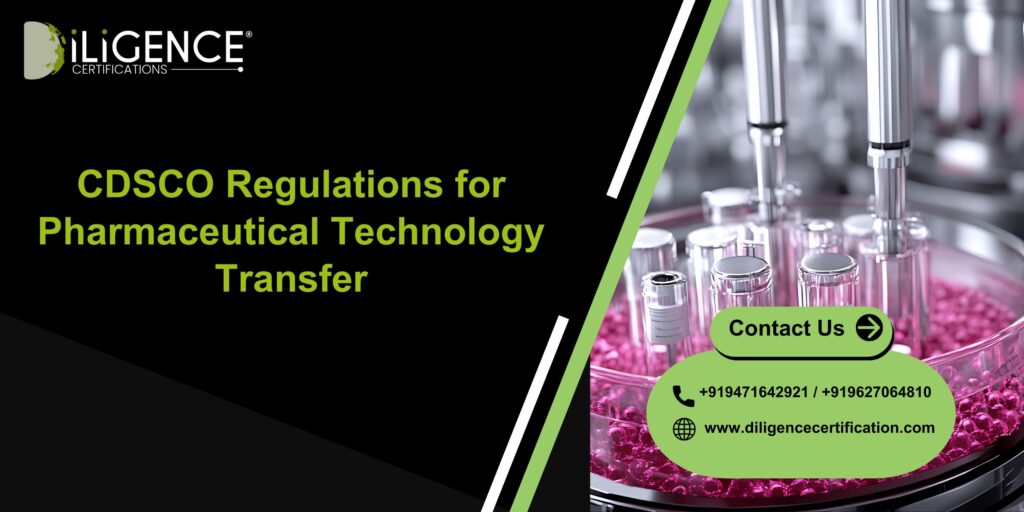
By - Central Drugs Standard Control Organisation (CDSCO) approval is required while technology transfer affects the manufacturing process and/or formulation and/or quality of the-approved drug.
- In cases of transfer of the facilities of manufacture, process scaling up, or a change in critical equipment, previous regulatory intimation or approval is required.
- The act of validation and relative comparability is required to ensure that the transferred technology retains the quality, safety, and efficacy.
- Updated documentation such as Site Master File, process validation reports, stability studies, and updated dossiers should be submitted to CDSCO.
- Post-transfer includes GMP, inspection, and pharmacovigilance. All these must be carried out within the new manufacturing facility.
Introduction
The concept of pharmaceutical technology transfer would entail the systematic transfer of knowledge of the product, the manufacturing process, and the controls from one location to the other. In the Indian context, the transfer of all such information would be regulated under the supervision of the Central Drugs Standard Control Organisation CDSCO so that, in the course of the transfer of technology, the quality, safety, and efficacy of the drugs are not affected. This would be in accordance with the Drugs & Cosmetics Act along with the principles of Good Manufacturing Practices.
What is a CDSCO License?
CDSCO License: A regulatory license given by the CDSCO to the manufacture, import, or sale of a drug/medical device, as well as the conduct of clinical trials on a drug/medical device. This is a license given by the CDSCO. It is ensured by the CDSCO License that all the drugs meet the Drug & Cosmetics Act, 1940. Based on the task, licenses issued by CDSCO may range from manufacturing licenses to import registrations and clinical trials or marketing permits in collaboration with concerned State Drug Control Authorities.
Key Points:
- A CDSCO License is the regulatory approval from the Central Drugs Standard Control Organisation to operate pharmaceutical and medical device activities in India.
- Such regulations include manufacturing, importing, selling, distributing, or conducting clinical trials of any drug, medical, or health device.
- It also ensures that there is compliance with the Drugs & Cosmetics Act, 1940.
- It verifies that products comply with basic criteria associated with quality, safety, and efficacy.
- CDSCO issues licenses either centrally or through State Drug Control Authorities, depending on the nature of the approval.
Why is CDSCO Certification Mandatory
The CDSCO certification in India is an important part of ensuring the safety, efficacy, and quality of the drug, device, and COSMETIC articles that are being made available for purchase within the Indian marketplace itself. The CDSCO certification, which is an important part of the CDSCO, ensures that all the articles being developed, imported, and made available within the Indian marketplace comply with the requirements set out within the Drugs and Cosmetics Act, 1940. This ensures that poor-quality and/or unsafe articles are not being developed, imported, and made available within the marketplace, following the principles of Good Manufacturing Practices.
Key Reasons:
- By doing so, the manufacturer can be ensured that the medicines, devices, and cosmetics are produced according to the necessary standards.
- “CDSCO certification is adhered to in order to abide by Drugs & Cosmetics Act, 1940 & relevant regulations.”
- It aims to prevent the sale of poor quality, spurious, and unsafe drugs in India.
- It also ensures that all GMP and regulatory requirements are being met.
- It protects public health through regulation, monitoring, and post-market surveillance activities carried out by the Central Drugs Standard Control Organisation (CDSCO).
Importance and Benefits of CDSCO Certification
| Importance | Benefits |
| This covers adherence to the Drugs and Cosmetics Act, 1940, and the regulatory requirements in India. | Enhances the brand’s position and perception with the medical and health audience. |
| Ensures strict controls regarding quality, safety, and efficacy of medications as well as medical devices. | Facilitates legal manufacturing, import, and marketing of regulated products in the Indian market |
| Prevents the manufacture, sale, of sub-standard, spurious, or unsafe goods. | It enhances market accessibility and expansion for business. |
| Ensures that GMPs are followed to the letter in all manufacturing facilities. | Reduces associated risks, fines, and product recalls. |
| Improves governance of regulations and public health protection through the Central Drugs Standard Control Organisation (CDSCO). | It helps to provide long-lasting sustainability in conducting its business activities. |
Step-by-Step Process of CDSCO Certification
Step1:Documentation
- Define product category (drug, medical device, cosmetic, IVD)
- Technical dossier and product information preparation
- Obtain company registration documents and manufacturing/import licenses
- Compliance with CDSCO documentation requirements
Step2:Product Testing
- Send product samples to NABL-accredited/BIS-recognized
- Perform safety, performance, and quality tests
- Collect valid test reports
- Ensure adherence to CDSCO requirements
Step3:Application Submission
- Register yourself on the CDSCO SUGAM portal
- Submissions of Applications by CDSCO
- As mentioned in various
- All necessary documents and test reports have been uploaded
- Pay the mandated CDSCO government fees
Step4:Scrutiny and Inspection
- CDSCO evaluates submitted documentation
- Technical assessment: Product details
- Manufacturing site inspection can be performed
- Queries/ Clarifications raised, if any
Step5:Grant of License
- Application approved by Central Drugs Standard Control Organization
- CDSCO License / Registration Certificate issued
- Approved product for manufacturing/import and sale in India
- Validity of the license renewable as per regulatory terms
Documents Required for CDSCO Certification
| Category | Documents Required |
| Business Documents | Business license/registration, ISO certificate, organizational details |
| Manufacturer Details | Factory layout, process flow chart, machinery list, production details |
| Product Documents | Product specifications, component list, user manual, model details |
| Testing Documents | Test report from BIS-recognized lab, sample details, test request form |
| Legal & Compliance | Authorization letter, brand ownership proof, trademark certificate (if any) |
| Import/Foreign Manufacturer (If applicable) | AIR (Authorized Indian Representative) details, contract agreement, overseas manufacturer documents |
Timelines, Costs, Validity & Renewal
- Timelines: Processing of CDSCO certification typically consumes 20-30 working days, of which 7-15 days are required for product testing, subject to the nature of the product and resolution of inquiries.
- Expenses: Fees charged by the government differ according to product types, whether it be a drug, medical device, cosmetic, or import product. Other costs can also be incurred depending on inspection, retesting, or changing documentation.
- Validity:In most cases, a CDSCO license/registration certificate is issued with a validity period of 2 years, depending on several regulatory conditions.
- Renewal: The process of renewing a license has to be carried out before its expiry date to prevent a suspension or lapse in the license.
- Renewal Requirements:A set of updated documents, formatted test reports (if needed), and the payment of predetermined fees are the necessities for successful renewal under the Central Drugs Standard Control Organization.
Why Choose Diligence Certifications
Diligence Certifications is a popular regulatory and compliance advisory company to smoothly and easily get the approval for the business. The team is well-versed in CDSCO, BIS, and other regulatory-type certifications and provides full-fledged support from documentation and filing the process to dealing with the authorities, if needed. Diligence Certifications emphasizes providing transparent, accurate, and timely results so that the risk and time involved in the process can be minimized by the clients.
Conclusion
CDSCO certification is a significant part of ensuring the necessary standard of quality, safety, and efficacy of pharmaceuticals being marketed within the Indian market. Focusing on those regulations, the organization will be able to steer clear of any form of legal troubles, as well as market credibility, while ensuring public health by following the guideline laid down by CDSCO, which improves market entry in India among other future goals.
Frequently Asked Questions (FAQs)
What is CDSCO ?
Central Drugs Standard Control Organisation (CDSCO) is the central regulatory authority for drugs, devices, and cosmetics.
Approval from the CDSCO in India is mandatory.
Yes, the approval of the products from the CDSCO is mandatory for the importers of these products.
What does Pharmaceutical Technology Transfer Mean?
It includes the structured transfer of product, process, and quality knowledge across manufacturing sites.
At what point is the approval of CDSCO necessary for the purpose of technology transfer?
Any changes that affect the manufacturing process, formulation, equipment, and product quality must be approved.
Which documents are required for approval with the CDSCO?
First of all, it has to do with preparation documentation such as Site Master File, Product Dossier, Test Reports, and GMP records.
How long does it take to get this certification by CDSCO?
It lasts for about 20 to 30 days of work, depending on the product type and individual inquiries/organizational inquiries.
To what extent does the license issued by CDSCO prevail?
Licenses by CDSCO usually remain valid for up to 2 years.
Is the testing of products compulsory while approval is sought from CDSCO?
Indeed, product testing by NABL-accredited or BIS-recognized laboratories is generally asked for.
Can CDSCO Licenses be renewed?
Yes, and quite importantly, these licenses are supposed to be renewed before their dates of expiration through fresh documentation and payment.
What if the CDSCO compliance requirement is not fulfilled?
Non-compliance could lead to suspension of licenses, imposition of fines, product recalls, and lawsuits.