BIS Certification
 CDSCO
CDSCO
 PESO
PESO
 CPCB
CPCB
 LMPC
LMPC
 WPC Approval
 Global Approvals
 TEC
TEC
 ARAI
ARAI
 BEE
BEE
 ISO Certification
 DGCA Certification
 NOC For Steel
 APEDA Registration























 Business Registration
 FSSAI Mark Certification












 (32).jpg)
 Legal Services
 Trademark Registration
 Copyright Registration
 Patent Registration
 By
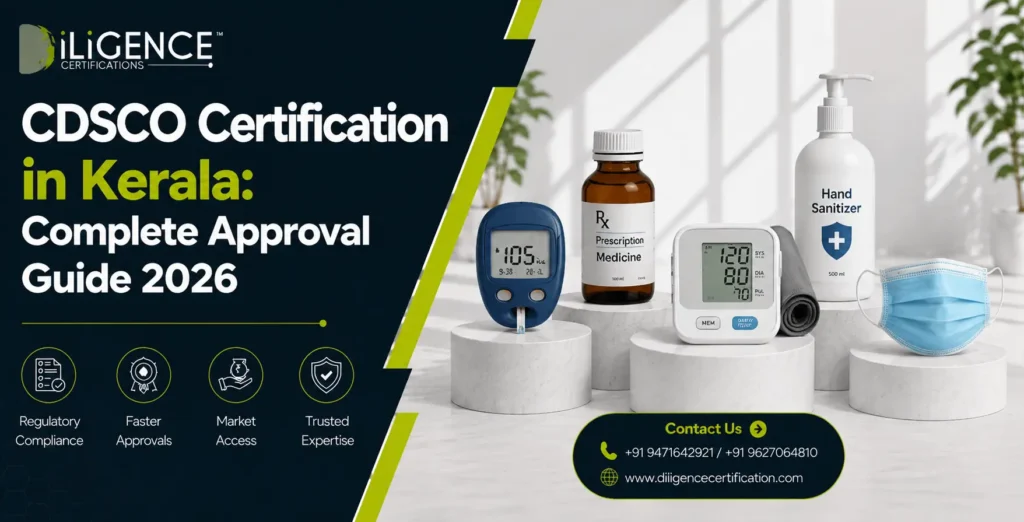
By - The CDSCO certification is essential for the approval of drugs, devices, and other diagnostics and regulated healthcare products in Kerala before being marketed or imported to India.
- Products that adhere to safety, quality, and clinical requirements in India as per the guidelines set by the CDSCO should be approved before being sold in India.
- Accurate documentation, product classification, and online submission through SUGAM portal are necessary to avoid the risk of getting rejected.
- Manufacturers and importers of products from Kerala should ensure adherence to central licensing requirements.
Introduction : CDSCO certification in Kerala
A medical device importer from Kochi recently faced an unexpected delay at customs. The shipment had already cleared international quality checks, packaging was complete, and hospital buyers were ready. Still, the goods were held.
The reason was simple but critical missing regulatory approval under the CDSCO framework.
This problem is common in Kerala. The state boasts an ever-evolving medical and pharmaceutical industry, in places like Kochi, Trivandrum, and Calicut. Nevertheless, most companies tend to overlook the high level of compliance needed under the terms of CDSCO before engaging in any activity within the medical industry.
The reality is that CDSCO approval is the legal passport that opens up the Indian market for medical equipment, drugs, diagnostic instruments, and cosmetics. Otherwise, advanced technology will be detained or rejected.
What is CDSCO Certification in Kerala?
CDSCO certification in Kerala refers to regulatory approval issued under India’s central drug and device law system, governed by Drugs and Cosmetics Act of 1940 The Central Drugs Standard Control Organisation (CDSCO).
It ensures that medical products meet defined standards of:
- Safety
- Quality
- Clinical effectiveness Compliance in manufacturing Businesses operating in Kerala that offer medical devices, diagnostic instruments, implant procedures, or pharmaceutical preparations need to conform to the CDSCO guidelines before entering the market.
Why is CDSCO Certification Important for Kerala Companies?
The healthcare facilities available in Kerala are well-equipped, and the state boasts many hospitals. Therefore, Kerala is highly competitive in the medical arena. However, regulatory compliance is mandatory.
CDSCO certification in Kerala is important because:
- Prevents customs rejection of imported medical goods
- Enables legal manufacturing and distribution in India
- Builds hospital and institutional trust
- Reduces regulatory penalties and recalls
- Ensures alignment with Indian clinical safety standards
A compliance officer once compared it to “passport control for healthcare products”without it, movement simply stops.
Products Covered Under CDSCO Regulation
CDSCO certification in Kerala applies to a wide range of healthcare and regulated product categories. Each category is assessed based on risk, intended use, and impact on human health.
1. Medical Devices
Medical devices form one of the most strictly regulated categories under CDSCO due to direct patient safety involvement.
They include:
- Equipment for diagnosis: Instruments that are utilized to diagnose diseases, including imaging systems, ECG machine, and pathology analysis systems. Accuracy and calibration standards apply to this category of devices.
- Surgical instruments: Surgical tools including forceps, clamps, scalpels, and sophisticated surgical instruments. Sterility and high quality are vital criteria in evaluating the devices.
- Implants: Devices inserted into the human body, including dental implants, orthopedic implants, and heart stents. This category of devices is tested extensively for safety and biocompatibility.
- Monitoring devices: Instruments which measure patient’s health parameters constantly, such as blood pressure measurement system, ICU monitoring system, and oxygen saturation device. Reliability and high accuracy are vital criteria in this case.
2. Pharmaceuticals
The pharmaceutical product goes through extensive clinical evaluation and safety analysis before it is approved by the CDSCO.
Products in this category include:
Prescription medicines: These medicines need prescriptions from doctors and include categories such as antibiotics, pain management medication, and chronic illness treatments.
Novel drug formulation: These new drug formulations are recently developed and require safety analysis and data from clinical trials to be marketed.
Injectable medicine: These drugs come in sterile preparations, meant for injection into the body. Examples include vaccines, insulin injections, and other intravenous medicines.
3.In-Vitro Diagnosis
These IVDs are used to detect diseases in an environment outside the body.
They include:
Blood tests: This refers to glucose monitors and blood grouping kits used in disease screening. They need to be accurate and consistent.
Corona/Virus detection kits: These are fast and laboratory-based tests used to determine the presence of any virus. Validation according to clinical standards is important.
Laboratory reagents: These are chemicals used in diagnostic laboratories.
4. Cosmetics
- Some of the cosmetic products that come under the purview of CDSCO because of their medical importance include the following categories:
- Skincare products: Cosmetic products meant for use in the case of acne, pigmentations, and skin disorders.
- Medical-grade cosmetic products: Advanced cosmetic products that need safety and compliance validation.
Step-by-Step CDSCO Certification Process in Kerala
The approval process is centralized but applicable across Kerala industries through the CDSCO SUGAM portal.
Step 1: Product Classification
The first step in CDSCO certification in Kerala is classification:
- Is it a drug
- Is it a medical device
- What risk class does it fall under
Incorrect classification is one of the main reasons for rejection.
Step 2: Technical Documentation Preparation
Companies must prepare a complete technical dossier:
- Device Master File (DMF)
- Plant Master File (PMF)
- Clinical evaluation report
- Safety and stability data
- Quality management certificates
Step 3: Application Filing on CDSCO Portal
Applications are submitted through the SUGAM online portal.
Mistakes commonly seen;
- Wrong form selection
- Missing annexures
- Incorrect device category mapping
Step 4: Regulatory Review
Authorities assess:
- Product safety
- Clinical evidence
- Manufacturing compliance
- Risk classification accuracy
Queries may be raised during this stage.
Step 5: Inspection (If Required)
For manufacturing units in Kerala, CDSCO may conduct:
- Plant inspection
- Quality system audit
- Documentation verification
Step 6: Final Approval
Once satisfied, CDSCO grants approval for:
- Manufacturing license
- Import license
- Marketing authorization
Documents Required for CDSCO Certification in Kerala
For obtaining CDSCO certification in Kerala, companies must submit a complete technical and regulatory dossier. Each document plays a specific role in verifying product safety, manufacturing quality, and compliance with Indian regulatory standards.
1. Manufacturing License
- This license is needed by all manufacturers who make medicines or devices in India.
- This certificate may be issued by the appropriate State Licensing Authority or CDSCO, as applicable.
- This confirms that the manufacturing unit complies with Good Manufacturing Practice (GMP).
- It authorizes the manufacturing unit to manufacture medicines in India.
- It provides information about production facilities, process descriptions, and other related data.
- Without this license, manufacturing authorization will not be possible in India.
2. Plant Master File (PMF)
The Plant Master File provides a complete overview of the manufacturing facility.
It includes:
- Location and layout of the plant
- Equipment details and production capacity
- Quality control systems and SOPs
- Hygiene and environmental control measures
- Staff qualifications and training records
This document helps regulators assess whether the facility is capable of consistent and safe production.
3. Device Master File (DMF)
The Device Master File is essential for medical devices and diagnostics.
It contains:
- Product design and technical specifications
- Raw materials used in manufacturing
- Risk classification and intended use
- Sterilization and packaging methods
- Performance testing and validation data
This is one of the most critical documents for CDSCO review.
4. ISO 13485 Certificate
This certificate confirms that the company follows an internationally recognized quality management system for medical devices.
- Demonstrates compliance with global manufacturing standards
- Ensures controlled design, production, and post-market processes
- Improves acceptance during CDSCO evaluation
- Reduces regulatory scrutiny on manufacturing quality systems
5. Free Sale Certificate (For Imports)
Required for imported medical devices and pharmaceuticals.
- Issued by the country of origin regulatory authority
- Confirms that the product is legally sold in the exporting country
- Acts as proof of international market approval
- Mandatory for import license applications in India
6. Clinical Evaluation Report
This document provides scientific evidence of product safety and effectiveness.
Includes:
- Clinical trial data (if applicable)
- Published research references
- Risk-benefit analysis
- Real-world performance data
It is especially important for new drugs and high-risk medical devices.
7. Authorization Letter
An authorization letter is required when an applicant appoints a third-party representative.
- Legally allows consultant or importer to act on behalf of manufacturer
- Must be signed by an authorized company official
- Defines scope of representation in CDSCO application process
Without this, applications may be rejected due to representation issues.
8. Product Labeling Details
Label compliance is strictly reviewed under CDSCO regulations.
Must include:
- Product name and intended use
- Manufacturer details
- Batch number and manufacturing date
- Expiry date and storage conditions
- Regulatory warnings (if applicable)
Incorrect labeling is a common reason for query generation.
9. Test Reports from Approved Labs
Test reports validate product safety and performance.
- Must be issued by NABL-accredited or CDSCO-approved laboratories
- Includes chemical, biological, and performance testing
- Confirms compliance with applicable Indian Standards
- Required for both domestic and imported products
Common Challenges in CDSCO Certification in Kerala
Even well-established companies in Kerala face regulatory delays due to documentation and classification gaps.
Key Issues:
- Incorrect product classification
Leads to wrong application route and rejection or re-submission. - Incomplete technical files
Missing DMF/PMF sections or inconsistent data triggers regulatory queries. - Missing test reports
Without valid lab reports, safety validation cannot proceed. - Label compliance errors
Minor mistakes in labeling format often result in application hold. - Delay in clinical data submission
Lack of supporting clinical evidence slows down approval significantly.
These issues typically result in repeated clarification requests and extended approval timelines.
Real-World Industry Scenario
A diagnostic firm from Kochi was planning to introduce a quick test kit for diagnosing infections. The test kit had already proved its efficacy in the European market and had received favorable reviews.
But while undergoing CDSCO clearance in India, there were certain requirements for the same:
Clinical data for India
Labeling according to the regulations of India
Test validation reports specific to India
Thus, delay occurred not because of the failure of the product but due to regulatory differences.
Why Choose Diligence Certifications
Diligence certifications Choosing the right compliance partner significantly reduces approval delays and regulatory risk in CDSCO certification in Kerala.
Key Advantages:
- End-to-end regulatory assistance from classification to approval stage
- Highly skilled in CDSCO documentations and SUGAM online application submission process
- Zero-error technical dossier preparation minimizing query iterations
- Quick delivery by way of compliance process mapping
- Regulatory support for medical devices, diagnostic products, pharma, and cosmetics
- Regulatory responses to CDSCO queries and preparation for inspections
- Compliance approach customized according to product types
- Less likelihood of rejection due to poor documentation and/or incorrect classification of products
- At Diligence Certifications, our emphasis is more on implementation and not just documentation.
Conclusion
It becomes imperative for businesses operating in sectors related to medicine, pharmaceuticals, and diagnostics in the Indian state of Kerala to ensure that their business is CDSCO certified. It helps assure safety and quality of goods according to Indian requirements, ensuring the same when they reach hospitals, clinics, and customers.
Businesses which put effort into making sure that they have completed their documentation, classification, and filing procedures accordingly tend to avoid many issues and delays. On the other hand, businesses which do not follow these practices tend to face a lot of queries from authorities.
Hence, CDSCO certification in Kerala is an absolute must for all those businesses wishing to operate in India’s healthcare industry.
Frequently Asked Questions
What is CDSCO certification in Kerala?
Regulatory approval that is required for medical devices, drugs, and diagnostics prior to manufacturing, importation, and sales in India.
Which authority provides CDSCO approval?
CDSCO is the organization responsible for issuing the approvals under the Ministry of Health & Family Welfare.
Is CDSCO certification mandatory in Kerala?
Yes, all medical devices, pharmaceuticals, and diagnostics must comply with this regulation
What is the purpose of CDSCO SUGAM portal?
This is an online platform that is used for filing applications, providing documents, and receiving the approval.
How fast can I receive CDSCO approval?
The process usually takes up to 3-12 months.
What are common causes for CDSCO rejection?
Incorrect classification, absence of technical documents, inaccurate test reports, wrong labeling
Should MSMEs obtain CDSCO approval in Kerala?
Yes, even small manufacturers and startups should have this approval if their product is within the scope of regulation.
Is it necessary to provide CDSCO approval when importing medical devices?
Yes, for any regulated products to be imported into India.
Can CDSCO approval be assigned to another company?
No, each application will only serve the interests of the applicant itself.
What happens if a product is sold without CDSCO approval?
It may lead to product seizure, penalties, and legal action under Indian drug and device laws