BIS Certification
 CDSCO
CDSCO
 PESO
PESO
 CPCB
CPCB
 LMPC
LMPC
 WPC Approval
 Global Approvals
 TEC
TEC
 ARAI
ARAI
 BEE
BEE
 ISO Certification
 DGCA Certification
 NOC For Steel
 APEDA Registration























 Business Registration
 FSSAI Mark Certification












 (32).jpg)
 Legal Services
 Trademark Registration
 Copyright Registration
 Patent Registration
 By
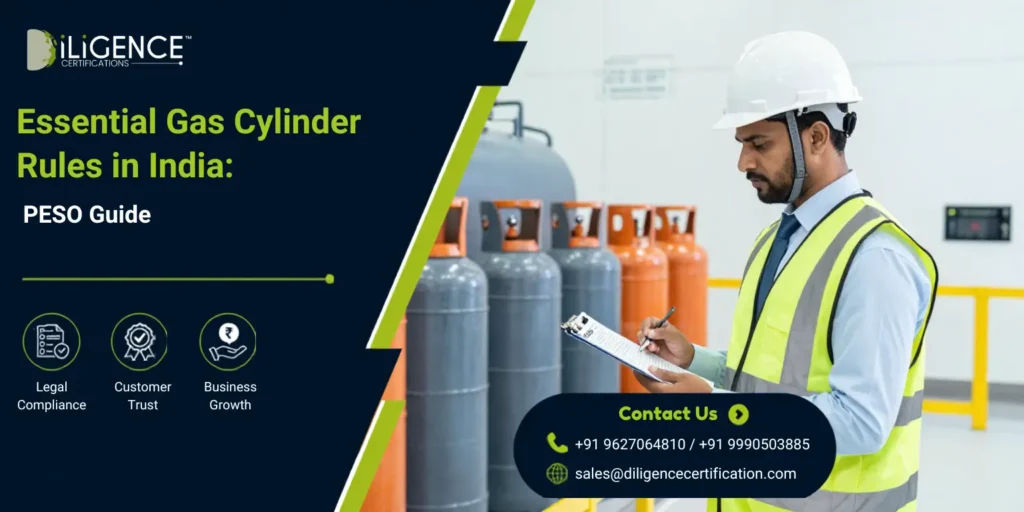
By - Gas Cylinder Rules in India govern the manufacturing, importing, filling, possession, testing, storage, and transportation of gas cylinders.
- Gas Cylinders Rules, 2016, enforced by PESO, lay down the guidelines regarding approved cylinders, valves, premises, licences, testing, and handling.
- Companies that are into business of compressed gases should first ensure their licence, cylinder standard, testing guidelines and premises.
Introduction
One company contacted us when they had already purchased a full gas filling system. The machinery was installed, cylinders were ordered, and the team was ready to launch operations. Everything seemed fine on paper. The issue was that the regulatory aspects were taken for granted.
The planning of the premises, the approval and testing of the cylinders and the licensing requirements have not been properly correlated with the relevant gas cylinder regulations. It means that the business had the equipment available, but was not able to legally operate with it according to the initial plans.
It is a rather widespread mistake in the field of compressed gases. Although a cylinder seems to be just a metal vessel, as soon as it is designed for compression, liquefaction or dissolving of gas under pressure, it becomes a subject of regulation.
What Are Gas Cylinder Rules in India
The gas cylinder laws are all the legal and technical regulations applicable to gas cylinders in India used in connection with compressed gas cylinders. This includes the regulations concerning cylinder standards, testing, filling, possession, storage, transportation, import, and licensing.
The primary law applicable is the Gas Cylinders Rules, 2016, which have been framed under the Explosives Act. The primary law is the one which defines the technical aspects of the cylinder and the use thereof, and also makes provision for the licensing of various activities.
The law is most significant for companies dealing with gases like oxygen, nitrogen, hydrogen, carbon dioxide, gases related to LPG, medical gases, industrial gases and other compressed gases depending upon its classification.
It is essential to understand that not every activity concerning cylinders is regulated in the same manner.
What Are the Rules for Filling Gas Cylinders
Cylinder filling is one of the areas where businesses often make incorrect assumptions.
Under the Gas Cylinders Rules, filling and possession are regulated activities. Rule 43 establishes the licensing requirement for filling and possession, subject to specified exceptions.
Before a cylinder is filled, the cylinder and its valve or fittings must satisfy the prescribed requirements. Rule 45 states that cylinders must be of an approved type and standard, have passed the required examination and testing, and comply with relevant provisions of the rules.
In practical terms, a filling facility should not treat the filling machine as the centre of compliance. The entire system matters:
cylinder → valve → filling equipment → gas → operating pressure → premises → storage → safety controls → licence
If one part is unsuitable, the whole operation can become a compliance concern.
What Does PESO Have to Do With Gas Cylinder Rules
The Petroleum and Explosives Safety Organisation (PESO) is the central regulatory authority associated with the administration and enforcement of several petroleum, explosives and compressed-gas safety requirements in India.
PESO provides the official Gas Cylinders Rules, 2016, related FAQs, forms and SOPs through its website.
For a business, PESO involvement can arise in areas such as:
- Gas cylinder filling
- Storage of compressed gases
- Cylinder import
- Cylinder manufacturing
- Testing and inspection
- Gas-filling premises
- Certain specialised cylinder operations
- Approval of cylinder types and specifications
The exact requirement should be determined from the proposed activity rather than assumed from the gas name alone.
What Documents Are Generally Needed
The exact document list depends on the licence or approval being sought, but a gas-cylinder compliance application may involve technical, corporate and site-related information.
Typical documentation can include:
- Company incorporation or business details
- Applicant and authorised-person details
- Site ownership or occupancy documents
- Site layout and premises plan
- Surrounding-area information
- Cylinder specifications
- Gas details
- Cylinder and valve certificates
- Applicable test certificates
- Equipment specifications
- Safety arrangements
- Fire and emergency provisions
- Technical drawings
- Previous approval or licence details, where applicable
- Supporting declarations and undertakings
The technical drawings deserve particular attention.
Under the rules, an applicant seeking a licence to fill and store compressed gas is required to submit specifications and a plan of the proposed premises showing how the prescribed provisions will be complied with. The rules also refer to the surrounding area within 100 metres of the relevant facilities in the submitted plan.
This is one reason an application should not be prepared by simply uploading generic documents.
How Should Gas Cylinders Be Stored
Storage is where operational discipline becomes visible.
Cylinders should be stored in an arrangement appropriate to the gas and the applicable safety requirements. The storage area should be planned to minimise risks from heat, ignition sources, mechanical damage, incompatible materials and unauthorised access.
A practical storage review should consider:
- Whether cylinders are secured against falling.
- Whether filled and empty cylinders are properly segregated.
- Whether incompatible gases are appropriately separated.
- Whether ignition sources are controlled.
- Whether ventilation is adequate for the gas involved.
- Whether access is restricted.
- Whether emergency response arrangements are available.
- Whether the storage quantity remains within approved limits.
- Whether cylinder identification remains clear.
For a client operating a busy industrial facility, we generally recommend thinking of the storage area as a controlled process zone rather than simply a corner where cylinders are kept.
That change in mindset makes a difference.
Gas Cylinder Rules for Different Industries
The same regulatory framework can affect very different industries.
Medical and healthcare facilities
Hospitals and medical facilities may handle oxygen, medical oxygen, nitrous oxide and other gases. Cylinder identification, storage, segregation and safe handling become especially important because cylinders are often moved between storage areas and patient-care locations.
Manufacturing plants
Factories may use oxygen, nitrogen, hydrogen, argon, carbon dioxide or specialised gases for welding, cutting, inerting, heat treatment or production.
Here, the compliance challenge is often scale: multiple cylinder banks, frequent deliveries and a combination of filled and empty cylinders.
Laboratories
Laboratories may use smaller quantities but can have a wider variety of gases. Compatibility, ventilation and cylinder securing become important considerations.
Gas distributors
Distributors must manage cylinder movement, inventory, documentation and customer supply while ensuring that the cylinders entering their operation remain within the applicable regulatory requirements.
Cylinder manufacturers and importers
For manufacturers and importers, compliance begins earlier. Cylinder design, material, manufacturing standards, inspection, testing, approval and documentation may all become relevant.
Common Mistakes Businesses Make
Starting the facility before regulatory review
This is one of the most expensive mistakes.
A company may construct a storage or filling facility first and discover later that the proposed layout does not align with the applicable requirements.
Using an overseas certificate as the only approval
International test certificates can be useful technical evidence, but businesses should determine whether the cylinder satisfies the standards and approval requirements applicable in India.
Treating every gas cylinder as the same
Oxygen, hydrogen, LPG-related gases, nitrogen and other gases have different physical properties and safety considerations.
The compliance approach should therefore be gas-specific.
Ignoring cylinder test status
A cylinder may appear physically sound while its test status is no longer valid.
Preparing generic drawings
A site plan should reflect the actual premises, equipment, cylinder storage, safety arrangements and surrounding area. Generic drawings often create questions during scrutiny.
How Diligence Certifications Helps With Gas Cylinder Compliance
At Diligence Certifications, our approach is to start with the client’s actual operation rather than begin with a standard document checklist.
A company handling compressed gases may require a different compliance route depending on whether it manufactures cylinders, imports them, fills gas, stores cylinders, distributes them or uses them for its own industrial process.
Our PESO-related support can include requirement assessment, documentation review, application preparation, technical coordination, licence-related assistance and compliance guidance.
Conclusion
Comprehension of gas cylinder regulations is crucial for any company involved in manufacturing, importation, filling, storing, distribution or usage of compressed gas cylinders in India. The regulations include more than just getting the license. They also include such issues as the standardization of cylinders, testing of cylinders, valves, filling procedures, storage facilities, drawings, safety measures, and ongoing compliance.
The Gas Cylinders Rules, 2016 act as the major regulatory document, while PESO deals with all licensing and approval matters. It is therefore important for businesses to identify what regulation applies to them before setting up the filling plant, extending their cylinder storage, or importing cylinders.
Such pre-planning will enable the avoidance of a frequent occurrence where equipment or facilities are acquired without realizing some regulatory concerns.
Frequently Asked Questions
What are gas cylinder rules in India?
Gas cylinder rules in India regulate the manufacture, import, filling, testing, possession, storage and handling of cylinders containing compressed gases. The primary framework is the Gas Cylinders Rules, 2016, administered through PESO.
Is a PESO licence required for filling gas cylinders?
Yes, in general, filling compressed gas into cylinders is a regulated activity and requires the applicable PESO licence, unless a specific exemption under the Gas Cylinders Rules, 2016 applies.
What is Form-C under the Gas Cylinders Rules, 2016?
Form-C is used for applying for the grant, amendment or renewal of a licence for filling and/or storing compressed gas in cylinders. The exact requirements depend on the proposed gas, quantity, premises and activity.
Are gas cylinders required to undergo periodic testing?
Yes. Gas cylinders must comply with applicable examination and testing requirements. Cylinders that do not meet the prescribed testing or service requirements should not be used for filling or operation.
Can gas cylinders be stored without a PESO licence?
Certain exemptions are provided under the Gas Cylinders Rules, 2016. However, these exemptions have specific conditions relating to factors such as gas type, quantity, purpose and transportation. Businesses should verify whether their particular situation qualifies.
Do imported gas cylinders require PESO compliance?
Yes. Imported cylinders must be assessed against the applicable Indian requirements. An overseas certificate or approval should not automatically be considered sufficient for commercial use, filling or storage in India.
What documents are needed for a gas cylinder PESO licence?
Depending on the application, documents may include site plans, ownership or occupancy documents, cylinder specifications, test certificates, equipment details, safety arrangements, technical drawings, applicant information and other supporting documents prescribed for the relevant licence.
What are the important requirements for gas cylinder storage?
Storage arrangements should consider the characteristics of the gas, cylinder securing, ventilation, segregation, ignition-source control, access restrictions, emergency arrangements and applicable quantity or distance requirements. The facility should also operate according to the approved conditions.
Which gases are covered by the Gas Cylinders Rules?
The rules can apply to various compressed, liquefied or dissolved gases depending on their characteristics and the particular activity. Common industrial and medical gases include oxygen, nitrogen, hydrogen, carbon dioxide and other regulated gases. The exact requirement should be determined from the gas classification and intended use.
How can Diligence Certifications help with gas cylinder compliance?
Diligence Certifications can assist businesses in identifying the applicable PESO requirement, reviewing documentation, preparing applications, coordinating technical information and providing guidance for gas-cylinder-related licensing and compliance. The appropriate route depends on the company's specific gas, cylinder type, quantity, premises and activity.