



 BIS Certification
 CDSCO
CDSCO
 CPCB
CPCB
 LMPC
LMPC
 WPC Approval
 Global Approvals
 TEC
TEC
 ARAI
ARAI
 BEE
BEE
 ISO Certification
 DGCA Certification
 NOC For Steel














 Business Registration












 Legal Services
 Trademark Registration
 Copyright Registration
 Patent Registration
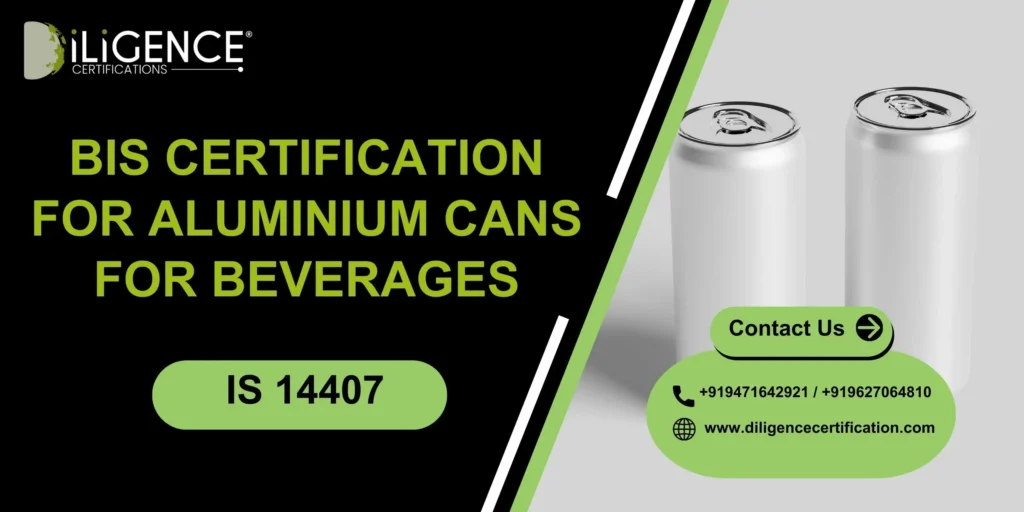
- IS 14407 specifies the requirements of material, coating, and dimensional for ALUMINIUM CANS FOR BEVERAGES.
- Ensures that only food-grade aluminum is used and that internal lacquers are safe to prevent possible contamination.
- Cans are to be tested for leakage, pressure, and corrosion in laboratories approved by BIS.
- The manufacturing process needs to maintain the quality of products along with proper marking and is traceable.
- The BIS-certified cans bear the ISI Mark, which indicates safety and is within the ambit of Indian standards.
Introduction
BIS Certification of ALUMINIUM CANS FOR BEVERAGES-IS 14407.The BIS Certification of Aluminium Cans of Beverage Packaging-IS 14407 attempted to cover that aluminium cans, used for packing beverages like carbonated beverages, juices, energy drinks, and other beverages, will cover important requirements concerning safety, hygiene, and performance characteristics. Coming into direct contact with liquids that are consumable, important characteristics of these cans include material quality, interior coating, and resistance against mechanical strengths. The Indian Standard IS 14407, formulated by the Bureau of Indian Standards, needs specifications concerning Aluminium quality, Protective coatings, Dimensions, and Test methods.
What is IS 14407?
IS: 14407 is an Indian Standard that is published by the Bureau of Indian Standards (BIS) to define the technical specifications of aluminium cans that are used as packaging containers for beverages. This standard lays down aluminium material, internal lacquer coating, dimensional, mechanical strength, and performance specifications to make the containers safe for direct contact with liquids. The standard also includes other compulsion tests like leak testing, press-resistant testing, coating condition testing, and corrosion resistance testing, with the aim of making the aluminium beverage cans safe for storing both carbonated and non-carbonated drinks without interfering with their safety and quality. IS 14407 certification ensures the purity, strength, and usability of aluminium beverage cans in the Indian market.
Key Points:
- This is the Indian standard specification for aluminium cans that are used to pack beverages.
- “It defines the quality of the material and the internal food grade coat to prevent contamination,”
- It provides dimensional and construction specifications for the cans to ensure they are safe and uniform.
- It must involve a leak test, pressure test, and corrosion resistance test.
- The compliance process makes sure that the cans are safe, strong, and appropriate for storing carbonated and non-carbonated substances.
Why is BIS Certification Mandatory
BIS Certification Under IS 14407 is imperative to ensure that aluminium beverage cans are safe, hygienic, and reliable enough to pack liquids that can be consumed by human beings. As aluminium cans are used to pack liquids that come into direct contact with human consumers, any sub-quality material used could result in increased chances of contamination, leakages, or chemical reactions that can impact the drinking quality of the substance. BIS Certification makes it imperative that only food-grade aluminium is used along with approved lacquers to pack products within aluminium cans that can be sold in the Indian marketplace.
Key Reasons:
- It ensures the use of food-grade aluminium and food-safe coatings for drink cans.
- This will protect from contamination, leakage, and reaction with the liquid.
- It ensures quality and performance testing in BIS-approved laboratories.
- It also implements standardized production, identification, and trackability.
- Consumer health and product safety are protected.
Importance and Benefits of BIS Certification
| Importance | Benefits |
| Guarantees the safety of drinks as well as drink hygiene by regulating the material properties as well as the coating. | Increases consumer confidence in packaged drinks. |
| Prevents chemical contamination of aluminium and beverages. | Helps minimize product reject and product leakage. |
| Ensures the quality of the cans is of a similar standard. | Improves Market Acceptance & Brand Awareness. |
| It protects public health through the enforcement of stringent testing requirements. | Promotes longer shelf life and prevents product damage. |
| Enables regulatory compliance when selling beverage cans in India. | Gives manufacturers the competitive edge through ISI Marking. |
Step-by-Step Process of BIS Certification
Step1:Documentation
- Collect required technical documents
- Prepare product specifications
- Gather company registration details
- Ensure documents follow BIS format
Step2:Product Testing
- Send samples to a BIS-approved lab
- Conduct safety and quality tests
- Receive test reports
- Confirm compliance with BIS standards
Step3:Application Submission
- Fill out the BIS application form
- Upload all required documents
- Attach valid test reports
- Pay the necessary BIS fees
Step4:Scrutiny and Inspection
- BIS reviews submitted documents
- Authority verifies test results
- Factory/product inspection may occur
- Clarifications requested if needed
Step5:Grant of License
- BIS approves the application
- License number is issued
- Product can carry BIS mark
- Renewal required before expiry
Documents Required for BIS Certification
| Category | Documents Required |
| Business Documents | Business license/registration, ISO certificate, organizational details |
| Manufacturer Details | Factory layout, process flow chart, machinery list, production details |
| Product Documents | Product specifications, component list, user manual, model details |
| Testing Documents | Test report from BIS-recognized lab, sample details, test request form |
| Legal & Compliance | Authorization letter, brand ownership proof, trademark certificate (if any) |
| Import/Foreign Manufacturer (If applicable) | AIR (Authorized Indian Representative) details, contract agreement, overseas manufacturer documents |
Timelines, Costs, Validity & Renewal
- Timelines: Usually from 20 to 30 days, with only 7-15 days for the testing.
- Costs: The cost of the government and the test varies depending on the product. There can be some additional charges though.
- Validity: The validity period is 2 years in most situations.
- Renewal: The renewal is done before the expiration; there should be updated documents/tests; the renewal
Why Choose Diligence Certifications
Diligence Certifications is a reliable certification consultant offering expert guidance for certification by the BIS with respect to the standard: IS 14407 for aluminum beverage cans. They have in-depth knowledge of the Indian regulations and assist the manufacturers with certification from the BIS in every step, from documentation and testing to the date of application and ISI marking. This helps the manufacturer in overcoming the certification process conveniently and ensures that the aluminum cans conform to all the necessary standards and safety measures as per the Indian market requirements.
Conclusion
The BIS Certification for Aluminium Cans for Beverages, according to IS 14407, plays an integral role in determining the safety, cleanliness, and quality of the packaged beverages sold in India. The application of stringent norms on the material, coating, and performance criteria for these products prevents the user/consumer from being tainted with the contamination of the unhygienic products. Hence, the need for acquiring the BIS Certification for Aluminium Cans for Beverages, according to IS 14407, has assumed immense significance for any packing manufacturer/supplier.
Frequently Asked Questions (FAQs)
What is IS 14407?
This is an Indian Standard laying down requirements for aluminum containers utilized for the packaging of beverages.
Is it essential for all aluminum cans to be BIS certified?
Yes, Packing of aluminum beverage cans requires BIS certification in India.
What does IS 14407 specify?
The points that are connected with the quality of material, the coating, the size, and the performance are all about the same for containers made of aluminum.
Why is the internal lacquer important?
The internal lacquer assumes great significance because it prevents the reaction of the aluminum and the drink.
What tests are required in IS 14407?
Tests for leakage, pressure resistance, and corrosion are obligatory.
Can carbonated drinks be packaged in IS 14407 cans?
Yes, these cans are for carbonated as well as non-carbonated products.
What mark is given after BIS certification?
They have ISI Marks on them.
What is the issuing organisation for the IS
Certification is issued by the “Bureau of Indian Standards (BIS).”
How long is the duration of the BIS license?
A license is normally valid for a period of two years.”
Why is BIS certification important?
It provides safety, hygiene, and quality of beverage packaging.”