 BIS Certification
 CDSCO
CDSCO
 PESO
PESO
 CPCB
CPCB
 LMPC
LMPC
 WPC Approval
 Global Approvals
 TEC
TEC
 ARAI
ARAI
 BEE
BEE
 ISO Certification
 DGCA Certification
 NOC For Steel
 APEDA Registration























 Business Registration
 FSSAI Mark Certification












 (32).jpg)
 Legal Services
 Trademark Registration
 Copyright Registration
 Patent Registration
 By
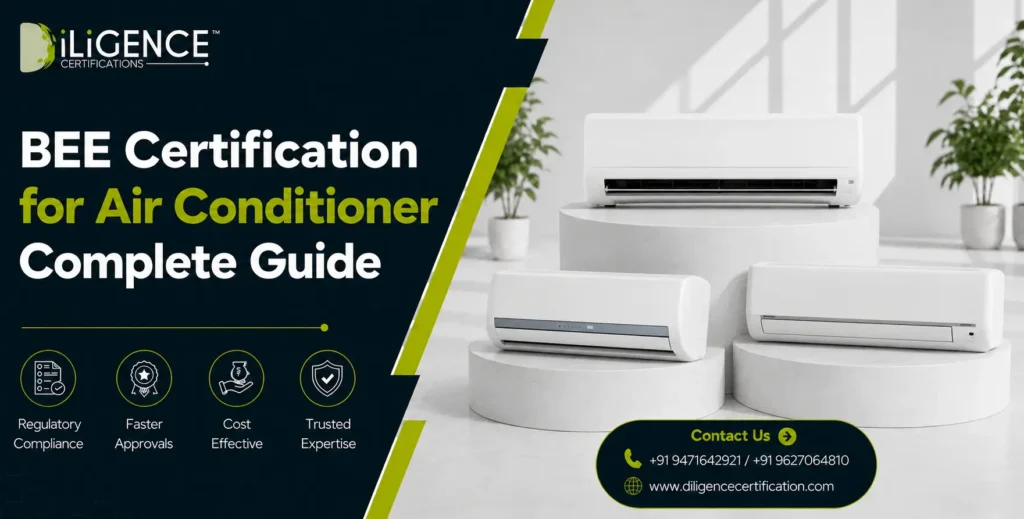
By - BEE certification for air conditioner is mandatory for energy rating and labeling under India’s energy efficiency norms.
- Regulation under the Bureau of Energy Efficiency ensures that air conditioners have a minimum star rating prior to their being sold.
- Air conditioners without a BEE mark cannot be legally sold in India.
Introduction
A shipping company in Mumbai had received a consignment of split air-conditioners from Southeast Asia. The items were functioning properly, were reasonably priced, and were already sold to distributors. However, they remained stuck at the clearing level for weeks.
The issue was not customs duty or documentation errors. The problem was simpler the units had no valid BEE certification for air conditioner labeling.
The importer assumed energy labels could be added locally. That assumption cost him an entire season’s sales cycle.
This is not an isolated case. AC manufacturers and importers across India do not seem to appreciate the stringent nature of India’s energy efficiency regime. Room ACs have to carry mandatory labels issued by the Bureau of Energy Efficiency (BEE) under the Ministry of Power before entering the market.
Understanding this system is not optional anymore-it is a market entry requirement.
What is BEE Certification for Air Conditioner?
The BEE rating of air conditioners is a standard system for energy efficiency rating whereby ACs are rated according to their power consumption rating.
The process is regulated by the Bureau of Energy Efficiency operating under the Ministry of Power in the Government of India.
The certification ensures:
- ACs consume less electricity for cooling output
- Consumers get transparent energy performance data
- Manufacturers improve product efficiency over time
In simple terms, no BEE label means no legal sale in India’s retail or e-commerce market.
Why BEE Certification for Air Conditioner is Mandatory
India’s air conditioning demand is rising rapidly due to climate conditions and urbanization. Without regulation, electricity consumption from cooling systems would strain the national grid.
The BEE certification framework solves this by:
- Standardizing energy consumption benchmarks
- Controlling inefficient product entry into the market
- Helping consumers compare AC models easily
- Reducing long-term electricity load on the grid
For manufacturers and importers, compliance is not optional. Retailers like Amazon, Flipkart, and offline chains will reject non-compliant products.
Step-by-Step Process of BEE Certification for Air Conditioner
1. Product Testing in NABL-Approved Lab
AC units must undergo performance testing in accredited laboratories. Parameters include:
- Cooling capacity
- Power consumption
- Seasonal efficiency
2. Technical Documentation Submission
Manufacturers submit:
- Product specifications
- Factory details
- Model variants
- Energy performance data
3. Registration on BEE Portal
Each model is registered individually on the BEE labeling platform.
4. Label Design Approval
Energy labels must follow strict design guidelines issued by BEE.
5. License Issuance
Once verified, BEE issues certification allowing labeling and sale.
Documents Required for BEE Certification for Air Conditioner
The documentation stage is one of the most critical parts of the BEE certification for air conditioner process. In most cases, approvals are delayed not because of technical failure, but due to incomplete, inconsistent, or improperly structured paperwork.
The Bureau of Energy Efficiency demands verified proofs for the identification of the product, its manufacture and energy efficiency from each applicant, whether manufacturer, importer or OEM brand.
The list below includes a brief overview of each document required to be submitted.
1. Company Incorporation Certificate
This document establishes the legal identity of the applicant company.
It confirms:
- The business is legally registered
- The entity is authorized to operate in India
- The applicant name matches compliance records
For importers, this ensures the entity responsible for market distribution is officially recognized.
2. GST Registration Certificate
GST registration validates the tax identity of the company operating in India.
It is required to:
- Verify business legitimacy
- Link product sales to tax compliance
- Ensure traceability of commercial transactions
3. Product Technical File
This is the most important document in the BEE certification for air conditioner process.
It includes:
- Product specifications (tonnage, compressor type, refrigerant)
- Design drawings or technical sheets
- Energy consumption details
- Model variants and configurations.
4. ISO Certifications (If Applicable)
ISO certifications, such as ISO 9001 or ISO 14001, are not always mandatory but strengthen application credibility.
They indicate:
- Quality management systems in manufacturing
- Environmental compliance practices
- Standardized production processes
5. Test Reports from Accredited Laboratories
This is a mandatory technical requirement.
Reports must be issued by NABL-accredited laboratories and include:
- Cooling performance data
- Power consumption metrics
- ISEER calculation results
- Environmental testing parameters
6. Authorized Signatory Details
This document identifies the person legally responsible for submitting and managing the application.
It includes:
- Name and designation of authorized person
- Identity proof (as required)
- Company authorization letter
7. Manufacturing Plant Information
This is required to verify production capability.
It includes:
- Factory address and location details
- Production capacity
- Manufacturing process overview
- Quality control systems
Cost of BEE Certification for Air Conditioner
The fee that would be incurred in registering an air conditioner under BEE Certification is not constant. This fee is subject to change based on the scale of the business, the complexity of the product, and the compliance strategy adopted by the manufacturer or importer of the product.
From a practical point of view, small-scale businesses incur less fees per model while larger organizations enjoy economies of scale. However, importers have some hidden costs that they may not have thought about. The most prevalent cost in terms of BEE Certification is the cost of retesting due to changes in the design, wrong documentation, and misclassification of models in the certification process.
This is one of the costs that would make both the process lengthy and costly. Overall, the compliance cost should be seen as both the fee paid as well as the cost incurred indirectly.
Validity and Renewal Rules in BEE Certification for Air Conditioner
However, the certification of the BEE for an air conditioner is not a once-for-all process. In fact, it is a process that keeps changing in order to ensure that the air conditioners comply with the set regulations of energy efficiency in the country.
This is because there is need to keep updating the certification through maintenance or even revalidation.
1. Validity Period: Why BEE Certification is Time-Bound
The validity of BEE certification for air conditioners generally ranges between 1 to 3 years, depending on the specific notification cycle issued by the Bureau of Energy Efficiency.
The variation in validity depends on:
- Updates in star rating norms
- Introduction of revised ISEER benchmarks
- Changes in seasonal testing methodology
- Category-specific efficiency revisions
2. Renewal Requirement: When and Why It Becomes Mandatory
Renewal of BEE certification for air conditioner is required when:
- The validity period ends
- BEE introduces revised labeling standards
- Star rating thresholds are updated
- The product is reintroduced in a new regulatory cycle
Renewal is not a simple extension. It often involves:
- Updated documentation submission
- Fresh compliance verification
- Revised energy label approval
3. Re-Testing Rules: When Product Changes Trigger Fresh Evaluation
Re-testing becomes mandatory when there are significant modifications in product design or performance characteristics.
Common triggers include:
- Change in compressor type or brand
- Modification in cooling capacity (tonnage adjustment)
- Upgrade from non-inverter to inverter technology
- Structural redesign affecting airflow or energy consumption
- Change in refrigerant type
4. Regulatory Updates: Why Compliance is Continuous
India’s energy efficiency framework is dynamic. The Bureau of Energy Efficiency frequently revises standards to align with:
- National energy conservation goals
- Climate conditions and peak load demand
- Technological advancements in HVAC systems
- Global efficiency benchmarks
5. Business Impact of Renewal and Validity Cycles
For manufacturers and importers, these rules directly influence:
- Product launch planning cycles
- Inventory management strategies
- Pricing and marketing timelines
- Seasonal availability (especially summer demand peaks)
A missed renewal window can result in:
- Temporary suspension of sales
- Delisting from e-commerce platforms
- Disruption in distributor supply chains
Common Mistakes in BEE Certification for Air Conditioner
There are several companies that face challenges in securing certification from the Bureau of Energy Efficiency for their air conditioners due to compliance errors that could have easily been avoided.
The following section presents a comprehensive analysis of some of the common errors and the effects that they have on the BEE certification process.
1. Submitting Outdated Test Reports
One of the most common reasons for rejection is the use of expired or non-valid test reports.
BEE certification requires performance data from NABL-accredited laboratories that reflect the current design of the product. However, companies often submit:
- Reports from older product versions
- Test results from pre-upgraded compressor models
- Reports generated under previous efficiency standards
This creates a mismatch between actual product specifications and declared performance data.
2. Incorrect Model Grouping
Model grouping is often misunderstood in the BEE certification for air conditioner process.
Manufacturers sometimes attempt to combine multiple AC variants under a single registration to reduce cost and paperwork. This works only when models share identical:
- Cooling capacity range
- Compressor type
- Energy consumption profile
- Technical configuration
Errors occur when:
- Inverter and non-inverter models are grouped together
- Different tonnage units are combined under one label
- Cosmetic variants are treated as identical technical models
3. Mismatch in Energy Label Design
Energy labels are strictly regulated under BEE guidelines.
A frequent error occurs when the submitted label does not match:
- Approved star rating data
- Font size and layout specifications
- Colour coding requirements
- Model identification details
Some companies design labels for marketing appeal rather than regulatory compliance. This leads to inconsistencies during verification.
4. Ignoring ISEER Calculation Standards
The Indian Seasonal Energy Efficiency Ratio (ISEER) is the core metric used for AC classification.
Errors arise when:
- Internal engineering teams use incorrect seasonal assumptions
- Foreign test reports use non-Indian rating standards
- Conversion between EER and ISEER is miscalculated
- Data rounding is done incorrectly
Since BEE uses India-specific climate data, imported assumptions often fail validation.
5. Launching Products Before Certification Approval
Many businesses make the strategic mistake of launching products while the BEE certification for air conditioner is still under review.
This typically happens when:
- Marketing timelines are fixed in advance
- Distributor commitments are already made
- Inventory is pre-positioned in warehouses
However, BEE certification must be approved before any public sale or listing.
Why Choose Diligence Certification?
The choice of a compliance partner goes beyond the mere issue of documentation and influences product launch schedules, regulatory risk, and readiness to enter the market. Diligence Certification helps the manufacturer/importer/brand through systematic and comprehensive assistance in obtaining BEE certification for air conditioners and other approvals in India.
1. End-to-End Compliance Handling
From product classification to final label approval, the entire BEE process is managed without fragmented coordination between labs, portals, and authorities.
2. Faster Approval Cycle Management
Documentation errors and retesting delays are minimized through pre-verification of technical files before submission.
3. Strong Technical Documentation Support
Assistance in preparing Device/Model Technical Files, energy performance records, and labeling artwork as per BEE norms.
4. Reduced Rejection Risk
Applications are structured to align with current BEE guidelines, reducing the chances of query generation or rejection.
5. Experience Across Energy Compliance Domains
Beyond ACs, support extends to appliances under multiple energy efficiency categories regulated in India.
6. Coordination with Accredited Labs
Coordinating tests with accredited labs under the NABL scheme saves time during sample submission and reporting.
7. Compliance with Changes
Updates in BEE, Star Rating Scheme, and changes in policies are recorded for maintaining compliance during the process.
8. Time and Cost Saving
No need for retests or correction of paperwork, which results in reduced certification cost.
9. Dedicated Compliance Guidance
Clear advisory support for manufacturers and importers entering the Indian appliance market for the first time.
10. Structured Application Strategy
Each case is handled with a compliance roadmap tailored to product category, reducing uncertainty in approval timelines.
Conclusion
The BEE certification for air conditioner is not just a regulatory checkbox. It defines whether a product can legally exist in India’s cooling market.
Those who take it as an integral part of their product strategy and not a regulatory requirement generally manage to stay away from delays, penalties, and market entry problems.
Manufacturers and importers and brands looking to expand into India will greatly benefit by aligning themselves with the BEE requirements beforehand.
If the approach to compliance is still reactive, this is generally where the supply chains begin to slow down.
frequently asked question
BEE certification of an air conditioner means what?
It refers to a mandatory certificate of energy efficiency granted by the Bureau of Energy Efficiency which rates AC on basis of power consumption
Is it mandatory to have BEE certification for selling air conditioner in India?
Yes. Without having proper BEE certification, it is illegal to market or sell any air conditioner in India
By whom BEE certification is issued?
The BEE certification is issued by the Bureau of Energy Efficiency, Ministry of Power.
For how long the BEE certification remains valid?
Validity of BEE certificate generally lasts for 1 to 3 years according to recent regulatory amendment cycle.
What is the testing requirement of BEE certification?
Testing of performance includes testing of cooling capacity, power consumption, and ISEER efficiency in NABL accredited laboratories.
Are imported air conditioners able to be sold without BEE certification?
Absolutely not. Imported air conditioners are subject to BEE labeling regulation too.
How long does the certification process last?
It usually takes 3-6 weeks
What is ISEER in AC rating?
ISEER is an Indian Seasonal Energy Efficiency Ratio which measures cooling efficiency in various climatic zones of India.
Can one BEE label be applied to several models of AC?
Yes, but only if those models have similar technical specifications.
What will happen if the product is not certified?
There can be serious consequences such as penalties, recall of the products from the market and rejection from large retailers and online stores