



 BIS Certification
 CDSCO
CDSCO
 CPCB
CPCB
 LMPC
LMPC
 WPC Approval
 Global Approvals
 TEC
TEC
 ARAI
ARAI
 BEE
BEE
 ISO Certification
 DGCA Certification
 NOC For Steel










 Business Registration













 Legal Services
 Trademark Registration
 Copyright Registration
 Patent Registration
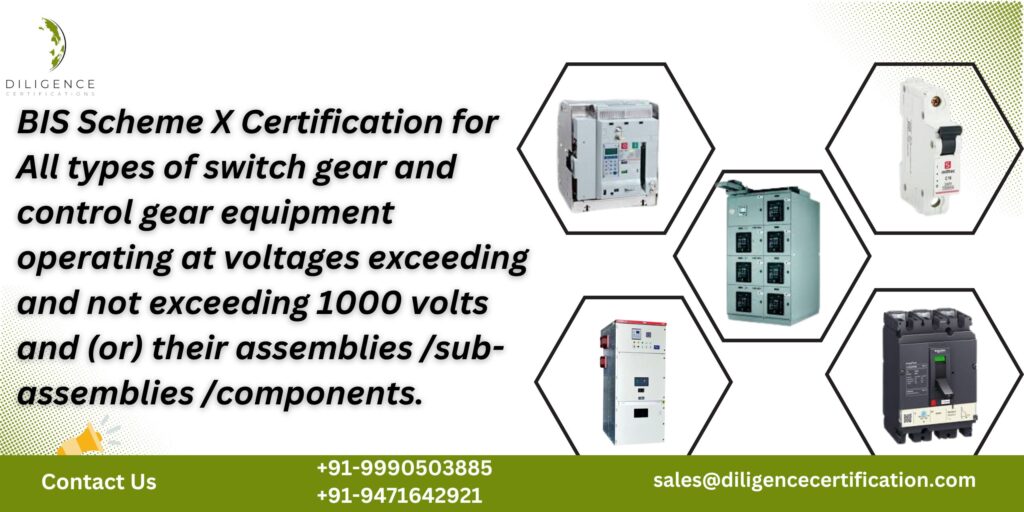
- BIS certification for switchgear confirms that products meet Indian safety and quality standards, so they can be legally sold in India.
- Low-voltage (LV) and high-voltage (HV) switchgear are required to be BIS certified under relevant Quality Control Orders, and Scheme X.
- BIS certification requires testing, audits of the manufacturing facility, documentation (which is largely manual), and the end product is also marked with the ISI logo.
- Licensed products will receive faster approval in tenders and have a reduced risk of rejection.
- BIS approval delays happen primarily as a result of insufficient documentation or the incorrect mapping of standards.
Introduction
The electrical safety and standardization segment gives a very important role to the switchgear and control gear equipment in the control and protection of electrical systems in the residential, commercial, and industrial fields. To certify that these important types of equipment meet safety, performance, and quality criteria, the Bureau of Indian Standards (BIS) has made certification mandatory under its product certification scheme. Regardless of whether it be low-voltage systems operating below 1000 volts or high-voltage setups over 1000 volts, the BIS certification for switchgear in India is essential for compliance, credibility, and access to the markets.
The following is a guide to everything about BIS certification for switchgear equipment including its importance, scope, process, required documents, cost factors, and the company’s efficiency in journey streamlining: Diligence Certification.
What are Switch Gear and Control Gear?
A switchgear is an electrical device used to switch, isolate, protect, and control electrical circuits and associated equipment. Circuit breakers, contactors, relays, disconnectors, load switches, fuses, and combinations of these devices are some examples of the switchgear.
The control gear is considered to be equipment used in controlling the operation of electrical loads, particularly motors and even industrial machines. These control gear systems are often integrated into switchboards, panels, or enclosed assemblies.
The switch gear, according to the working voltage, is mainly classified into:
Low voltage switch gear: Operating at a voltage not exceeding 1000V.
High voltage switch gear: Operating at voltage exceeding 1000V.
Both these categories and their components, assemblies, and sub-assemblies come under the mandatory certification of the Bureau of Indian Standards.
BIS Certification for Switch Gear – Why Is It Required?
To provide safety and reliability, the BIS certification for different categories of electrical products is made compulsory by the Government of India through the Compulsory Registration Scheme (CRS) and the ISI Mark Certification Scheme. Switchgear equipment, which is electrical protection and control equipment, must satisfy the Indian Standards (IS) laid out by BIS. In this regard, non-compliant switchgear will either be rejected for import, withdrawn from the domestic market, or face the imposition of penalties in terms of law.
The following are some of the major reasons why switchgear must be BIS-certified:
- – Electrical safety compliance: It lowers the risk of fire, shock, or short-circuits.
- – Market authorization: For sale or distribution on the Indian market.
- – Product reliability: Conformance with IS standards would inspire confidence from the customer.
- – Regulatory obligation: Required by law from domestic manufacturers and importers.
Types of Switch Gear Under BIS Certification Scope
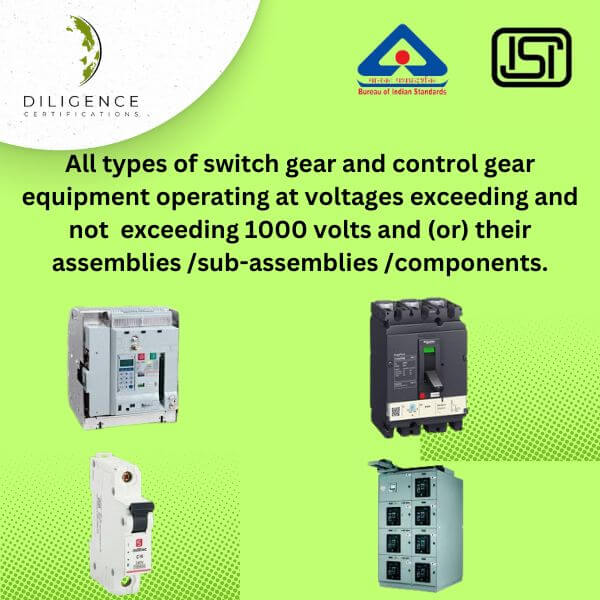
BIS certification covers all types of switch gear and control gear equipment, irrespective of voltage class or usage type. This includes:
1. Low Voltage Switch Gear (≤1000V)
- Miniature Circuit Breakers (MCBs)
- Molded Case Circuit Breakers (MCCBs)
- Residual Current Devices (RCDs)
- Low-voltage switchboards and panels
- Load break switches
- Control relays and contactors
- Fuses, isolators, and sub-assemblies
2. High Voltage Switch Gear (>1000V)
- Vacuum Circuit Breakers (VCBs)
- Gas Insulated Switchgear (GIS)
- High-voltage disconnectors
- Surge arresters
- Instrument transformers
- Control gear for HV applications
- Assemblies for sub-station integration
BIS Certification Schemes for Switch Gear
Depending on the type of product and the manufacturing set-up, BIS provides certification under different schemes:
1. ISI Mark Scheme (Domestic Manufacturers)
Under this scheme, domestic manufacturers must obtain the ISI licence and place the Standard Mark (ISI logo) on their switchgear equipment. The scheme covers:
- Factory inspections
- Product testing
- Surveillance audits
2. Foreign Manufacturer Certification Scheme (FMCS)
Overseas manufacturers intending to export switchgear to India have to obtain a BIS license under FMCS. The scheme provides for:
- Nominating an Authorized Indian Representative (AIR)
- Pre-licensing inspection by BIS officials
- Shipment of samples to Indian labs for testing
- Regular audit and surveillance of samples
BIS Certification Process for Switch Gear
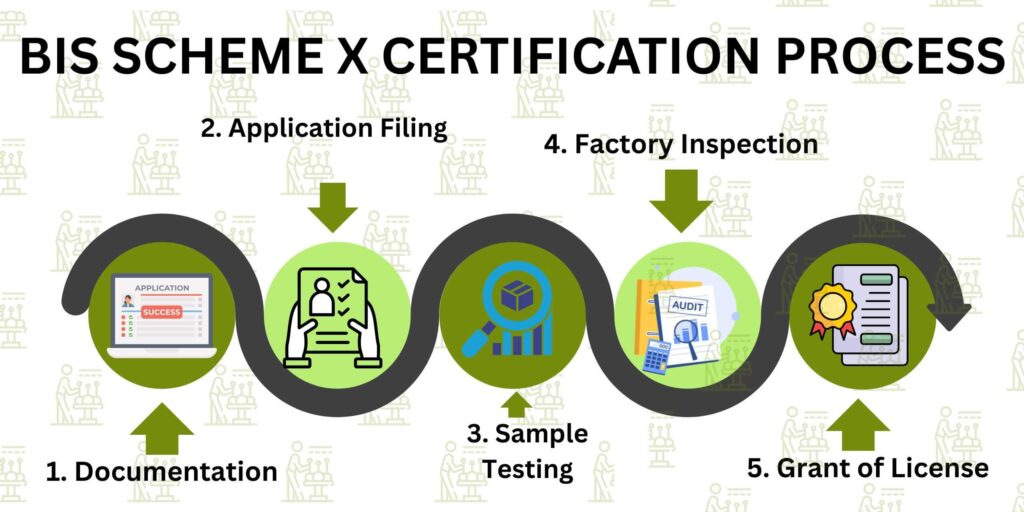
The BIS certification procedure for switchgear encompasses several important steps:
Step 1: Product Identification
Identify the exact category, voltage class, and standard applicable for the switchgear product.
Step 2: Document Preparation
- Prepare documents comprising
- Product specification sheet
- Manufacturing process flow
- Factory layout
- Quality control procedures
- Testing reports (if any)
- ISO certificates (if any)
Step 3: Application Submission
Fill your application on the BIS Portal either under ISI or FMCS as per the geographical location of the manufacturer.
Step 4: Sample Testing
Samples will be drawn either from the factory or the warehouse and tested at BIS-approved laboratories.
Step 5: Factory Audit
Factory audit will be conducted by BIS officials for infrastructure, QC processes, and test facilities.
Step 6: Granting Certification
After satisfactory results from testing and inspection, BIS grants approval in the form of a license for affixing the ISI mark.
Step 7: Post-Certification Surveillance
This shall cover regular audits, market surveillance, and periodic product testing.
Who Actually Needs the Licence?
Not everyone in the value chain needs their own BIS licence—but misunderstandings here delay tenders.
Manufacturers (Domestic)
If you manufacture finished switchgear assemblies or core devices covered by a notified IS and sell in India, you need active BIS certification for switchgear in your own name.
Foreign Manufacturers Exporting to India
Each legal manufacturing location must obtain a separate licence under the appropriate route (FMCS / Scheme X) to supply BIS‑marked goods. An Authorised Indian Representative (AIR) is mandatory. Without it, no valid BIS certification for switchgear applies to imports.
Brand‑Label / Private Label Deals
White‑labelling is not permitted under QCO frameworks. The actual manufacturer must hold the licence; the brand may be listed, subject to BIS inclusion rules. Always verify licence scope covers your labelled model before claiming BIS certification for switchgear.
System Integrators / Panel Builders
If you buy certified devices but fabricate custom panels, check whether the assembly standard itself is notified. If yes, you—the fabricator—need BIS certification for switchgear for the assembled panel, not just device certificates in the BOM.
Documents Required for BIS Certification
Key documents include:
- Business registration/license
- List of machinery and manufacturing equipment
- Internal quality control manual
- Product test reports (in-house/preliminary)
- Factory layout and production flowchart
- Authorized Indian Representative (AIR) agreement (for foreign entities)
Cost of BIS Certification for Switchgear
The cost of BIS certification for switchgear depends on several factors, such as:
- Type of switch gear (LV or HV)
- Number of models/variants
- Factory location (domestic or foreign)
- Lab testing charges
- BIS application and audit fees
- Consultant fees (if applicable)
Role of Diligence Certification in BIS Compliance
Diligence Certification serves as a professional resource for manufacturers and importers who want to obtain BIS certification for switchgear smoothly and quickly. Here’s how they provide value:
Gap Analysis / Product Mapping – Understanding precisely which IS/IEC standards (e.g., 60947, or 62271) you need to comply with for your switchgear products, and outlining your compliance gaps.
Documentation Support – Assisting with your technical files, BOM, QA procedures and drawings to ensure BIS submission is complete and accurate.
Testing Coordination – Engaging with BIS-accredited laboratories to schedule and manage type testing to save time and avoid unnecessary repeat testing.
Application and Audit Management – Filing your Manakonline application, engaging with BIS officers and preparing your plant for factory audits.
Variation and Scope Management – Supporting your inclusion of new product variants, kits of accessories, or upgrades under an existing BIS licence.
Surveillance and Verification – After your certification, they will manage your verification audits, document updates, and license renewals as needed.
Conclusion
The electrical infrastructure and automation systems of India have built up a demand base for high-quality, safe, and standardized switchgear equipment. It is now no longer optional but a statutory and competitive mandate for switch gear to have BIS certification. Whether for low-voltage panels or high-voltage breakers, BIS should be the one-stop gateway for the Indian market to offer a BIS certification seal on the product for guaranteed safety and performance levels.
Along with Diligence Certification, your trusted compliance partner, your path to hassle-free BIS certification is made smooth.
Frequently Asked Questions
What is BIS certification for switchgear?
It’s a licence granted by BIS to demonstrate that the switchgear is compliant with Indian Standards such as IS/IEC 60947 or 62271.
Is BIS certification mandatory for all sorts of switchgear?
Yes, if the product falls under Quality Control Orders or Scheme X of the Ministry of Heavy Industries.
What products are subject to BIS switchgear certification?
LV circuit breakers, contactors, MCBs, MCCs, HV GIS and metal clad switchgear.
How long does it take to get BIS certification?
On average 2-3 months for domestic manufacturers 3-6 for foreign plants.
What documents are required for BIS certification?
Technical drawings, test reports, QA documentation, Bills of Materials, Factory Licences.
Which are the main Indian Standards for switchgear?
For switchgear the main Indian Standards are the IS/IEC 60947 Series (LV) and IS/IEC 62271 (HV) Series.
Can imported switchgear be sold without BIS certification?
No, imports require BIS certified product with active licence.
What are the penalties for selling non-certified switchgear?
Fines, seizures of products you know several prosecutions under the BIS act.
How does the BIS mark get applied?
The ISI mark and the licence number, IS standard details must be on the products.
Does BIS certification need renewal?
Yes, it is valid for 2 years and must be renewed with updated test data.