



 BIS Certification
 CDSCO
CDSCO
 CPCB
CPCB
 LMPC
LMPC
 WPC Approval
 Global Approvals
 TEC
TEC
 ARAI
ARAI
 BEE
BEE
 ISO Certification
 DGCA Certification
 NOC For Steel
 APEDA Registration
















 Business Registration
 FSSAI Mark Certification












 Legal Services
 Trademark Registration
 Copyright Registration
 Patent Registration
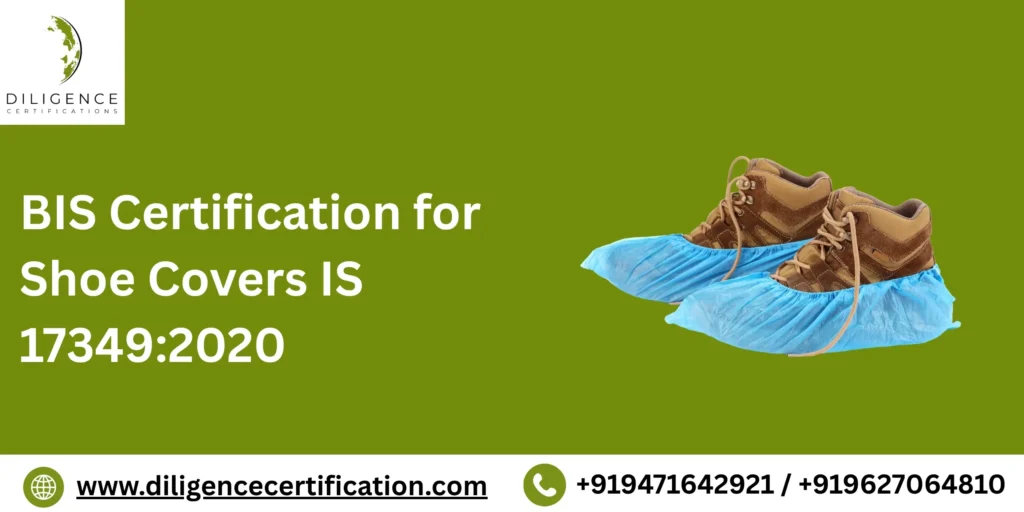
- BIS Certification Shoe Covers under IS 17349:2020 ensures compliance with medical textile safety and quality standards.
- This guide explains the certification process, mandatory documentation, and how expert BIS consultants simplify your journey.
- Stay compliant and competitive in India’s healthcare manufacturing sector.
- Manufacturers must undergo a factory inspection, product testing, and obtain a valid ISI Mark Licence from the Bureau of Indian Standards (BIS).
Introduction

A leading PPE exporter from Ahmedabad recently approached our BIS Certification Consultant team after nearly losing a deal with a reputed hospital chain. Their bulk supply of disposable shoe covers lacked the mandatory BIS Certification under IS 17349:2020. Without this compliance, their products were rejected at the final procurement stage.
This isn’t an isolated incident. With the Bureau of Indian Standards tightening checks on medical textile products like shoe covers, BIS Certification has become a non-negotiable compliance requirement in 2025.
Understanding IS 17349:2020 – Shoe Covers and Their Importance
Dirt, debris, and microorganisms should not enter clean environments. One of the most important tools for achieving this is shoe covers-they protect clean places from external contaminants. The Indian Standard IS 17349:2020 specifies guidelines for manufacturing and testing shoe covers. This blog will give an in-depth explanation of the importance of this standard, various possible tests conducted for shoe covers, essential documents required, apparatus that would be needed, and the materials to be used in the process.
What is BIS Certification for Shoe Covers?
BIS certification for shoe covers is compulsory quality certification under IS 17349:2020 for non-woven disposable shoe covers used in medical use, cleanroom, and hygiene settings. It is a certification that ensures the product is compliant with Indian standards for safety, durability, water penetration and tear strength.
This certification comes under the ISI Mark Scheme of the Bureau of Indian Standards (BIS), which requires manufacturers to undergo and pass inspections of the factory, evaluations of products, and quality audits.
Why BIS Certification is Mandatory for Shoe Covers?
- Regulatory compliance: BIS mandates this under the QCO (Quality Control Order) for medical textiles.
- Procurement requirement: Government and private hospitals now require ISI-marked PPE products.
- Market access: Without the ISI mark, manufacturers cannot sell shoe covers in the Indian market.
Who Needs BIS Certification Shoe Covers?
This certification is required for:
- Manufacturers of disposable/non-woven shoe covers
- OEMs supplying to hospitals, pharma, cleanrooms
- Exporters looking to enter or continue in the Indian market
“Many clients wrongly assume exports are exempt. If your product lands in India, certification is non-negotiable.” – Diligence Certifications
What is IS 17349:2020?

IS 17349:2020 outlines the specification for shoe cover requirements in different environments including hospitals, laboratories, and food processing units. This standard specifies effective shoe covers for preventing contamination in critical places, which are safer for use in a critical environment along with their materials used and known to be compliant with health and safety regulations, ensuring a healthy work environment.
IS 17349:2020
IS 17349:2020 is the Indian Standard for Non-Woven Shoe Covers – Specification, formulated by BIS.
Key Parameters Tested:
- Tensile strength of material
- Water repellency and resistance
- Seam integrity
- Material thickness and GSM (grams per square meter)
- Tear resistance
The shoe covers must be designed to prevent contamination, offer barrier protection, and retain structural integrity in sterile environments.
“Think of it like certifying a parachute before a jump. The smallest flaw can compromise safety.” – A leading BIS Certification Consultant
Importance of Shoe Covers
Shoe covers are very important for:
1. Infection control
In a healthcare facility like a hospital or clinic, every one of them needs shoe covers as part of infection control. This is to prevent the means of spread of pathogens through shoes that usually carry harmful bacteria and viruses. This reduce the chances of getting an infection from medical staff, normally referring to surgical and critical care hospital wards.
2. Contamination Control
Shoe covers have maintained the sterile conditions of cleanrooms and environments of pharmaceutical manufacturing and food processing facilities. They serve as preventive means of transferring dust and dirt and/or microbes from shoes to sensitive locations, which eventually affects product integrity and quality.
3. Safety and Compliance
Contents such as IS 17349:2020 put forth standards to obtain regulatory requirements for hygiene and safety. Compliance to such standards shows an organization as investing not just in safety but also underlines good setups in quality environments that gain reputation and customer trust.
Tests for Shoe Covers
Various tests can be performed to assess the quality and performance . Some of the tests that can be conducted within a day are described hereunder:
1. Physical Properties Test
It checks dimensions, weight, thickness, etc., to ensure meet all requirements. The precise measurement ensures proper fitting and working functionality.
2. Water Resistance Test
This test measures the level of water penetration resistance from a material, particularly in locations prone to spills or splashes. That tells how much better the shoe cover protects the wearer and the environment from liquid contamination.
3. Tensile Strength Test
This test determines the durability of the shoe covers by measuring the amount of force the material can withstand before breaking. Very high tensile strength is required to keep shoe covers from tearing during usage and thus keep providing protection.
4. Puncture Resistance Test
The puncture resistance test determines whether the shoe covers would get damaged from sharp objects brought into second activities. Puncture resistance is important because sharp objects or sharp debris may be in the same environment as the user.
5. Chemical Resistance Test
Chemical resistance is assessed on a plethora of chemicals found in laboratories or chemical processing environments: one of the most important tests for shoe covers used in such environments. Heavy influence on the results of this assessment test is the exposure to the different chemicals without yielding degradation.
6. Microbial Resistance Test
To what extent do they resist the growth of various bacteria and other microorganisms? Resistance to microbial growth could be a significant possibility in areas such as healthcare and food processing, which is quite sensitive to contamination.
7. Static and Dynamic Friction Tests
The importance of testing the friction properties for shoe covers is to ensure that they grip well enough not to allow slipping and/or falling, especially on surfaces exposed to wetness or located in slippery conditions.
Step-by-Step Process for BIS Certification of Shoe Covers
Step 1: Application Submission
File Form V along with product specifications, test reports, and documents via the BIS portal.
Step 2: Factory Audit by BIS Officer
Includes:
- Review of manufacturing setup
- Quality control protocols
- Raw material storage and traceability
Step 3: Sample Collection and Testing
BIS-approved labs will test your samples for IS 17349:2020 conformity.
Step 4: Grant of Licence (ISI Mark)
If compliant, BIS will issue a CM/L (Certification Marks Licence).
Step 5: Marking
ISI logo must be affixed clearly on the packaging and product label.

Documentation Requirements
This includes product specifications, as required by IS 17349:2020:
1. Specifications of Products
Specifications are necessary to describe the shoe covers, i.e., their materials, dimensions, and intended uses. This would help ascertain whether the product qualifies.
2. Test Reports
Record of all tests carried out to substantiate compliance with the standard. Reports show how the shoe covers performed in key areas.
3. Manufacturing Process Flow
Describes a production process with quality controls at each step. Such documentation is important in identifying the contamination points during manufacture.
4. QA Procedures
Any measures taken to guarantee the quality and conformity of a product including regular inspection procedures, training of employees, corrective actions, etc.
5. Compliance Certificates
Certificates from testing laboratories confirming the conformity of shoe covers according to IS 17349:2020 and other applicable standards.
Specialist equipment for testing shoe covers includes:
1. Tensile testing machine – a test machine applied from one end to the other until rupture occurs through applying a force to the material fabric cover of shoes. Then that gives very important information on the durability in terms of tensile strength and elongation.
2. Puncture testing equipment – Direct assessment of the resistance of the material to puncture when the conditions leading to punctures are simulated for a particular duration during use.
3. Water penetration tester – The water permeability using this type of testing equipment is subjected under conditions that are equivalent to exposure to the shoe covers with liquids. It would evaluate how the shoe covers with liquids prevent water from going through them.
4. Chemical Resistance Testing Apparatus – Simulating the exposure of these materials to various chemicals helps to evaluate the way the materials stand up against whatever toxic chemical may penetrate through the surface.
5. Microbial testing kits – famous kits for such testing, as they require such assessment as important for evaluating how shoe covers could compare when it comes to preventing the growth of bacteria as well as fungi being introduced.
6. Friction Testing Apparatus – This will try to check the static and dynamic properties of friction of the shoe covers in order to provide such grip in many environments where the shoe is worn.
Cost, Validity, Renewal & Eligibility
Cost of BIS Certification for Shoe Covers
The total cost may vary depending on factory size, testing requirements, and consultant services.
Validity of BIS Certification
A BIS Licence for shoe covers is valid for 2 years, provided all compliance requirements are maintained.
Renewal Process
Renewal is allowed every 2 years by submitting updated documents, paying fees, and ensuring the product still conforms to IS 17349:2020.
Who is Eligible?
- Indian manufacturers
- Foreign manufacturers exporting to India
- OEMs producing shoe covers for medical, pharma, or cleanroom use
Materials used in manufacturing Of Shoe Covers
Different kinds of materials from which shoe covers can be made, depending on the way they are to be used. Such materials include:
1. Polypropylene
Lightweight and breathable, it is often used for general-purpose shoe covers. It is very cost-effective so it is being used in various industries.
2. Polyethylene
Provides good water resistance, so it is suitable for use in a damp environment. Most often widely used for food processing and healthcare settings.
3. Vinyl or PVC
Used for applications where chemical resistance is needed. In laboratories or in industrial plants where hazardous materials may be spilled, these shoe covers serve as barriers against the chemicals.
4. Non-woven Fabrics
Well balanced between comfort and protection, these fabrics are mostly used for disposable shoe covers used for short duration in clean conditions.
Role of BIS Certification Consultants in the Process
Hiring a trusted BIS Certificate Consultant like Diligence Certifications streamlines compliance.
Key Benefits:
- Expert documentation and application support
- Factory audit readiness
- Liaison with BIS officials
- Timely test coordination and lab tie-ups
Conclusion
It is very important for the industries that maintain cleanliness and safety in practices to implement IS 17349:2020 which benefits them as a whole. It will ensure that the shoe covers produced by manufacturers satisfy the quality requirements, thus making it safer in use. Across regular testing and documentation, compliance is maintained and effectiveness of shoe covers increases as it prevents contamination.
Investing in the best shoe covers does not just represent regulatory compliance. Therefore, good shoe covers deeply affect the health and soundness of critical environments. Such standards, like IS 17349:2020, will keep evolving into the future with the changing requirements meeting new industry challenges. Prioritizing quality and compliance protects employees and customers and the integrity of products and encourages a culture of safety and responsibility everywhere.
Frequently Asked Questions
Is BIS Certification for Shoe Covers mandatory in 2025?
Yes, under IS 17349:2020 and QCO notification, all shoe covers must be BIS certified to be sold in India.
What is the applicable standard for the certification of shoe covers?
The applicable Indian Standard for India is IS 17349:2020 for Non-Woven Shoe Covers.
How long should it take to get BIS Certification for Shoe Covers?
It normally takes about 30-45 working days, depending upon the audit scheduling and laboratory testing timelines.
Can I get certified to ISO 13485 rather than BIS Certification?
No, BIS certification is a requirement for product compliance and ISO 13485 certification is only for quality systems.
What are the repercussions if I sell non-certified shoe covers?
If you sell non-ISI marked shoe covers in India, it can result in product removal from the market, fines, and penalties, and have legal consequences.
Do I need the services of a BIS consultant or can I apply for BIS myself?
You can apply yourself and there is no restriction - but, if you engage the services of a BIS consultant, you are much more likely to be successful, with less risk of rejection, and resolution timelines will be shortened.
Is BIS Certification valid for exports?
The BIS certification states compliance for the Indian market. That said, some buyers based outside of India will require that the ISI mark be part of the PPE you provide them, since the item is manufactured in India.
What are the cost implications for certification?
Costs are all dependent on the size of the factory, testing complexity, and consultant fees. Approximate costs will normally be between INR 65,000 and 1.2 Lakhs.
Can BIS certification be suspended?
Yes; BIS Certification can be suspended, if the product fails the ongoing surveillance or non-compliance is found during special inspections.
Is the ISI mark compulsory on packaging too?
Yes, it should be displayed on the shoe cover and packaging as well, as per BIS marking guidelines.