



 BIS Certification
 CDSCO
CDSCO
 CPCB
CPCB
 LMPC
LMPC
 WPC Approval
 Global Approvals
 TEC
TEC
 ARAI
ARAI
 BEE
BEE
 ISO Certification
 DGCA Certification
 NOC For Steel











 Business Registration












 Legal Services
 Trademark Registration
 Copyright Registration
 Patent Registration
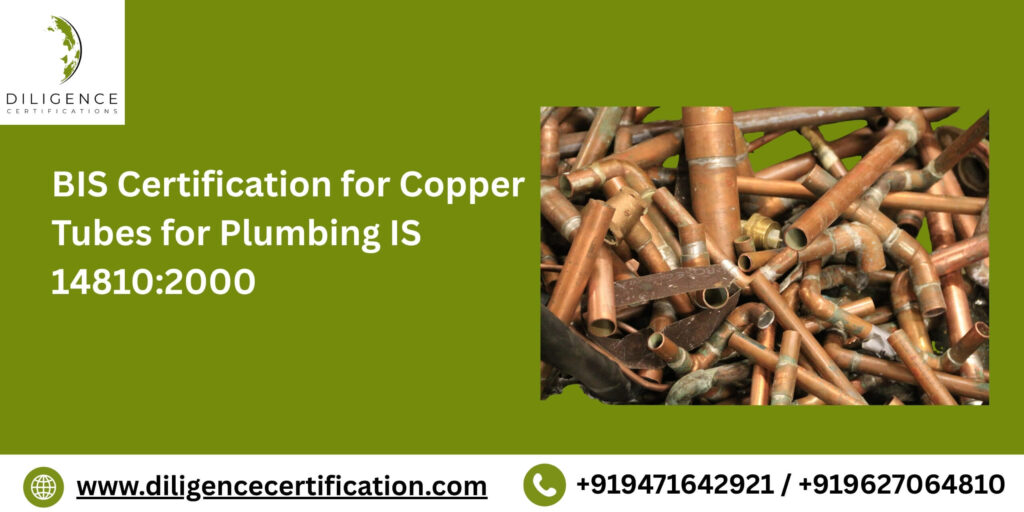
- BIS Certification under IS 14810:2000 is mandatory for copper tubes used in plumbing systems.
- The ISI mark certifies dimensional accuracy, corrosion resistance, and pressure handling.
- BIS consultants like Diligence Certifications streamline your registration process, audit prep, and license issuance.
Introduction:
In 2023, a Copper tubes for plumbing hardware supplier based in Delhi faced a customs seizure of imported copper tubes. Customs reinstated the lot upon receipt of appropriate documentation, but the wholesaler faced a non-compliance (BIS License under IS 14810:2000) with their stock that matched specifications. Their loss on the stock (still unreleased) amounted into the lakhs (hundreds of thousands), which was unacceptable, as they had pending contracts with major real estate developers.
The Delhi wholesaler contacted Diligence Certifications Ltd., in a rush situation asking for assistance. Diligence met with them to audit their documentation, liaised with one of the designated BIS Labs for instant registration purposes, and obtained the valid ISI mark within 30 working days.
It is important to recognize that this experience represents a waking reality—BIS Certification for Copper Tubes for Plumbing has become a legal requirement for use in public infrastructure in India when sold.
What is BIS Certification for Copper Tubes for Plumbing?
BIS Certification for Copper Tubes in Plumbing verifies that tubes are compliant with BIS For IS 14810:2000 the Indian Standard which assures their use in potable water supply systems, drainage and sanitary plumbing. BIS Certification for Copper Tubes for Plumbing confirms that the tubes meet IS 14810:2000, the Indian Standard that ensures their suitability in potable water supply systems, drainage, and sanitary plumbing.
The certification:
- Authorizes the use of the ISI mark
- Confirms corrosion resistance and material purity
- Ensures leak-free, pressure-resistant performance
- Is mandatory for manufacturers, suppliers, and importers
Copper Tubes for Plumbing Specification
Plumbing systems constitute a vital part of modern infrastructure and make possible the safe and efficient transport of water and other fluids in residential, commercial and industrial applications. The reliability and performance of plumbing systems have a close relationship with their materials. It is therefore very necessary to conform to standards such as IS 14810:2000. Such are the guidelines issued by the Bureau of Indian Standards (BIS) under which requirements for copper tubes for plumbing applications are given; these include material quality, dimensions, and performance criteria.
The BIS Certification for Copper Tubes guarantees that the goods meet the rigorous provisions of IS 14810:2000. Manufacturers and suppliers prefer this certification very much because it is important for plumbing installations in drinking water lines, where safety, durability and corrosion resistance properties of a plumbing system are the most important. Certified copper tubes guarantee the best quality plumbing systems, which are trustworthy, durable and environmentally safe.
By following BIS Certification for Copper Tubes, manufacturers will also be able to participate in developing better solutions for plumbing, which in turn will improve the health of the society and its infrastructure. The certification establishes the need for maintenance of high standards in the selection of materials and equipment used in production because this is a measure toward efficient and sustainable management of water in various settings.
Understanding IS 14810: 2000
IS 14810: 2000 prescribes the use of copper tubes for plumbing applications. The copper tubes stand durable, corrosion-resistant, and easy to install. Thus, these tubes are preferably used in modern plumbing. The standard covers all aspects such as:
- Material Composition: The composition of copper chemical includes pure chemicals level at a high standard for operational purposes and corrosion resistance.
- Mechanical Properties: The tensile strength, elongation, and hardness characteristics will denote that the tubes can withstand internal pressures as well as external forces.
- Dimensional Specifications: Define tolerances for diameter, wall thickness, and other dimensions to guarantee compatibility and easy installation.
- Test Requirements: Details methods for mechanical testing, hydrostatic pressure testing, and other quality checks to ensure compliance with performance standard requirements.
IS 14810:2000 – Standard for Copper Tubes in Plumbing

IS 14810:2000 governs copper tubes used in:
- Potable water piping
- Gas and sanitary plumbing
- Industrial liquid transport
Key technical parameters:
- Chemical purity: minimum 99.90% copper (Cu)
- Dimensional tolerances (OD, thickness, length)
- Mechanical strength and elongation
- Internal/external surface smoothness
Who Needs a BIS Licence for Copper Tubes for Plumbing?
The following stakeholders must comply:
- Indian manufacturers producing copper tubes
- Importers bringing copper plumbing tubes into India
- OEMs using tubes in geysers, heat exchangers, chillers
- Real estate developers sourcing copper plumbing fittings
- Distributors and public works suppliers
Why BIS Certification is Crucial for Plumbing Copper
- Regulatory Compliance: BIS enforces ISI mark usage under CRS
- Safety & Reliability: Confirms durability in pressure plumbing
- Buyer Trust: Preferred by builders, plumbing contractors, and PWDs
- Avoid Penalties: Non-licensed stock risks customs seizure and market bans
BIS Certification Process for Copper Tubes (IS 14810:2000)
Step 1: Application Filing
- Prepare Form-V, product info, lab test reports, QA documents
Step 2: BIS Factory Audit
- BIS officials inspect machinery, traceability, and in-house lab setup
Step 3: Product Testing
- Samples taken by BIS are tested in BIS-approved/NABL labs against IS 14810:2000
Step 4: License Issuance
- BIS grants a license to use ISI mark for compliant products
Step 5: Ongoing Surveillance
- Periodic inspections and sample checks ensure continued compliance

Documents Required for BIS Registration
- Manufacturing license/Udyam certificate
- Plant layout, flow chart, and QA documents
- BIS/NABL test reports of copper tubes
- Brand name certificate (if branded)
- In-house lab equipment calibration
- Declaration of conformity with IS 14810:2000
Cost, Validity & Timeline for BIS License for Copper
| Parameter | Details |
| Validity | 1 to 2 years |
| BIS Certification Cost | Depends on Products |
| Time Required | 30–45 working days |
| Renewal | Needed before expiry with retesting |
ISI Mark for Copper Tubes
The ISI mark on copper tubes indicates:
- Compliance with IS 14810:2000
- BIS approval of factory and process
- Reliability in pressure, corrosion resistance, and safe plumbing use
Builders and government tenders often mandate ISI-certified plumbing materials.
Lab Testing and Test Records:
This includes the methods of testing under IS 14810: 2000 compliance – Modern Laboratory Facilities:
Laboratories available and properly equipped with modern machinery and technology for true, straight tests.
Keeping Test Records:
Properly keeping all records of tests carried out-the notwithstanding methodologies followed, the observations made, and, finally, the results-obtains that facility for traceability and audit purposes of such conformities, which serve as resources for quality assurance.
Periodic Testing:
Testing at intervals is with the understanding that the quality ought not to change over time with changes in the production lot and raw materials.
Labeling, Marking, and Packaging
Proper labeling, marking, and packaging will see to it that accredited copper tubes not in any way fail to meet the requirements of the sectors using them:
- Labeling: This includes essential components like manufacturer’s name, batch number, standard number (IS 14810: 2000), and relevant dimensions for every tube.
- Marking: Permanent marks on the tubes, such as embossing or etching, help identify the product’s specifications and origin.
- Packaging: Secure packing will prevent physical damage from occurring during shipment and while in storage. Proper packaging also guards the physical pipes from hazards like environmental moisture and contaminants
Unit of Control and Batch Compliance
A control unit means the number of tubes manufactured under similar Conditions and go through the mechanisms for quality control. The key aspects are as follows:
1. Batch Definition: A control unit almost always consists of tubes produced with the same material lot and manufacturing run.
2. Sampling: Random sampling of each batch tests the entire batch for performance against specifications.
3. Batch Traceability: Each batch will be properly documented linking it to raw materials, production conditions, test results, and thus allowing for quality control and resolution for pertinent issues.
Test Certificate
A Test Certificate would be issued after successful testing and compliance with IS 14810: 2000. This is inclusive of:
- Product Information: Which consists of the dimensions of the tube as well as its composition material and other specifications concerning the product.
- Test Results: Summarizes the findings of mechanical, dimensional, and performance tests.
- Certifying Body Details: Information regarding the certifying organization and its qualifications.
- Manufacturer Declaration: The statement of compliance with the standard and assurance in quality.
Achieving Certification Stages
1. Material Testing
Chemical checking of copper to ensure that it meets the purity and quality standards as specified in IS 14810: 2000.
2. Dimensional Inspection
Measurements of the tubes would be taken inclusive of diameter and wall thickness for comparison against the specified tolerances.
3. Performance Testing
These tests will include hydrostatic pressure testing that will establish the conditions under which the tubes can operate pressurized without leakage or failure.
4. Documentation and Process Auditing
Also involves detailed documentation of the manufacture process, quality control procedures, and testing. Undergo an audit with a recognized certifying body to confirm the compliance.
5. Issuance of the Certification
After passing all evaluations, the body issuing the certification grants a certificate confirming the conformity to IS 14810: 2000.
Purposes for which certified copper tubes can be applied
- Residential Plumbing. Here certified copper tubes are used in the water supply and distribution systems within the homestead.
- Commercial Buildings. HVAC systems and piping networks in these buildings feature certified copper tubes.
- Industrial applications. Suitable for high-demand and corrosive environments in which fluids shall be transported.
- Health Care. Areas where the criteria of purity and durability are essential in plumbing for the supply of water and gas.
Challenges to Become Certified
Although certification offers a lot of benefits, getting it is usually quite a process for most manufacturers. They have to make sure that all their products can be properly tested using high-end, sophisticated equipment, while at the same time subjecting them to stringent quality control throughout the entire manufacturing process. Cumulatively, these constitute proper documentation and bona fide training of personnel involved in the whole process of certification as well.
Benefits for Stakeholders
- Manufacturers: Competitiveness and wider market access.
- Installers and Contractors: These are products easily installed and trustworthy.
- End-User: Long-lived plumbing systems with little maintenance.
Role of BIS Certification Consultants
A BIS Certificate Consultant provides:
- Technical document drafting
- Lab coordination and sample prep
- End-to-end factory readiness support
- Application filing, audit handling, renewal management
Why Choose Diligence Certifications?
- 10+ years of BIS experience in metal piping industry
- 1000+ certifications completed across India
- Dedicated BIS consultants in Delhi, Pune, Bengaluru
- Zero-rejection track record in ISI certifications
Conclusion
If you manufacture or supply copper tubes for plumbing, obtaining BIS Certification under IS 14810:2000 is not just a regulatory formality—it’s a strategic move. It builds credibility, wins tenders, and guarantees product safety for homes, hospitals, and infrastructure projects.
Certified copper pipes for indoor transportation of water are increasingly more increasingly becoming known as trademarks of quality, efficiency, and environmental sustainability. By doing just this, an organization has made a transition toward the best practices that concern operational efficiency and environmental responsibility by being compliant with this requirement. In today’s continuously advancing plumbing industry, anything compliant with such standards will guarantee the durability and functionality measures for the products produced.
For more information on an understanding of how the process works or what long-term benefits come with IS 14810:2000 compliance, one ought to visit the accredited certifying agency, particularly Diligence Certifications. Bearing in mind that expert guidance and support are on hand, credentials could be looked at more more strategically in regard to investment in excellence rather than as regulatory requisites. Certification puts copper tubes for plumbing over the edge in market value and enhances the reputation of your brand, putting you at the forefront of the delivery of quality plumbing solutions for the modern world.
Let Diligence Certifications be your best ally in the course of engaging in the certification process, assuring your products stand as per the highest quality standards and compliance.
Frequently Asked Questions
What is IS 14810:2000?
It is the Indian Standard specifying requirements for copper tubes used in plumbing, including pressure strength, corrosion resistance, and material quality.
Is BIS Certification mandatory for copper plumbing tubes?
Yes, BIS Certification is mandatory for manufacturing, importing, or selling copper tubes for plumbing use in India.
How long does it take to get BIS Certificate for copper tubes?
The full process generally takes 30–45 business days with proper documentation and testing.
What are the testing requirements?
Tubes must undergo third-party testing at a BIS-approved lab covering physical, mechanical, and chemical parameters.
Can foreign manufacturers apply under IS 14810:2000?
Yes. Through the Foreign Manufacturer Certification Scheme (FMCS), global brands can apply for BIS licensing.
What happens during BIS surveillance?
Officials check testing records, sample product batches, and factory conditions to verify ongoing compliance.
Do I need in-house testing to qualify?
Preferably yes. If not, testing must be outsourced to an approved lab with traceability and calibration in place.
Can I sell copper tubes without ISI mark?
No. It is illegal to sell copper plumbing tubes in India without a BIS license and ISI mark.
What is the role of BIS consultants?
They ensure a smooth, compliant journey—right from application, testing, audit handling, to post-certification support.
What are the penalties for non-compliance?
Selling uncertified products may lead to fines, seizure, and legal action under the BIS Act.