


 BIS Certification
 CDSCO
CDSCO
 CPCB
CPCB
 LMPC
LMPC
 WPC Approval
 Global Approvals
 TEC
TEC
 ARAI
ARAI
 BEE
BEE
 ISO Certification
 DGCA Certification
 NOC For Steel
 APEDA Registration











 Business Registration
 FSSAI Mark Certification










 Legal Services
 Trademark Registration
 Copyright Registration
 Patent Registration
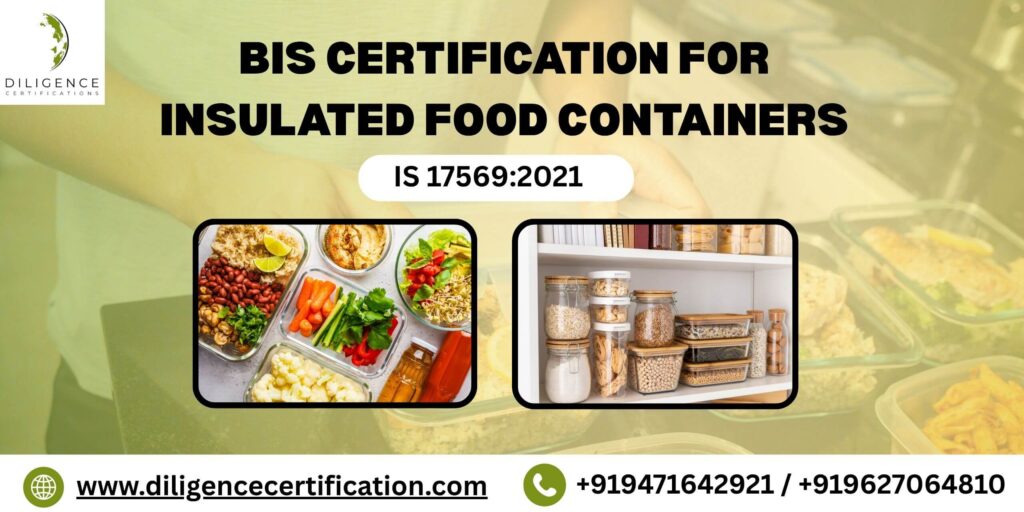
- Insulated Containers provide thermal protection for food, beverage items while in storage or transportation.
- Used widely across hospitals, cloud kitchens, and catering companies throughout India for safe and hygienic food distribution.
- Fulfills the mandatory BIS Certification norms referred to IS 17569:2021 process for quality and structural integrity.
- Manufactured using a combination of insulated foaming, leak-proof molding, and safety testing.
- The product has ISI Mark, batch production and documents, and is available for Diligence Certification for regulatory projects.
Introduction
The Bureau of Indian Standards (BIS) has set regulations for Insulated Containers for Food Storage under IS 17569:2021 to ensure quality, safety, and durability. These containers are widely used for food transportation, storage, and preservation, making compliance with this standard essential for manufacturers.
BIS certification for IS 17569:2021 guarantees that the insulated containers meet the required safety and performance standards. Diligence Certification provides expert consulting services to help businesses obtain BIS certification seamlessly.
Ensuring compliance with IS 17569:2021 is crucial for manufacturers and suppliers who want to enter the Indian market, as BIS certification enhances the credibility and acceptability of the product among consumers and regulatory authorities.
What Are Insulated Containers?
Insulated containers are unique storage units designed specifically to keep their internal temperature hot or cold while transporting and briefly storing items. Insulated containers have broad applications in the food service industry, hospital catering, community kitchens and cold-chain logistics throughout India.
Unlike plastic crates or thermal bags, insulated containers are constructed with several layers. Most insulated containers have:
- The inner food grade component
- The insulation layer (usually constructed of polyurethane foam)
- The outer impact resistant shell (HDPE or stainless steel)
Insulated containers use secure lids, possess leak-proof seals, and can hold temperature for 4 to 12 hours.
Understanding IS 17569:2021
IS 17569:2021 outlines tests for thermal insulation, leak prevention, and impact resistance in insulated containers.
Indian Standard IS 17569:2021 is the latest specification that governs insulated containers for food storage. This standard defines:
- Thermal retention efficiency based over defined time intervals
- Material safety (non-toxic food-grade plastics or metal)
- Structural durability (must undergo drop and impact – testing)
- Capacity range (standard sizes from 5L – 50L)
Must meet mandatory lab testing and keep documentation to prove ongoing compliance.
Key Highlights of IS 17569:2021
The following table summarizes the major aspects of IS 17569:2021:
| Feature | Description |
| Scope | Specifies requirements for insulated containers used for food storage. |
| Material Requirements | Must be food-grade, non-toxic, and resistant to corrosion |
| Thermal Insulation | Should maintain temperature retention as per defined parameters. |
| Design & Construction | Durable structure with leak-proof and impact-resistant properties. |
| Performance Tests | Includes thermal insulation efficiency, leakage test, and durability tests. |
| Marking & Labeling | Must include manufacturer details, batch number, and BIS Standard Mark |
The Benefits of Insulated Containers
To recap, objectivity is not personal: “Insulated containers sustain food safety, reduce waste, and protect the food or product.”
- Protects temperature: Retains cold and hot temperatures for a minimum of 6-8 hours.
- Reduces spoilage: When the temperature is preserved, food is less likely to become contaminated and spoiled by bacteria.
- Stackable, spill proof: Containers are designed to be ergonomic, and prevent spillage when transporting food.
- Reusable, safe: A one-time purchase gives you a forever safe and quality food product.
- Hygienic, easily cleaned: Smooth, inner layer avoids the ability for any residual build-up which can be a cleaning problem.
- Certified: Potentially able to acquire BIS and Diligence Certifications, for tendered projects.
Importance of BIS Certification for Insulated Containers
Relevance of BIS Authentication for Insulated Containers
BIS certification guarantees that insulated food storage containers conform to very high quality standards and thus offers:
- Consumer Safety: Avoidance of contamination and enhancement of freshness of foods and beverages.
- Access to Markets: In India, BIS certificate is mostly compulsory for marketing any product.
- Competitive Edge: Compliance with BIS standards instills trust to customers besides brand reputation.
- Regulatory Compliance: Meeting government rules saves a lot of legal troubles and fines.
- Quality Assurance: Regular checks and tests ensure consistency in product quality.
List of Test Equipment Required
It is to the above specifications that manufacturers subject their products for stringent testing on specialized equipment:
- Thermal Conductivity Tester – Measures the insulation of the container.
- Leakage Testing Apparatus – Checks the presence of water and air leakages in the container.
- Impact Resistance Tester – Tests the durabilities and strength of the container.
- Humidity and Temperature Chamber – Tests the performance in different climatic conditions.
- Material Composition Analyzer – Used for ensuring that the material used is food-grade and not toxic.
- Insulation Efficiency Testing Device – Evaluate the heat retention capacity.
- Compression & Load Testing Machine – Tests the substance under stress.
The above tests make it possible to determine whether an insulated container complies with the BIS certification requirements under IS 17569:2021.
Scheme of Inspection and Testing
However, during compliance with IS 17569:2021, manufacturers were obliged to follow SIT scheme by BIS. Some key processes include:
- Raw Material Inspection – This inspects the quality of food-grade materials.
- In-process Inspection – Checks for quality at different intervals during the work process.
- Finished Product Testing – A complete test according to the parameters of IS 17569:2021.
- Batch-wise Sampling – It is mandatory to sample batches for testing.
- Marking & Labeling Check – This ensures that the labeling of both the product and the container is correct and legible.
- Certification & Reporting – Submission of test reports to BIS.
In the regular surveillance audits and factory inspections, continued compliance with the certification standards is ascertained.
BIS Certification Process for Insulated Containers for Food Storage

Further steps towards BIS certification for IS 17569:2021 include:
Stage 1: Application submission
- The manufacturers have to apply for BIS certification under the product category specified under
- compulsory registration scheme or the ISI Mark Certification Scheme.
- The submission of application online is done on the BIS portal through required documents.
Step 2: Product Testing at BIS Recognized Lab Test
The insulated container will be tested at BIS approved lab for compliance against IS 17569:2021, and a complete test report will be generated and forwarded to BIS.
Stage 3: Factory Inspection (if applicable)
The manufacturing unit premises shall also be visited by BIS officials to assess the capacity of the unit to manufacture and quality control its products.
Stage 4: Granting of BIS Certification
- Verification through test reports and inspection of the factory and then grants the certification by the said authority, BIS.
- Then the manufacturer can use the BIS Standard Mark (the ISI Mark) on the product.
Step 5: Surveillance & Renew
- Renewed certificates shall cover the rules defined by the BIS for a fixed time where periodic surveillance audit for compliance is conducted.
Documents Required for BIS Certification
These are the documents that manufacturers should have to present while applying for BIS certification based on IS 17569:2021:
- Business Registration Documents – Proof of the establishment and an active legal identity for a business
- Manufacturing Unit Particulars – Data regarding production capacity and infrastructure
- Product Specifications – Technical details, material compositions and structural designs.
- Test Reports – Laboratory test results proving compliance as per IS 17569:2021.
- Quality Control Measures – Record inspections, testing, and quality assurance quality documents.
- Marking & Labeling Samples- Proof to show the correct usage of BIS Standard Marks in the samples.
- Factory Inspection Reports: If applicable, results of BIS inspection for the production facility.
Why Diligence Certification?
At a business level Diligence Certification will help all manufacturers who wish to obtain BIS certification for Insulated Containers for Food Storage under IS 17569:2021. The services include:
- Application Assistance – Helping in the process of application to BIS, formulation of plant audit requirements, etc.
- Coordinating the Product Testing- Testing in BIS-approved laboratories.
- Factory Inspection Assistance- Preparing for an BIS factory visit.
- Documenting Compliance- Ensuring all documents are in place.
- Post-Certification Support- Help in awareness concerning checks and audits, periodic usage.
It is a hassle-free certification provided to manufacturers and exporters having years of experience concerning regulatory compliance.
Conclusion
nsulated Containers are no longer a luxury but a necessity for anyone transporting food across India’s diverse climatic zones. Whether it’s a hospital tiffin service or a wedding caterer, using BIS-certified insulated containers ensures food stays safe, hygienic, and within the required temperature range.
More importantly, certified containers backed by Diligence Certification provide traceability and documentation for compliance-heavy projects. This includes third-party test validation, production batch tracking, and long-term accountability—a requirement increasingly requested by government buyers and top institutional clients.
Need BIS-approved insulated containers with full documentation and Diligence Certification?
Get Free Consultant today for certified supply, fast delivery, and expert-backed compliance support. Diligence Certification Guide
Frequently Asked Questions
What is an insulated container used for?
Insulated containers keep the temperature of the food during storage and delivery; this is significant in catering cold kitchens, and kitchens used by institutions with a statutory fundamental duty for safety.
What material are BIS-certified insulated containers made of?
Food-grade HDPE or stainless steel for the inner walls, and rigid polyurethane foam insulation between the inner and outer wall of a container.
How does the ISI Mark ensure a food container is safe?
It certifies the product complies with safety requirements in India as specified in IS 17569:2021 and thermal and hygienic performance tests have been passed.
Is BIS certification necessary for food storage containers?
For public procurement and tenders, or in isolated instances of an industrial kitchen - absolutely. It ensures compliance and guarantees the credibility of a product.
Can insulated containers be used for cold foods?
Yes. Insulated containers can hold hot and cold temperatures for hours if they are pre-conditioned.
What makes insulated containers leak-proof?
Precision-molded lids with silicone or EPDM gaskets provide an airtight seal and prevent spillage.
How long can these containers hold food hot?
Typically, food remains hot for 4-8 hours, depending upon the thickness of insulation, ambient temperature and pre-heating method.
Are the containers reusable for the long term?
A manufacturer can typically use high quality insulated containers for 5-7 years in a daily use situation if they take care to do so.
Is there a way to check if my container confirms with IS 17569:2021?
Look for the ISI mark, check the BIS license and request test reports referring to IS 17569:2021.
Am I able to use insulated containers to transport liquids?
Yes, as long as the rated model is for liquids and it contains internal seals that will avoid leakage.