



 BIS Certification
 CDSCO
CDSCO
 CPCB
CPCB
 LMPC
LMPC
 WPC Approval
 Global Approvals
 TEC
TEC
 ARAI
ARAI
 BEE
BEE
 ISO Certification
 DGCA Certification
 NOC For Steel
 APEDA Registration














 Business Registration
 FSSAI Mark Certification











 Legal Services
 Trademark Registration
 Copyright Registration
 Patent Registration
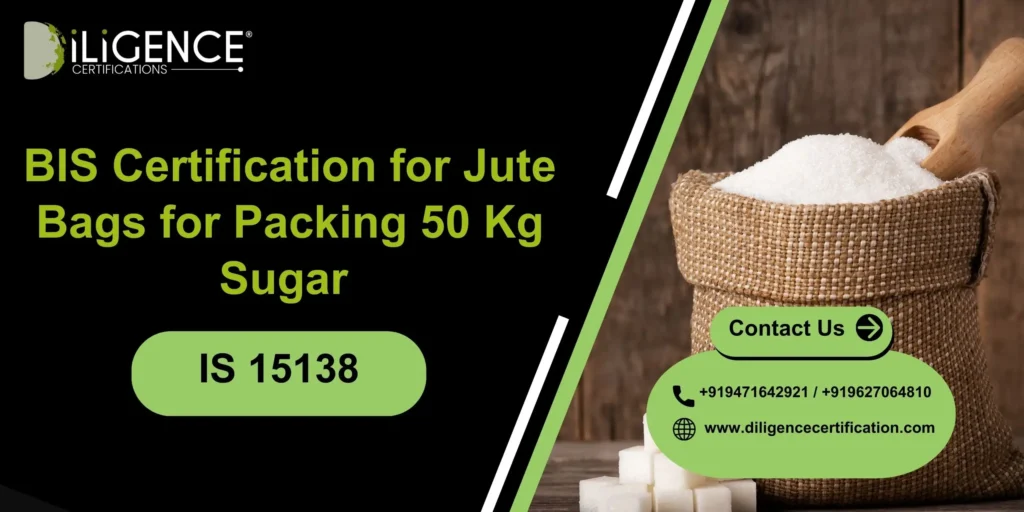
- Compulsory Quality Compliance as per IS 15138 BIS for Jute Bags for Packing certification, as stated in IS: 15138, ensures that the jute bags used for packaging sugar, which weighs 50kg, conform to standards regarding strength of fabric, stitching, dimensions, and load-carrying capacity safety.
- Assured the Safe Transportation of Sugar is processed in jute bags according to the standards of the ‘Cigarette Exporters Association of Pakistan’ because the certified jute bags ensure greater strength, tear-resistance.
- Mandatory for Manufacturers and Suppliers in India Jute bags intended for sugar packaging have to be approved by BIS certification before being supplied to sugar mills, government procurement agencies, or public distribution systems by manufacturers or suppliers.
- Tested by BIS Recognized Laboratories For certification, sample testing is also carried out at BIS-approved labs to check parameters including the strength of breaking, mass per unit area, seam strength, as well as overall workmanship. Enhances Market Acceptance and Trustworthiness of Regulations The jute bags recognized by BIS certification improve the authenticity and acceptability of the product in government as well as private bids, along with boosting the cause for environment-friendly packaging.
Introduction | BIS for Jute Bags for Packing
Packaging is a very important sector within the sugar supply chain, and this is especially true in a country such as India, which produces, transports, stores, and distributes sugar on a very large scale. Of all the materials used for making sugar packaging, the most preferred one for packing sugar that comes in a 50kg bag is indeed a jute bag, and for this purpose, the Government of India has made Bureau of Indian Standards (BIS) Certification for Jute Bags for Packing 50 Kg Sugar as per IS: 15138 compulsory.
Such a certification is important because it ensures that sugar packaging bags are of the highest quality in relation to fabric, tensile strength, stitching, size, and carrying capacity. Such bags ensure that the sugar is not contaminated or lost, in addition to offering a guarantee to the sugar bag manufacturer, sugar mill, and buying agency that it is not compromised in any way.
What is BIS Certification for Jute Bags under IS 15138?
BIS Certification is the conformity certificate given by the Bureau of Indian Standards, which is the national standards body of India. In the context of jute bags used for packing sugar that weighs 50 kg, BIS certification is regulated by IS 15138, which is an Indian Standard in this matter that lays down its technical specifications.
IS 15138 specifies guidelines on:
- Jute fabric kind and quality
- Construction standards
- Weaving standards
- The breaking strength and load-carrying ability
- Stitching Pattern and Seam Strength
- Features, tolerances, and working
- Painting and identification obligations
Jute bags attaining success in tests conducted in the BIS-recognized testing laboratories and satisfying all the specified parameters only have the right to use the Standard Mark (ISI Mark). If not certified by the ISI Mark, the manufacturers and suppliers of jute bags shall not be authorized to sell these in the regulated markets for packaging sugar for 50 kg.
Key Features of IS 15138 Certified Jute Bags
BIS certification in IS 15138 is not a mere formality, as mentioned earlier, but it also acts as a mechanism to ensure the quality of the products. Some key aspects, as mentioned below, differentiate IS 15138-certified jute bags from regular bags:
1. High Tensile and Breaking Strength The standard says it should be able to withstand a minimum breaking strength for the jute fabric so that it can carry up to 50 kg of sugar without bursting when it’s being handled or transported.
2. Controlled Fabric Weight and Construction IS 15138: The mass per unit area of jute fabric, along with the method of construction, which includes both the warp and weft yarns, is defined.
3. Strong Stitching & Seam Quality The type of stitching, stitches per unit length, seam strength – all are strictly regulated so as not to cause seams to break during lifting, stacking, or transportation.
4. Exact Dimensions & Tolerances Certified jute bags must meet certain dimensions and tolerances so that there is uniformity in stacking and storing, as well as in machine handling.
5. Proper Marking and Traceability Each approved bag should be marked appropriately with details such as the manufacturer, the batch, and the ‘BIS Standard Mark’.
Why BIS Certification is Required – Key Reasons
BIS certification for jute bags as per IS 15138 is mandatory for some crucial reasons as follows:
1. Legal Requirements Government authorities, sugar mills, and distribution systems are made to procure only BIS-certified jute bags. Failure to do so may result in the rejection of shipments and will lead to legal action.
2. Quality Assurance This ensures that all the jute bags are of the minimum required standards and hence eliminate the issue of bursting, sugar leakage, and contamination.
3. Protection of Stakeholders Right from the farmers, sugar mills, transportation, and through to consumption, BIS certification safeguards every party concerned by ensuring safe packaging.
4. Uniformity Across the Industry IS 15138 establishes a level of standardization among suppliers so that quality is not a concern irrespective of the supplier and geographic location.
5. Environmental Responsibility Jute is biodegradable. BIS certification encourages eco-friendly use of sustainable materials in packaging without compromising on performance.
Importance and Benefits
| Importance | Benefits |
| Ensures compliance with IS 15138 | Avoids legal penalties and supply rejections |
| Maintains packaging strength and safety | Reduces sugar loss during transit and storage |
| Mandatory for government and PSU tenders | Increases eligibility for large-scale contracts |
| Standardizes manufacturing practices | Improves operational efficiency and consistency |
| Promotes eco-friendly packaging | Enhances brand image and sustainability goals |
BIS Certification Process
Step1:Documentation
- Collect required technical documents
- Prepare product specifications
- Gather company registration details
- Ensure documents follow BIS format
Step2:Product Testing
- Send samples to a BIS-approved lab
- Conduct safety and quality tests
- Receive test reports
- Confirm compliance with BIS standards
Step3:Application Submission
- Fill out the BIS application form
- Upload all required documents
- Attach valid test reports
- Pay the necessary BIS fees
Step4:Scrutiny and Inspection
- BIS reviews submitted documents
- Authority verifies test results
- Factory/product inspection may occur
- Clarifications requested if needed
Step5:Grant of License
- BIS approves the application
- License number is issued
- Product can carry BIS mark
- Renewal required before expiry
Documents Required for BIS Certification
| Category | Documents Required |
| Business Documents | Business license/registration, ISO certificate, organizational details |
| Manufacturer Details | Factory layout, process flow chart, machinery list, production details |
| Product Documents | Product specifications, component list, user manual, model details |
| Testing Documents | Test report from BIS-recognized lab, sample details, test request form |
| Legal & Compliance | Authorization letter, brand ownership proof, trademark certificate (if any) |
| Import/Foreign Manufacturer (If applicable) | AIR (Authorized Indian Representative) details, contract agreement, overseas manufacturer documents |
Timelines, Costs, Validity & Renewal
- Timelines: Usually from 20 to 30 days, with only 7-15 days for the testing.
- Costs: The cost of the government and the test varies depending on the product. There can be some additional charges though.
- Validity: The validity period is 2 years in most situations.
- Renewal: The renewal is done before the expiration; there should be updated documents/tests the renewal
Challenges of Obtaining BIS Certification Without a Consultant
Though BIS certification is mandatory, the process can contain certain complexities for manufacturers planning for certification on their own without the assistance of professionals. These may include the following:
1. Lack of Technical Understanding In order to understand IS 15138 specifications, test parameters, and documentation requirements, certain technical knowledge is needed, which is not a common attribute among manufacturers.
2. Inaccurate Mistakes in application forms, factory information, or test reports usually cause objections, postponements, or disapproval by BIS officials.
3. Failures in Sample Testing In the absence of pre-evaluation, a material may fail in the BIS-approved labs because of minor variations in the weight of the material, stitching, and tested strength parameters.
4. Issues of Factory Inspection BIS carries out extensive tests on factories. Lack of compliance with manufacturing controls, testing facilities, and documentation may lead to non-approvals.
5. Time and Cost Overruns Repeating corrections, re-testing, as well as re-inspection, thereby increasing time and costs, expenses associated with production.
Why Choose Diligence Certificate & Consultancy?
When it comes to the certification of BIS for jute bags to pack 50 Kg. Sugar as per IS 15138, the right choice of consultancy partner can help a lot. Diligence Certificate & Consultancy offers end-to-end support in this regard, designed to make the entire certification journey smooth and hassle-free.
1. Expert Technical Advice We can ensure your product and factory are fully aligned with the compliance requirement through in-depth knowledge of our team at IS 15138 and BIS procedures.
2. Correctness of Documentation We handle complete documentation, right from application filing to test coordination, without any errors, and this considerably reduces approval timelines.
3. Pre-Testing & Gap Analysis Before the official testing, a detailed gap analysis is performed in order to identify and fix any kind of non-conformities beforehand, reducing a chance for the failure of a sample.
4. Support of Factory Inspection We prepare your manufacturing unit for BIS inspection by aligning quality controls, records, and testing infrastructure with BIS expectations.
5. Faster Approval and Peace of Mind By approaching the matter in a structured way, with experience, you will save much time, reduce costs, and gain peace of mind to focus on your core business.
Conclusion
BIS certification for jute bags with regard to packing 50 kg sugar as per IS 15138 is not just a regulatory requirement; it acts as a mark for the assurance of quality, reliability, and building trust. It ensures that jute bags in sugar packaging are strong, durable, safe, and environmentally responsible. For manufacturers and suppliers, it opens them up to many potential government tenders, large institutional buyers, and more opportunities for long-term business growth.
Frequently Asked Questions (FAQs)
What is BIS Certification for jute bags used in 50kg sugar packaging?
BIS Certification for Jute Bags as per IS 15138: BIS certification for jute bags as per IS 15138 is a legal requirement for ensuring the strengths, stitches, and durability for packing 50 kg of sugar in jute bags are as per specifications.
Is BIS certification mandatory for jute bags used in sugar packaging?
Yes, BIS certification is compulsory for jute bags intended for packing 50 kg sugar, particularly in the case of sugar mills, government procurement organizations, and public distribution networks.
What is IS 15138?
IS 15138 is an Indian Standard, which describes the requirements and parameters of jute bags to be used for packaging sugar weighing 50kg.
Who needs to obtain certification under IS 15138?
Whoever manufactures jute bags used for packing 50 kg sugar needs BIS certification. Those who import the bags or supply the bags also require BIS certification for the bags they are supplying
What tests are needed for certification by BIS for jute bags?
Testing encompasses the following:breaking strength of the fabric, test weight per unit area, strengthdimensional accuracystitchingquality of craftsmanship, tested in BIS recognized labs.
How long does it take to obtain the BIS certification for jute bags?
The certification process may take anywhere from 30 to 60 working days, depending on the accuracy of the documents submitted, the results of sample testing, and the preparedness of the factory for the inspection.
Is it possible to obtain BIS certification without the help of a consultant?
Yes, it is, but the procedure may be very cumbersome with all the technical standards and requirements for documentation and inspection. Many manufacturers prefer consultants in order to avoid delays and rejections.
What if jute bags are supplied without BIS certification?
Supplying non-certified jute bags can result in rejection of consignments, financial penalties, loss of government contracts, and even legal action by regulatory authorities.
What is the validity period of BIS certification of Jute Bags?
BIS certification is typically valid for a period ranging from one to two years. This, however, is renewable, provided the requirements specified above with respect to surveillance are fulfilled.
In what way does BIS certification help jute bag manufacturers?
BIS certification increases the authenticity of a product, makes it legally valid from a governmental perspective, and boosts customer acceptance in bulk orders as well as governmental orders.