


 BIS Certification
 CDSCO
CDSCO
 CPCB
CPCB
 LMPC
LMPC
 WPC Approval
 Global Approvals
 TEC
TEC
 ARAI
ARAI
 BEE
BEE
 ISO Certification
 DGCA Certification
 NOC For Steel














 Business Registration













 Legal Services
 Trademark Registration
 Copyright Registration
 Patent Registration
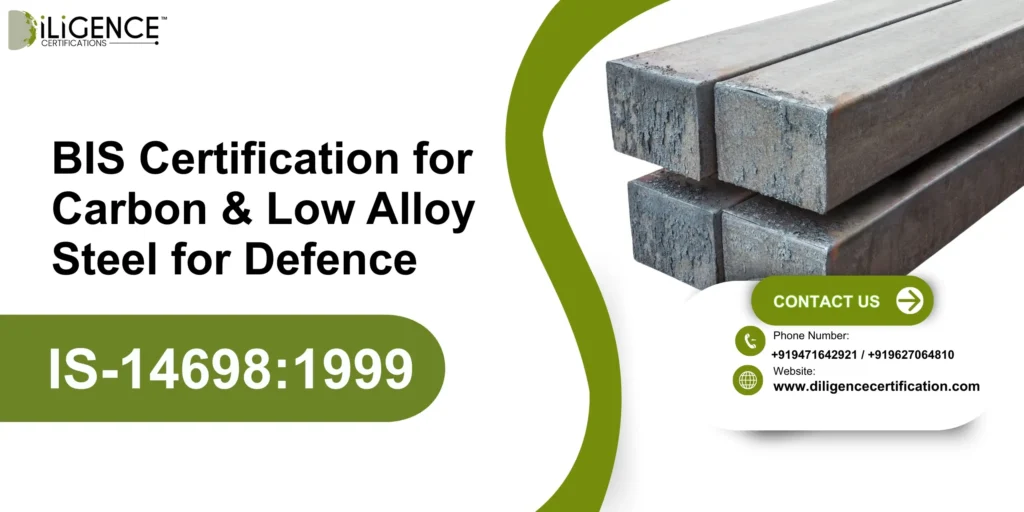
- Carbon and Low Alloy Steel for Defence (IS 14698:1999) is a product that needs a certification from the BIS in order to maintain its compliance, quality, and suitability for the defence sector.
- The standard commits the service of the armed forces to observe the metal and the chemical components of defences billets, blooms, slabs, and bars, as well as their mechanical properties and dimensional tolerances.
- The producers are obliged to submit samples to various testing units that are approved by the BIS and that can carry out the tests of tensile, impact, and macro etch analysis on the products in order to check the quality of the products.
- Factory inspections and the quality management system records are two of the most significant elements of the BIS certification procedure that aims at ensuring a production that can be repeated and traced.
- Steel certified by BIS opens up a legal market, increases the trust of defence contractors, and is a prerequisite for government procurement tenders.
Introduction | Carbon and Low Alloy Steel
Quality and conformity are two features that cannot be compromised in India’s defence manufacturing sector. The steel employed in making the shell bodies, proof shots, and other such heavy components of the armament must be of such a kind that these materials meet the safety and performance standards through rigorous tests. Well, this is a point where the standard for Carbon & Low Alloy Steel for Defence (IS 14698:1999) comes into the picture.
In order to be allowed to manufacture, supply, or import such steels legally, producers need to have a certificate from the Bureau of Indian Standards (BIS). Certification from the BIS is a stamp of approval not just for a steel’s chemical makeup, mechanical properties, and dimensions but also for a manufacturer’s reputation, access to markets, and eligibility for defence sector tenders.
Technically, many manufacturers might have efficient production lines but they are still struggling in comprehending and fulfilling the BIS compliance requirements. Obtaining certification according to IS 14698:1999 is a guarantee that each billet, bloom, slab, and bar is conforming to the national standards thus giving the defence clients the trust that those materials are capable of withstanding the tough nature of their service applications.
What is IS 14698:1999 ?
IS 14698:1999 is the Indian Standard specification for carbon and low alloy steel billets, blooms, slabs, and bars used in the manufacture of shell bodies and proof shots for defence services. The standard specifies the chemical, mechanical, and dimensional requirements that the products have to meet in order to be used in high, stress defence applications. The standard is part of the Steel & Steel Products Quality Control Order and, thus, implementation is compulsory. BIS certification is an endorsement of conformity to these specifications.
Key points
- Chemical Composition Standards: Gives the allowed percentage ranges for carbon, manganese, nickel, chromium, and other alloy elements that are needed to achieve optimal strength and durability.
- Mechanical Property Requirements: Defines the parameters of tensile strength, yield strength, elongation, and impact resistance that are necessary for defence grade steel.
- Dimensional and Tolerance Guidelines: Are the means by which billets, blooms, slabs, and bars are checked to ensure they meet the exact size and weight requirements for a uniform manufacturing result.
- Testing and Inspection Protocols: Require thorough laboratory testing, sampling, macro, etch inspections, and factory audits to confirm quality and conformity.
Why is BIS Certification Mandatory?
BIS certification by the Bureau of Indian Standards (BIS) is obligatory for Carbon and Low Alloy Steel for Defence (IS 14698:1999). The reason is that it facilitates the control of the steel products that form the physical basis of the defence are the ones which meet the national quality and safety standards. Defence, grade steel goes through extreme pressures and stresses, and very slight variations in the chemical composition, mechanical properties, or dimensional accuracy can result in the destruction of the whole system.
Key Points
- Compliance with the Law: BIS certification is in line with the national regulations, so it excludes the possibility of legal penalties and market restrictions.
- Quality Confidence: It endorses the chemical, mechanical, and dimensional standards, thus the safety of steel used in the fabrication of ammunition and shells is guaranteed.
- Market Entry: Only products with BIS certification can participate in government defence tenders and contracts.
- Reputation and Reliability: It is an instrument of trust for the defence clients and private manufacturers that the steel is in conformity with the standards recognized internationally.
Importance and Benefits of BIS Certification
| Importance | Benefits |
| It safeguards material to be in accordance with Indian laws and regulations applicable to the defense steel sector. | Rights to be able to take part in government and defence contracts are granted. |
| It serves as a confirmation that the chemical composition and mechanical properties of the material are in accordance with IS 14698:1999. | The product gets a quality stamp which instils confidence among customers and stakeholders. |
| It certifies that the billets, blooms, slabs, and bars are not only technically suitable but also safe for high, stress defence applications. | The chance of material failure is minimized thus security of operations is assured. |
| Production processes become standardized from batch to batch thus the quality remains uniform. | The internal quality control, efficiency, and the reduction of waste are all enhanced. |
| It serves as a documented quality standard and audit readiness for inspections. | Brand reputation gets strengthened and the brand becomes more competitive in the defence market. |
Step-by-Step Process of BIS Certification
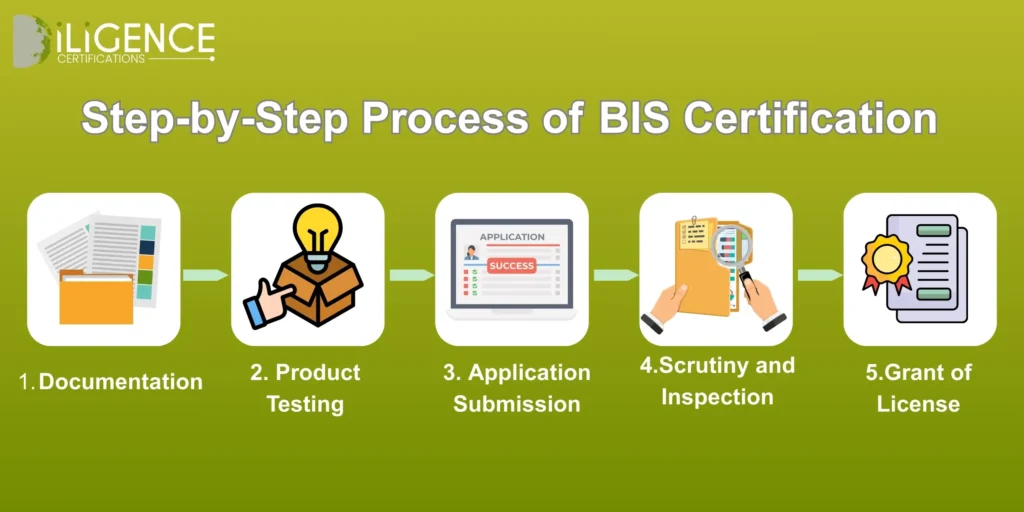
Step1:Documentation
- Collect required technical documents
- Prepare product specifications
- Gather company registration details
- Ensure documents follow BIS format
Step2:Product Testing
- Send samples to a BIS-approved lab
- Conduct safety and quality tests
- Receive test reports
- Confirm compliance with BIS standards
Step3:Application Submission
- Fill out the BIS application form
- Upload all required documents
- Attach valid test reports
- Pay the necessary BIS fees
Step4:Scrutiny and Inspection
- BIS reviews submitted documents
- Authority verifies test results
- Factory/product inspection may occur
- Clarifications requested if needed
Step5:Grant of License
- BIS approves the application
- License number is issued
- Product can carry BIS mark
- Renewal required before expiry
Documents Required for BIS Certification
| Category | Documents Required |
| Business Documents | Business license/registration, ISO certificate, organizational details |
| Manufacturer Details | Factory layout, process flow chart, machinery list, production details |
| Product Documents | Product specifications, component list, user manual, model details |
| Testing Documents | Test report from BIS-recognized lab, sample details, test request form |
| Legal & Compliance | Authorization letter, brand ownership proof, trademark certificate (if any) |
| Import/Foreign Manufacturer (If applicable) | AIR (Authorized Indian Representative) details, contract agreement, overseas manufacturer documents |
Timelines, Costs, Validity & Renewal
- Timelines: Usually from 20 to 30 days, with only 7-15 days for the testing.
- Costs: The cost of the government and the test varies depending on the product. There can be some additional charges though.
- Validity: The validity period is 2 years in most situations.
- Renewal: The renewal is done before the expiration; there should be updated documents/tests; the renewal
Why Choose Diligence Certifications
- Expertise in Defence Steel Certification: Deep understanding of IS 14698:1999 facilitates proper documentation, testing, and audit readiness.
- End, to, End Support: Guidance through every step, from submitting the application to getting the BIS license, factory audits, and surveillance assistance.
- Time, Efficient Processes: A streamlined method that reduces waiting times for lab tests and BIS inspections.
- Customized Consultancy: Implementing quality solutions from internal audits of your manufacturing setup.
- Proven Track Record: The successful certification of several manufacturers across India has facilitated the trust of BIS and defence clients.
Conclusion
ConclusionObtaining a BIS certificate is an essential milestone for producers who want to provide high quality steel to the Indian defence sector.
For Carbon and Low Alloy Steel for Defence (IS 14698:1999), conformity to BIS standards is the prerequisite for safety, trustworthiness, and qualification for government tenders. Cooperation with Diligence Certifications makes this intricate procedure comfortable, as the experts take care of the entire process from documentation, through factory audits, to getting the final license.With the help of Diligence Certifications, the manufacturers are not only able to meet the mandatory requirements but they also enjoy the benefits of enhancing their
operational efficiency, maintaining quality at the same level, and increasing their reliability in the defence market. Obtaining a BIS certificate for your steel is not just about compliance, it is a well thought out decision that will guarantee business development and loyalty in the long run.
Frequently asked questions
What is Carbon & Low Alloy Steel for Defence (IS 14698:1999)?
This is an Indian Standard that defines the quality requirements for the steel that is to be used in the production of the bodies of the shells and proof shots for the defense.
Why is this steel chosen for the production of the defense?
The major reason is that it can withstand high strength, long service life, and at the same time, it is resistant to very high pressure.
What tests are required under IS 14698:1999?
Among other tests, the standard calls for chemical analysis, tensile testing, impact testing, and macro etch inspection.
Can foreign manufacturers apply for BIS certification?
Yes, but only through an Authorised Indian Representative (AIR).
How long does BIS certification take for defence steel?
It is usually 30, 60 days for a domestic manufacturer, depending on the duration of the audit and testing.
What if BIS certification is not obtained?
The manufacture or sale of defence grade steel will be illegal in India.
How can Diligence Certifications help?
They are the perfect partner for the BIS license, assisting with everything from the gathering of documents to getting the license.
Is BIS certification required for IS 14698:1999?
Yes, it is required by the Steel & Steel Products Quality Control Order that BIS certification be obtained.
who is the BIS certification issuer in India?
BIS (Bureau of Indian Standards) is the organization that issues the certification.
What are the products specified in IS 14698:1999?
Billets, blooms, slabs, and bars made of carbon and low alloy steel for the production of defence materials.