



 BIS Certification
 CDSCO
CDSCO
 CPCB
CPCB
 LMPC
LMPC
 WPC Approval
 Global Approvals
 TEC
TEC
 ARAI
ARAI
 BEE
BEE
 ISO Certification
 DGCA Certification
 NOC For Steel












 Business Registration












 Legal Services
 Trademark Registration
 Copyright Registration
 Patent Registration
- Carbon Steel Sheets for Porcelain Enamelling (IS 9485:1980) are manufactured with several special considerations aimed at achieving uniform enamel adhesion, resistance to fish, scaling, and a surface finish that is absolutely free from any defects after firing.
- The standard covers sheets of both cold, reduced and hot, rolled carbon steel that are used in enamelled appliances, cookware, and sanitaryware.
- Strictly controlled chemical composition with low sulphur and phosphorus is very important to avoid blistering during the enamelling process.
- BIS certification to this standard is a quality hallmark indicating that the product meets the chemical, mechanical, and enamelling performance requirements beyond the basic strength properties.
- Manufacturers (not traders) only can obtain BIS certification under the ISI Mark Scheme for this product.
- The surface quality requirements are very strict as even the slightest defects can lead to the rejection of the product after porcelain enamelling.
Introduction | Carbon Steel Sheets
Carbon steel sheets for porcelain enamelling should not be viewed as mere flat steel products. Any slight variation in chemical composition or surface condition in actual production can cause blistering, lack of adhesion, or fish scaling after firing, which are some of the defects that can be encountered. These defects lead not only to increased rejection rates, but also affect the reputation of the finished products in the market.To counter these problems, Carbon Steel Sheets for Porcelain Enamelling are governed by a separate Indian Standard, IS 9485:1980, which specifies very stringent requirements with respect to chemistry, mechanical properties, and surface quality. Manufacturers supplying appliances, cookware, and sanitaryware industries need to comply with this standard.The Bureau of Indian Standards (BIS) is the main source responsible for ensuring that only those steel sheets which meet these specialised enamelling requirements are given the ISI mark.
What is IS 9485:1980?
IS 9485:1980 is a standard formulated by the Bureau of Indian Standards (BIS) to define the technical specifications of carbon steel sheet materials to be enamelled with porcelain. The standard applies to the carbon steel sheets that are cold, reduced (cold, rolled) and hot, rolled, respectively, in the areas where a uniform, defect- free enamel coating is a must. As opposed to the standards of general purpose steel, IS 9485:1980 is about the steel’s behavior during the enamelling process and after that.
Key points
- Defines the limits of chemical composition to minimise defects in enamelling such as fish, scaling and blistering
- Specifies mechanical properties suitable for controlled deformation during enamel firing
- Establishes very strict surface quality requirements in order to achieve good enamel adhesion
- Describes steel sheets in coils or cut lengths for industrial enamelling useMention the provisions in enamelling performance and adherence testing
- IS 9485:1980 forms the basis for BIS certification and ISI marking of enamel, grade carbon steel sheet
Why is BIS Certification Mandatory?
BIS certification is a must to guarantee that the carbon steel sheets for porcelain enamelling are of good quality and meet the technical specifications of IS 9485:1980. This safety measure allows manufacturers, buyers, and end users to coexist by excluding the possibility of a substandard steel sheet that would make the enamelling process fail. The Bureau of Indian Standards (BIS), through regulatory instruments such as Quality Control Orders, mandates certification as a way to ensure legal compliance, product reliability, and market credibility.
Key Points
- Guarantees product compliance with IS 9485:1980 standards for enamel, grade carbon steel.
- Eliminates the occurrence of the most common fish, scaling, blistering, and poor adhesion defects.
- A prerequisite for the legal manufacture, sale, and supply of covered products under QCOs.
- Serves as a quality assurance reference point for OEMs and large buyers., Prevents the circulation of low, quality or non, tested steel in the Indian market.
- Improves traceability, accountability, and consumer trust., It is a prerequisite for carbon steel sheet using the ISI Mark.
Importance and Benefits of BIS Certification
| Importance of BIS Certification | Benefits to Manufacturers & Buyers |
| Ensures compliance with IS 9485:1980 technical requirements | Guarantees consistent enamel adhesion and reduced product rejection |
| Prevents supply of substandard enamel, grade steel | Builds trust with OEMs, appliance brands, and bulk buyers |
| Mandatory for legal manufacture and sale in India | Avoids penalties, seizures, and supply, chain disruptions |
| Establishes uniform quality standards across the industry | Improves brand credibility and market acceptance |
| Enables regulatory oversight by the Bureau of Indian Standards (BIS) | Facilitates easier participation in tenders and long, term contracts |
Step-by-Step Process of BIS Certification
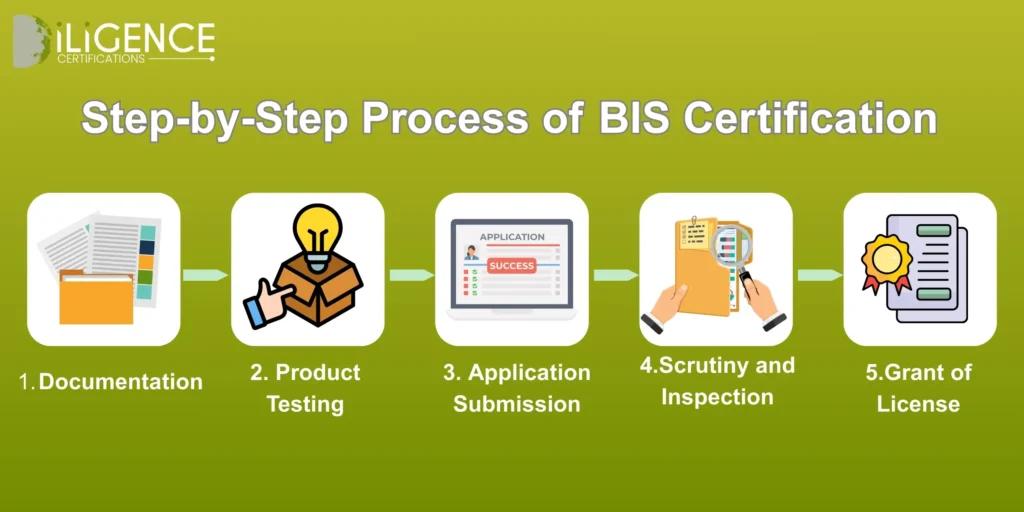
Step1:Documentation
- Collect required technical documents
- Prepare product specifications
- Gather company registration details
- Ensure documents follow BIS format
Step2:Product Testing
- Send samples to a BIS-approved lab
- Conduct safety and quality tests
- Receive test reports
- Confirm compliance with BIS standards
Step3:Application Submission
- Fill out the BIS application form
- Upload all required documents
- Attach valid test reports
- Pay the necessary BIS fees
Step4:Scrutiny and Inspection
- BIS reviews submitted documents
- Authority verifies test results
- Factory/product inspection may occur
- Clarifications requested if needed
Step5:Grant of License
- BIS approves the application
- License number is issued
- Product can carry BIS mark
- Renewal required before expiry
Documents Required for BIS Certification
| Category | Documents Required |
| Business Documents | Business license/registration, ISO certificate, organizational details |
| Manufacturer Details | Factory layout, process flow chart, machinery list, production details |
| Product Documents | Product specifications, component list, user manual, model details |
| Testing Documents | Test report from BIS-recognized lab, sample details, test request form |
| Legal & Compliance | Authorization letter, brand ownership proof, trademark certificate (if any) |
| Import/Foreign Manufacturer (If applicable) | AIR (Authorized Indian Representative) details, contract agreement, overseas manufacturer documents |
Timelines, Costs, Validity & Renewal
- Timelines: Usually from 20 to 30 days, with only 7-15 days for the testing.
- Costs: The cost of the government and the test varies depending on the product. There can be some additional charges though.
- Validity: The validity period is 2 years in most situations.
- Renewal: The renewal is done before the expiration; there should be updated documents/tests; the renewal
Why Choose Diligence Certifications
- Specialised Product Expertise :We provide focused compliance support for Carbon Steel Sheets for Porcelain Enamelling (IS 9485:1980), ensuring technical requirements, testing, and BIS audit expectations are addressed correctly from the start.
- End-to-End BIS Certification Support : Complete assistance from application filing and documentation to factory inspection and licence grant.
- Reduced Approval Timelines :Pre-audit readiness and gap analysis help minimise re-testing, objections, and approval delays.
- Industry-Focused Consulting : Practical experience with steel manufacturers and enamel-grade product lines, not generic compliance handling.
- Post-Certification Assistance : Ongoing support for surveillance audits, licence renewal, and marking compliance under BIS norms.
Conclusion
Manufacturers providing enamel coated steel grade steel to industries like appliances, cookware, and sanitary ware must adhere to IS 9485:1980.Carbon Steel Sheets for Porcelain Enamelling (IS 9485:1980) delineates the standards for chemical composition, surface quality, and enamelling performance in such detail that obtaining a BIS certification is more of a requirement than a mere formality. Meeting these standards is a legal requirement and, therefore, leads to enhanced product trustworthiness and customer preference.If technically guided, the certification process is well planned and can be anticipated. Diligence Certifications stays with the manufacturers during the whole process, i.e. from submission, testing, audit preparation, to licence maintenance. By combining regulatory knowledge with industry practical insight, Diligence Certifications allows businesses to get BIS certification in a timely, efficient manner and avoid compliance pitfalls.
Frequently asked questions
What is IS 9485:1980?
It is an Indian Standard specification that defines the chemical, mechanical, and surface
Why is BIS certification required?
BIS certification serves as a guarantee that steel sheets are in conformity with IS 9485:1980 standards. It helps in averting the occurrence of defects such as blistering, fish scaling, and poor enamel adhesion.
Who can apply for BIS certification?
As per the ISI Mark Scheme, the application for BIS certification is limited to manufacturers only, and traders cannot apply.
What types of steel sheets are covered?
The standard applies to cold, rolled, cold, reduced (rolled), and hot, rolled carbon steel sheets that are used in enamelled appliances, cookware, and sanitaryware.
What are the key benefits of BIS certification?
Ensures product quality, creates consumer confidence, meets legal requirements, and lessens the occurrence of enamel defects in the final products.
What documents are required for certification?
Registration of business, factory plan, details of the machinery, product specifications, test reports from a lab recognized by BIS, and legal/compliance documents.
What is the certification process?
Documentation Product testing Application submission Scrutiny & inspection License grant.
How long does BIS certification take?
BIS certification usually takes 2030 days. Product testing accounts for 715 days.
What is the validity of the BIS license?
The license of BIS (Bureau of Indian Standards) is generally valid for a period of 2 years and renewal of the license is required before its expiry.
How does the BIS certification help the manufacturers and buyers?
It is a very important step for a manufacturer to take as it ensures consistent enamel adhesion of the product, thus preventing product rejection, it improves brand credibility and also it allows the company to participate in tenders and contracts.