



 BIS Certification
 CDSCO
CDSCO
 CPCB
CPCB
 LMPC
LMPC
 WPC Approval
 Global Approvals
 TEC
TEC
 ARAI
ARAI
 BEE
BEE
 ISO Certification
 DGCA Certification
 NOC For Steel














 Business Registration












 Legal Services
 Trademark Registration
 Copyright Registration
 Patent Registration
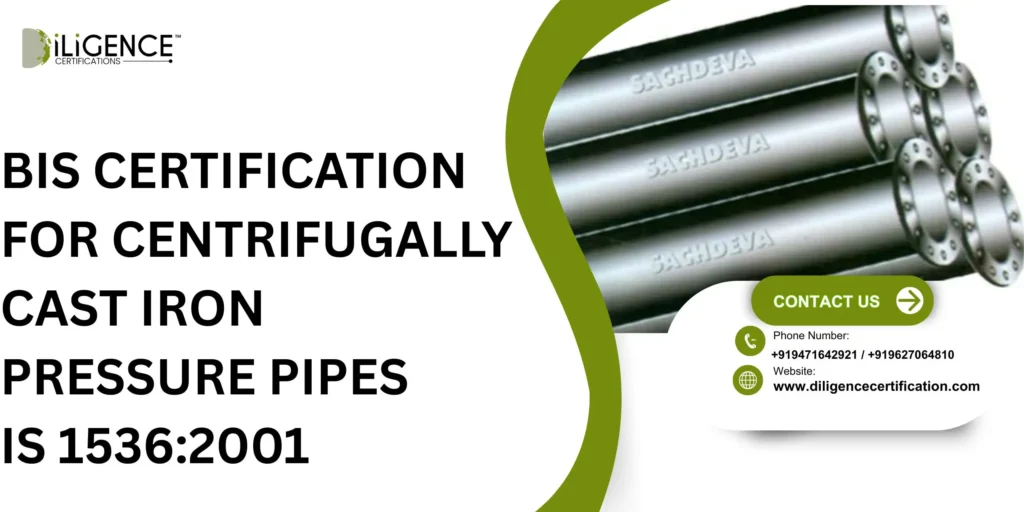
- Mandatory Compliance: In India, BIS certification CAST IRON PRESSURE PIPES is a must for the production and sale of centrifugally cast iron pressure pipes of the kind specified in IS 1536:2001.
- Quality Standard: The standard elaborates the requirements for the source materials, the sizes, the thickness of the walls, the layer, and the hydraulic performance.
- Application Use: These pipes find extensive use in water supply, sewerage, and irrigation systems as pressure carriers of fluids.
- Product Testing: Pipes undergo tests in BIS, approved laboratories for their ability to withstand pressure, tensile strength, quality of the coating, and general workmanship.
- ISI Mark Authorization: The ISI mark can be put by manufacturers who have been granted a license by the Bureau of Indian Standards, thus signifying quality assurance and acceptance in the market.
Introduction
BIS certification accorded to CAST IRON PRESSURE PIPES as per IS 1536:2001 is a testament to the quality of the pipes that water and other fluids under pressure can be conveyed safely. The pipes are one of the best in their kind as the centrifugal casting technique used in their manufacture makes them uniform in thickness, strong, and durable in service for a long time. The standard specifies various requirements for components, compositions, dimensions, coatings, hydraulic performance, and testing.
If producers want to be allowed to manufacture and sell pressure pipes that are safe and reliable for use in water supply, irrigation, and infrastructural projects in India, it is compulsory for them to conform to IS 1536:2001 as attested by the Bureau of Indian Standards.
What is IS 1536:2001?
IS 1536:2001 is a standard established in India. It is an Indian Standard developed by the Bureau of Indian Standards that specifies the details of the centrifugally cast iron pressure pipes which are suitable for the conveyance of water and other fluids under pressure. The regulation stipulates that such pipes should meet the standards in the aspects of features and lifespan as well as the size, quality of the coating, and hydraulic characteristics of the product, thus guaranteeing their suitability for water supply, irrigation, and sewerage infrastructure systems.
Key Points:
- Scope of Standard: Cover the grey iron centrifugally cast pressure pipes that are suitable for water supply and other pressure applications.
- Material Requirements:The chemical composition and mechanical properties are given, which are necessary to make the material strong and durable enough.
- Dimensional Standards:Define the sizes of the pipes, the thickness of the walls, the tolerances, and the straightness that are necessary in order for the performance to be at the same level.
- Protective Coatings:Indicates the product parts, both inside and outside, that will be coated in order to make the material more resistant to corrosion and, therefore, to extend its service life.
- Testing & Inspection: Require that the pressure testing, mechanical tests, and inspections be done in order to verify that the product is suitable for use.
Why is BIS Certification Mandatory
BIS Certification is a must to keep a check on products which are made and sold in India, whether they comply with the set Indian Standards in terms of quality, safety, and performance. In the case of infrastructural products like pressure pipes, the imposition of mandatory certification can effectively stop the dropping of substandard materials in the market that can, for instance, cause leakages, breakdowns, or even safety hazards. Certification to the relevant IS standards is a way of guaranteeing that products have been tested and inspected and that they have been made in controlled conditions, thus, ensuring their safety and security of the public. The condition is being implemented by the Bureau of Indian Standards through statutory regulations.
Key Reasons:
- Public Safety Assurance: It allows consumers to be protected by confirming that the products comply with safety and performance standards, hence the risks of product failures and accidents are reduced.
- Quality Consistency: It is a prerequisite for manufacturers to maintain standard production and quality control procedures in their factories if they are certified.
- Regulatory Compliance: It is a legal obligation for manufacturers to bring notified products to the Indian market.
- Infrastructure Reliability: Helps in maintaining the long, lasting nature and efficient performance of the products that are employed in the sectors such as water supply and construction which are of vital importance.
- Consumer & Market Trust: Certification through the ISI mark is a quality indicator to the consumers and thus facilitates market acceptance.
Importance and Benefits of BIS Certification
| Importance | Benefits |
| Ensures Safety: Makes sure that the products are in accordance with set safety and performance standards, thus the risk of failure is very low. | Assured Product Quality: Helps India confirm Indian Standards compliance for quality and performance that are consistent. |
| Maintains Quality: Acts as a referee in the implementation of uniform quality, material specifications, and manufacturing controls. | Enhanced Safety: Helps safety be improved by lessening the risks of defects, failures, and safety hazards in the end use. |
| Legal Requirement: Strict compliance is necessary for the production and sale of notified products in India. | Legal Market Access: Gives manufacturers the permission to manufacture and sell products in India legally. |
| Supports Infrastructure Reliability: Gives the assurance of sustained performance and strength over a period in, for instance, water supply and construction, which are critical applications. | Improved Market Credibility: The ISI mark makes the brand more trustworthy among the customers, government buyers, and regulators. |
| Creates Market Confidence: Products bearing the ISI mark enjoy greater acceptance by government agencies, buyers, and consumers. | Competitive Advantage: Products that are certified become the first choice in tenders and infrastructure projects. |
Step-by-Step Process of BIS Certification
Step1:Documentation
- Collect required technical documents
- Prepare product specifications
- Gather company registration details
- Ensure documents follow BIS format
Step2:Product Testing
- Send samples to a BIS-approved lab
- Conduct safety and quality tests
- Receive test reports
- Confirm compliance with BIS standards
Step3:Application Submission
- Fill out the BIS application form
- Upload all required documents
- Attach valid test reports
- Pay the necessary BIS fees
Step4:Scrutiny and Inspection
- BIS reviews submitted documents
- Authority verifies test results
- Factory/product inspection may occur
- Clarifications requested if needed
Step5:Grant of License
- BIS approves the application
- License number is issued
- Product can carry BIS mark
- Renewal required before expiry
Documents Required for BIS Certification
| Category | Documents Required |
| Business Documents | Business license/registration, ISO certificate, organizational details |
| Manufacturer Details | Factory layout, process flow chart, machinery list, production details |
| Product Documents | Product specifications, component list, user manual, model details |
| Testing Documents | Test report from BIS-recognized lab, sample details, test request form |
| Legal & Compliance | Authorization letter, brand ownership proof, trademark certificate (if any) |
| Import/Foreign Manufacturer (If applicable) | AIR (Authorized Indian Representative) details, contract agreement, overseas manufacturer documents |
Timelines, Costs, Validity & Renewal
- Timelines: Usually from 20 to 30 days, with only 7-15 days for the testing.
- Costs: The cost of the government and the test varies depending on the product. There can be some additional charges though.
- Validity: The validity period is 2 years in most situations.
- Renewal: The renewal is done before the expiration; there should be updated documents/tests; the renewal
Why Choose Diligence Certifications
Diligence Certifications is a reliable certification and compliance consultancy that assists manufacturers in effortlessly managing complicated regulatory requirements. With deep industry knowledge and a customer centric approach, Diligence Certifications offers a completeBIS certification and other statutory clearance support solution to the clients which is a quick approval, error, free documentation, and total compliance with Indian Standards.
Conclusion
BIS certification CAST IRON PRESSURE PIPES is essential to that, it plainly states that goods utilized in important industries conform to Indian quality, safety, and functional standards. The most common defective manufacturing method is removed through the imposition of rigorous requirements for testing, inspection, and quality control. Enforced compliance serves as a safety net not just for the general public and the stability of the facilities but also as a promotion tool for the market and a source of trust for consumers. Manufacturers who follow BIS norms are the ones who go the extra mile in terms of quality, law observance, and performance in the future, which is a great help for the Indian economy.
Frequently Asked Questions (FAQs)
Are 'centrifugally, cast iron pressure pipe' products required to have BIS certification?
Yes. BIS certification is compulsory for manufacturing and selling these pipes in India under IS 1536:2001.
Who grants BIS certification for CI pressure pipes?
Certification is granted by the Bureau of Indian Standards after testing and inspection.
What products are covered under IS 1536:2001?
Centrifugally cast grey iron pressure pipes intended for conveying water and other fluids under pressure.
What are the main uses for such wires?
These are typically utilized in water supply networks, sewerage systems, irrigation piping systems, and the like.
What tests are required for BIS certification?
Pressure test, tensile strength test, dimensional verification, coat quality test, workman ship test.
Where is product testing supposed to be done?
Product testing must be done in laboratories recognized by BIS only.
What is the duration of BIS certification?
Generally, it is up to 2 years and it can be renewed before it expires.
Can uncertified CI pressure pipes be sold in India?
The answer is no. Selling or supplying without BIS certification is a prohibited activity and may result in a fine.
What are the documents mostly required for certification?
Business registration documents, factory and process details, product specifications, and valid test reports.
Is factory inspection compulsory during the certification phase?
Yes. Factory inspection could be performed by BIS to confirm manufacturing capability and quality control systems.