BIS Certification
 CDSCO
CDSCO
 PESO
PESO
 CPCB
CPCB
 LMPC
LMPC
 WPC Approval
 Global Approvals
 TEC
TEC
 ARAI
ARAI
 BEE
BEE
 ISO Certification
 DGCA Certification
 NOC For Steel
 APEDA Registration























 Business Registration
 FSSAI Mark Certification












 (32).jpg)
 Legal Services
 Trademark Registration
 Copyright Registration
 Patent Registration
 By
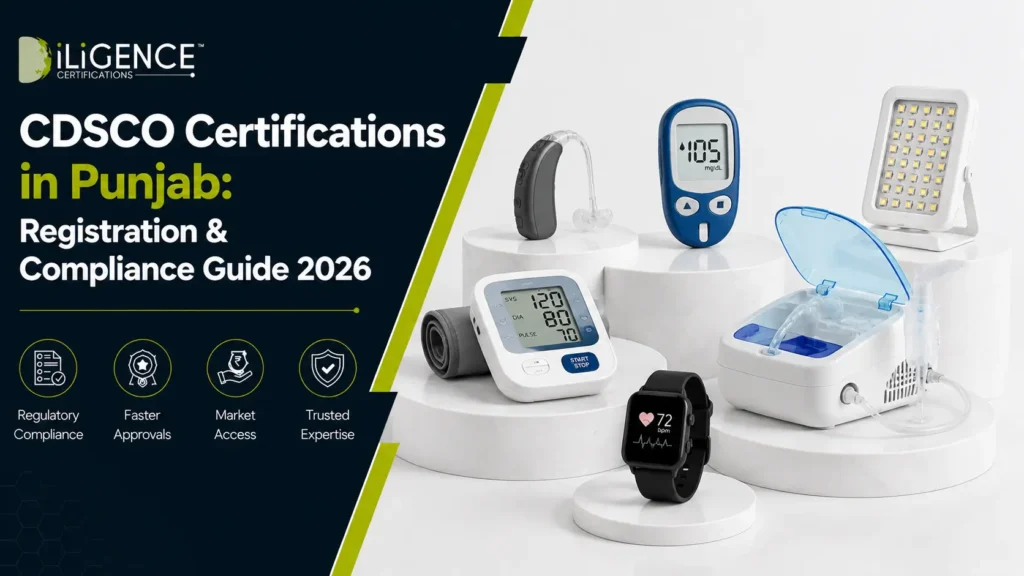
By - CDSCO certificates in Punjab are mandatory regulatory approvals for medicines, devices, diagnostic products, and cosmetic products before entering into the Indian market.
- The process of getting the certificate includes classification of the product, preparation of technical dossier, submission on SUGAM portal, and adherence to CDSCO guidelines.
- Firms in Punjab should maintain proper documentation and testing by accredited labs to prevent rejection.
Introduction: CDSCO certifications in Punjab
Recently, there was an incident where a pharmaceutical company in Ludhiana sought help from a regulatory expert as their product shipment had been delayed at the distribution phase.
This is a familiar case for the pharmaceutical sector in Punjab due to the growing presence of the healthcare industry in Punjab. The problem for even well-known firms arises when CDSCO certification in Punjab is not taken care of during the product launch phase.
Due to the significance of Punjab in terms of manufacturing of pharmaceutical, medical devices, and diagnostic products, Punjab is highly regulated in accordance with the Indian regulatory framework for drugs.
Central Drugs Standard Control Organization plays a crucial role in maintaining the safety and effectiveness of products.
This guide provides all the details of CDSCO approval in Punjab, required documents, classification, typical errors, and approach adopted by consultants for compliance like Diligence Certifications.
What is CDSCO Certification in Punjab?
CDSCO certification in Punjab refers to regulatory approval granted under Indian drug and medical device laws for manufacturing, importing, and marketing controlled healthcare products.
It applies to:
- Pharmaceuticals and drugs
- Medical devices and diagnostics
- Cosmetics with regulated claims
- Clinical investigation products
- Import and export of regulated healthcare items
Without this approval, products cannot legally enter the Indian healthcare market.
Product Classification under CDSCO Framework
Understanding classification is the first and most critical step.
Class A (Low Risk)
Products with minimal patient risk:
- Basic bandages
- Thermometers
- Surgical gloves
Class B (Low to Moderate Risk)
Products requiring controlled regulation:
- Diagnostic kits
- Basic monitoring devices
Class C (Moderate to High Risk)
Products with moderate safety sensitivity:
- Infusion pumps
- Surgical instruments
- Imaging equipment
Class D (High Risk)
Life-supporting or critical devices:
- Ventilators
- Implantable devices
- ICU machines
Correct classification directly impacts approval timeline and documentation requirements for CDSCO certifications in Punjab.
Key Regulatory Requirements for Punjab Manufacturers
- Both the manufacturers and importers need to adhere to strict documentation criteria.
- Mandatory Requirements
- License for manufacturing (where applicable)
- Device master file (DMF)
- Plant master file (PMF)
- ISO 13485 certification for quality system
- Technical dossier for product
- Accredited laboratory test reports
- Labelling and packaging conformity
- Letter of authorization (for Indian agents during imports)
- Proof of business registration
CDSCO Certification Process in Punjab (Step-by-Step)
Step 1: Product Identification and Classification
The product needs to be classified as per the CDSCO norms. Incorrect classification is a very common reason for rejection.
Step 2: Technical Documentation
The entire documentation is done, which includes:
Design of the product
Process of manufacturing
Data on safety and effectiveness
Risks associated with the product
Step 3: Laboratory Testing
Testing needs to be done at CDSCO-authorized laboratories.
Step 4: SUGAM Portal Submission
All applications are submitted digitally through the CDSCO SUGAM portal.
Step 5: Regulatory Review
Authorities review documents and may request clarification or additional data.
Step 6: Approval or Query Resolution
Once satisfied, CDSCO grants approval for manufacturing or import.
Documents Required for CDSCO Certifications in Punjab
Accurate documentation is essential to avoid delays.
Core Documents
- Manufacturing license (if applicable)
- Device Master File
- Plant Master File
- ISO certificates
- Product specification sheet
- Clinical evaluation reports
- Labeling artwork
- Test reports from accredited labs
- Authorization letter (for importers)
- Company incorporation documents
Any mismatch in these documents can lead to rejection or long delays.
Common Challenges Faced by Punjab Businesses
Many manufacturers face regulatory hurdles due to:
- Incorrect product classification
- Weak technical documentation
- Missing or inconsistent labeling
- Lack of Indian authorized agent
- Incomplete SUGAM submission
- Delays in laboratory testing
In Punjab’s competitive pharma ecosystem (Ludhiana, Baddi belt, Mohali), such delays can significantly affect product launch timelines.
Importance of CDSCO Compliance in Punjab Market
Punjab has one of India’s most active pharmaceutical and medical device manufacturing clusters.
Without proper CDSCO certifications in Punjab, businesses face:
- Customs clearance issues
- Market entry restrictions
- Product recalls or penalties
- Loss of distributor confidence
- Legal compliance risks
Regulatory approval is not just compliance-it is market credibility.
How Diligence Certifications Supports Businesses
Diligence Certifications assists manufacturers and importers through:
Certified Diligence Certifications helps businesses in Punjab to get complete CDSCO compliance from start to finish, that is, from product classification to approvals. The goal is to minimize documentation issues, avoid regulatory issues, and ensure seamless submission of the application through the SUGAM portal.
Conclusion
It is not an ordinary procedure to gain CDSCO certifications in Punjab; rather, it is the regulatory door through which your products will enter the Indian market.
Starting from product classification to documentation, testing, and final approval, everything should be handled accurately and in a regulatory fashion. It is necessary for businesses operating in Punjab to follow a strategic plan for CDSCO compliance to save time and trouble.
With the help of professional guidance from organizations such as Diligence Certifications, manufacturers can easily make their product approval process smooth.
For those who intend to introduce a new medical device or pharmaceutical product, the CDSCO certification process should always be considered as a priority.
Frequently Asked Questions
What are the applications of CDSCO certification in Punjab?
This is helpful in obtaining permission for drugs, medical devices, diagnostics, and cosmetics for marketing in India.
Is CDSCO certification mandatory in Punjab?
Yes, any regulated healthcare product has to obtain permission from CDSCO prior to manufacturing/importation/selling.
From where is the CDSCO permission obtained in India?
CDSCO permission is issued by Central Drugs Standard Control Organization (CDSCO).
What products require CDSCO certification?
Pharmaceuticals, medical devices, diagnostic kits, and regulated cosmetics need approval
What is the CDSCO SUGAM portal?
This is the official online platform for the submission and approval process of CDSCO.
Why do CDSCO applications get rejected?
Because of wrong classification, missing information or non-conforming labeli
Are foreign companies eligible for CDSCO approval?
Yes, but they need to appoint an Authorized Indian Agent.
Is product testing mandatory to get CDSCO certification?
Yes, the products need to be tested at the CDSCO recognized/accredited labs
How much time does it take to approve a product by CDSCO?
The time period depends on the kind of product and its documentation and could increase if any query comes.
What if the product gets sold without CDSCO approval?
Legal proceedings and many other issues may arise.