BIS Certification
 CDSCO
CDSCO
 PESO
PESO
 CPCB
CPCB
 LMPC
LMPC
 WPC Approval
 Global Approvals
 TEC
TEC
 ARAI
ARAI
 BEE
BEE
 ISO Certification
 DGCA Certification
 NOC For Steel
 APEDA Registration























 Business Registration
 FSSAI Mark Certification












 (32).jpg)
 Legal Services
 Trademark Registration
 Copyright Registration
 Patent Registration
 By
By - Diligence Certifications makes CDSCO license for General hospital medical devices application easy through accurate documentation and proper device categorization.
- Through its efficient management of technical questions, Diligence Certifications makes CDSCO application filings seamless.
- Furthermore, end-to-end assistance ensures that businesses comply with the compliance process after approval easily.
Introduction
One mid-sized manufacturer of medical devices supplying patient monitors to a chain of private hospitals in the state of Maharashtra from Ghaziabad was faced with the fact that the entire order of products could not be released at the procurement inspection stage. The problem lay in the fact that the necessary regulatory approval was not received according to the CDSCO standards.
Such situations are quite common. Many producers and distributors of hospital equipment consider the presence of technical specifications sufficient to sell their products on the Indian health care market. However, in reality, CDSCO License for General Hospital Medical Devices is the primary document determining the possibility of manufacturing and distribution of medical equipment in India.
Nowadays, India’s medical device industry is subject to strict regulations by Central Drugs Standard Control Organization (CDSCO). This organization regulates general hospital equipment including diagnostic devices, syringes, and surgical equipment among other categories. Violations are associated with the fact that the shipments are detained, penalty payments are required, and even the loss of the contract with an institution.
The following guide tells about CDSCO licensing procedure, devices regulated by CDSCO, and ways to comply with it.
What is CDSCO License for General Hospital Medical Devices
CDSCO License For General Hospital Medical Devices is the legal license provided by regulatory authorities under the Drugs & Cosmetics Act 1940 and Medical Device Rules 2017. This allows the manufacturing and import of medical devices in the Indian market.
The CDSCO system classifies devices into risk-based categories:
- Class A: Low-risk devices (e.g., surgical gloves, simple instruments)
- Class B: Low-moderate risk (e.g., infusion sets)
- Class C: Moderate-high risk (e.g., ventilators, imaging equipment)
- Class D: High-risk life-supporting devices
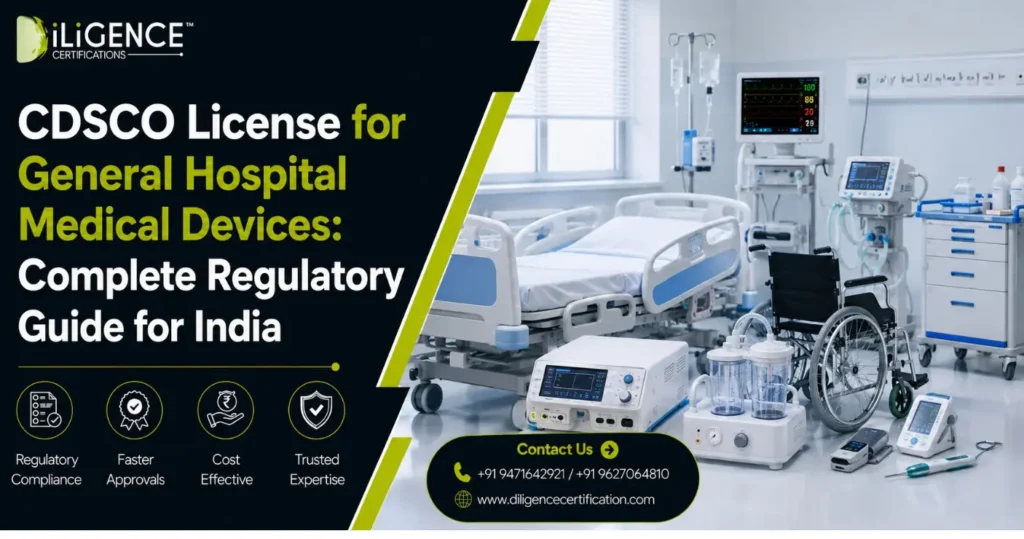
General Hospital devices can belong to Class A to C based on the usage and interaction with patients.
From a regulatory perspective, the CDSCO License for general hospital medical devices makes sure that each individual product complies with safety standards and quality requirements.
Why CDSCO License is Mandatory for Hospital Medical Devices
The health care industry cannot afford any kind of informal quality assurance process. Therefore, regulatory compliance ensures uniformity among all manufacturers and importers.
Key reasons include:
- Legal compliance under Indian medical device laws
- Patient safety assurance through standard testing protocols
- Mandatory requirement for government and institutional procurement
- Prevention of counterfeit or substandard devices in hospitals
- Market access across India without state-level restrictions
In the absence of CDSCO License for General Hospital Medical Devices, even the most technologically advanced product will be considered non-compliant in procurement auditing.
Types of CDSCO Licenses Applicable to Medical Devices
Understanding license categories is essential before applying.
1. Manufacturing License
Issued for companies producing medical devices in India. Common forms include MD-5 and MD-9.
2. Import License
Required for foreign manufacturers or Indian importers bringing devices into the country (MD-14 / MD-15).
3. Loan License
Applicable when manufacturing is outsourced but brand ownership remains with the applicant.
4. Test License
Used for clinical evaluation and product testing before commercial approval.
Each category has different technical and documentation requirements.
Eligibility Criteria for CDSCO License
Before applying for a CDSCO License for General Hospital Medical Devices, businesses must meet defined eligibility conditions:
- Valid business registration in India
- ISO 13485 certification for quality management systems
- Qualified technical staff with biomedical or engineering background
- Controlled manufacturing environment (for producers)
- Compliance with Good Manufacturing Practices (GMP)
- Access to approved testing laboratories
Regulators also assess whether the applicant has sufficient technical infrastructure to maintain product consistency.
Documents Required for CDSCO License for General Hospital Medical Devices
Documentation is one of the most critical stages in approval.
Key documents include:
- Company incorporation certificate
- Manufacturing site layout and details
- Device Master File (DMF)
- Plant Master File (PMF)
- ISO 13485 certification
- Product technical specifications
- Laboratory test reports from NABL-approved labs
- Quality assurance procedures
- Authorization letter (if consultant is involved)
Incomplete documentation is one of the primary reasons for delays in approval.
CDSCO License Process Step by Step
The CDSCO License for General Hospital Medical Devices can be obtained by following an organized process which involves the following steps:
Step 1: Device Classification
Determine the class of the device to be either Class A, B, C, or D.
Step 2: Documenting
Prepare the DMF, PMF, test reports, and quality systems documentations.
Step 3: Online Submission
Applications are submitted to the CDSCO online portal.
Step 4: Government Fee Payment
Fees depend on the licensing type and the class of devices.
Step 5: Technical Evaluation
The evaluation is done on safety and performance documentation.
Step 6: Inspection (if needed)
Inspection of the site takes place for the manufacturing unit.
Step 7: Clarification
Applicants have to answer questions or provide additional data.
Step 8: License Issue
Timeline for Approval
The approval timeline depends on device classification:
- Class A & B devices: 30-60 days
- Class C devices: 60-90 days
- Class D devices: 90-120+ days
Delays usually occur due to incomplete technical documentation or inspection scheduling issues.
CDSCO License Fees and Cost Factors
The cost structure varies depending on multiple factors:
- Government application fees
- Device classification category
- Testing laboratory charges
- Audit and inspection expenses
- Consultancy and documentation support (if used)
Higher-risk devices naturally involve higher compliance costs due to detailed evaluation requirements.
Compliance Requirements After Approval
Obtaining approval is not the end of the compliance cycle.
Companies must maintain:
- Post-market surveillance reporting
- Adverse event reporting system
- Periodic license renewal
- Batch-level record maintenance
- Internal and external audits
Regulators monitor ongoing compliance to ensure continued market authorization.
Common Challenges in CDSCO Approval
Businesses frequently encounter issues such as:
- Incorrect device classification
- Missing or inconsistent technical documentation
- Delay in laboratory testing reports
- Gaps in ISO compliance
- Communication delays during query resolution
A structured compliance approach reduces rejection probability significantly.
Benefits of CDSCO License for General Hospital Medical Devices
Holding a valid license provides strategic advantages:
- Legal entry into Indian healthcare market
- Eligibility for government hospital tenders
- Stronger brand credibility among hospitals
- Reduced procurement friction
- Export readiness for regulated markets
For most manufacturers, the CDSCO License for General Hospital Medical Devices becomes a baseline requirement for business scaling.
Internal Compliance Integration
Organizations often integrate CDSCO approval with broader compliance systems such as BIS and ISO frameworks.
These help align medical device approvals with broader regulatory readiness.
Real-World Industry Insight
A distributor based out of Delhi, who deals in ICU monitors, has been able to rationalize their procurement process following the clearance from CDSCO. Previously, there was a lot of documentation required by hospitals, which caused the hospitals to take long before bringing the products onboard.
This shows an overall shift in the medical device industry, whereby compliance and commercial velocity are interlinked.
Why Choose Diligence Certifications in CDSCO Licensing
Obtaining a CDSCO License for General Hospital Medical Devices involves complex documentation, correct device classification, and coordination with the regulatory authority. Even minor errors can lead to delays and repeated queries.
With the support of Diligence Certifications, this process becomes more streamlined through proper preparation of all required documents such as the Device Master File (DMF), Plant Master File (PMF), ISO 13485 certificate, and testing reports in line with CDSCO requirements.
Our specialists also assist in accurate classification of your device from Class A to D, helping you determine the correct licensing pathway and avoid regulatory complications.
We manage the process end-to-end-from application submission to handling technical queries-ensuring reduced delays and smoother approval.
After obtaining the license, we also provide support for ongoing compliance requirements, including reporting obligations and regulatory maintenance.
Conclusion
The CDSCO License for General Hospital Medical Devices is much more than simply a regulatory document. It is a compliance process that decides whether a product is allowed into India’s healthcare market.
For businesses, it is important to be ready to comply with the CDSCO rules to ensure smooth operation, strong hospital relations, and scalability in this heavily regulated market.
Companies that focus on the quality of documentation, device classification, and quality management systems usually face easier approval processes and less regulatory interference.
A good CDSCO strategy is not an option anymore, but a must in India’s market for medical devices.
Frequently Asked Questions
Does all hospital medical devices require CDSCO License?
Yes, almost all hospital medical devices require registration/license of its product under CDSCO before manufacturing, importation, or distribution in India.
What are hospital medical devices under CDSCO license?
These devices include patient monitors, syringes, surgical equipment, ventilators, diagnostic equipment, and infusion pumps.
Who issues the CDSCO License?
The CDSCO License is issued by the Central Drugs Standard Control Organization under the Ministry of Health & Family Welfare in India.
How much time does it take for CDSCO Licensing of medical devices?
It depends upon the classification of medical devices under CDSCO i.e. Class A, B, C, and D, as well as documentation. It usually takes 30-120 days.
Classification of medical devices under CDSCO?
Class A - Low risk
Class B - Low to Moderate risk
Class C - Moderate to High risk
Class D - High risk
Which are the required documents for getting CDSCO License for hospital medical devices?
Required documents include Device Master File (DMF), Plant Master File (PMF), ISO 13485 Certificate, Testing Certificates, and company documents.
Is there any possibility for foreign manufacturers to obtain CDSCO License in India?
Foreign manufacturers need to obtain CDSCO License through Indian importer.
What will be the case if marketed medical devices are not approved?
If medical devices are not approved, they would attract penalty / sanction like detention or rejection of import etc.
Is ISO 13485 Certification a must to obtain CDSCO License?
Yes, ISO 13485 Certification is a must because it indicates international conformity.
Are startups and small medical manufacturers able to obtain CDSCO License?
Yes, they are. It all depends on their ability to have the necessary facilities and documentation as per CDSCO requirements.