

 BIS Certification
 CDSCO
CDSCO
 CPCB
CPCB
 LMPC
LMPC
 WPC Approval
 Global Approvals
 TEC
TEC
 ARAI
ARAI
 BEE
BEE
 ISO Certification
 DGCA Certification
 NOC For Steel










 Business Registration











 Legal Services
 Trademark Registration
 Copyright Registration
 Patent Registration

- Cold, Reduced Tinmill Products, Blackplate (IS/ISO 11951:2016) is a quality assurance tool that Steel mills must comply with to produce high quality tinmilled products suitable for packaging and general industrial usage.
- BIS certification is a seal of approval to manufacturers that their products meet the set standards and, thus, they become more reliable to local and foreign customers.
- The standard deals with the specification of the mechanical properties, the chemical composition, and the surface finish, it is aimed at keeping the metal durable and rust resistant.
- Regular testing and compliance with IS/ISO 11951:2016 are ways of keeping away production defects thus, more yield and less waste are some of the benefits.
- Producers using certified blackplate products, in most cases, go through the supply chain operations with less hassle and have an easy time getting the export permits.
Introduction | Cold Reduced tinmill
In India, manufacturers have to ensure the quality of the product while also complying with the standards laid down by the authorities. Cold, Reduced Tinmill Products, Blackplate (IS/ISO 11951:2016) is a product that is mostly used in packaging and industrial sectors, hence it is very important that it is in conformity with the set standards.The Bureau of Indian Standards (BIS) assures that these products are made with quality materials and are able to perform well. BIS certification is not only a proof that the product is made according to IS/ISO 11951:2016, but it also increases the trust in the product among the market players, facilitates customer approvals and promotes easy movement of goods both in the domestic and foreign markets.As a matter of fact, after obtaining the BIS certification for their blackplate products, a steel packaging company in Maharashtra experienced less audit interruptions and thus had time to focus more on their core activities, which is an indication of how valuable the certification is in real business scenarios.
What is IS/ISO 11951 : 2016 ?
IS/ISO 11951:2016 is a globally recognized standard which is in line with the norms followed by the Bureau of Indian Standards (BIS). It lays down the detailed specifications of cold, reduced tinmill products, blackplate. It is mechanistically, chemically, and using surface quality standards that the document accomplishes the definition of steel sheet of the industrial and packaging application. Tinning, coating, or fabrication are the processes that the material can be used for after compliance with the standards set out in the document. Consistency, strength, and suitability are the main features that materials showing conformity to this document are characterized by.
Key points
- Material Quality Specifications: Gives the chemical makeup of the material, the thickness and other more specific mechanical properties such as tensile strength and yield point thus ensuring a uniform performance.
- Surface Finish Requirements: The standardizing body addresses the smoothness of the surface free from any defects and the resistance to the corrosion to facilitate the later coating or manufacturing processes.
- Testing and Inspection: Provides for a detailed testing routine at regular intervals, mechanical and chemical analysis should also be carried out to confirm standard compliance.
- Application Scope: These are metal sheets that are used in the production of cans, containers, and industrial components that require the maintenance of quality and trustworthiness.
Why is BIS Certification Mandatory?
Some products in India must have BIS certification as a condition prior to their sale in the market which is essentially a safety measure, a quality assurance, and a protection of the consumer. As an example, the certification for Cold, Reduced Tinmill Products, Blackplate (IS/ISO 11951:2016) serves as a verification that the steel sheets meet not only the standards set by the country but also the ones that are globally accepted. This, in turn, can bring down to a great extent the possibility of the material failing in the case of usage for packaging or industrial purposes.
Key Points
- Regulatory Compliance: BIS certification is a mandatory requirement imposed by the BIS Act and must be complied with in the case of certain steel products. Non compliance may lead to legal troubles and penalties.
- Quality Assurance: Certification is a measure of blackplate products being made according to IS/ISO 11951:2016 and thus ensuring the products have the same mechanical and chemical properties from one batch to another.
- Market Credibility: The products bearing BIS mark are considered reliable by customers, suppliers, and exporters, thus the business gets a good reputation and a competitive advantage.
- Facilitates Trade & Export: Blackplate sheets that have been certified are less likely to be subjected to scrutiny both in local and international markets which helps in easy movement of goods.
Importance and Benefits of BIS Certification
| Importance | Benefits |
| It is the basis of conforming to Indian and global standards. | Assures product quality and performance at a stable level. |
| Industrial and packaging applications lose less material due to failure because of the quality of the material used. | Creates trust among customers and enhances the value of a brand. |
| It is a requirement by the BIS Act for the metal products that are listed. | Makes it easy to get regulatory approvals and inspections. |
| Reinforces the company’s safety and reliability image. | Both local and foreign trade becomes easy. |
| Aids in the maintenance of standardization throughout different production batches. | Also, it reduces the rate of production that is rejected |
Step-by-Step Process of BIS Certification
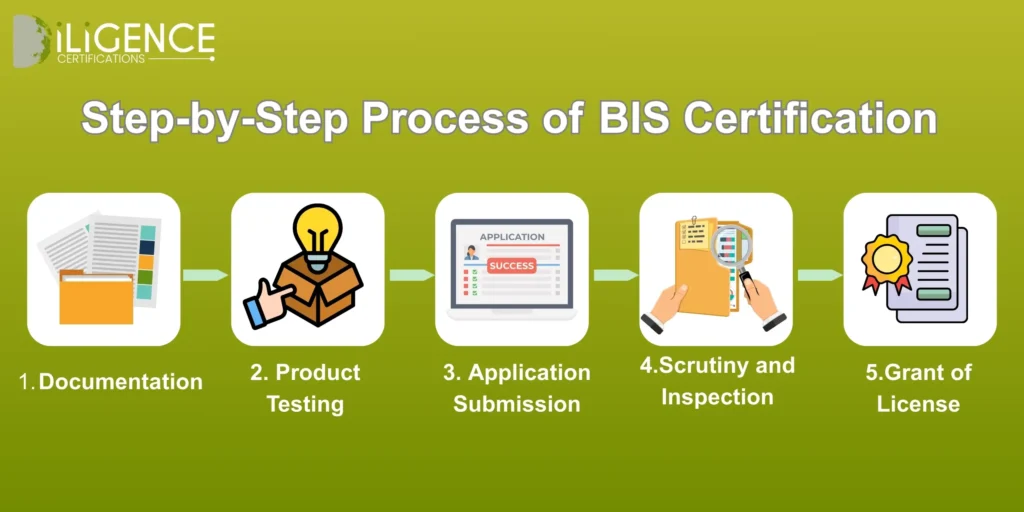
Step1:Documentation
- Collect required technical documents
- Prepare product specifications
- Gather company registration details
- Ensure documents follow BIS format
Step2:Product Testing
- Send samples to a BIS-approved lab
- Conduct safety and quality tests
- Receive test reports
- Confirm compliance with BIS standards
Step3:Application Submission
- Fill out the BIS application form
- Upload all required documents
- Attach valid test reports
- Pay the necessary BIS fees
Step4:Scrutiny and Inspection
- BIS reviews submitted documents
- Authority verifies test results
- Factory/product inspection may occur
- Clarifications requested if needed
Step5:Grant of License
- BIS approves the application
- License number is issued
- Product can carry BIS mark
- Renewal required before expiry
Documents Required for BIS Certification
| Category | Documents Required |
| Business Documents | Business license/registration, ISO certificate, organizational details |
| Manufacturer Details | Factory layout, process flow chart, machinery list, production details |
| Product Documents | Product specifications, component list, user manual, model details |
| Testing Documents | Test report from BIS-recognized lab, sample details, test request form |
| Legal & Compliance | Authorization letter, brand ownership proof, trademark certificate (if any) |
| Import/Foreign Manufacturer (If applicable) | AIR (Authorized Indian Representative) details, contract agreement, overseas manufacturer documents |
Timelines, Costs, Validity & Renewal
- Timelines: Usually from 20 to 30 days, with only 7-15 days for the testing.
- Costs: The cost of the government and the test varies depending on the product. There can be some additional charges though.
- Validity: The validity period is 2 years in most situations.
- Renewal: The renewal is done before the expiration; there should be updated documents/tests; the renewal
Why Choose Diligence Certifications
- Knowledge of BIS certification for Cold, Reduced Tinmill Products, Blackplate (IS/ISO 11951:2016) to the extent of ensuring absolute conformity.
- Complete assistance starting from the filing of the application till the granting of the BIS license.
- Efficient process that saves time and avoids the inconveniences of the business operations.
- Appropriate counseling to the different sizes of the manufacturers, small, medium, and large.
- Proven track record of successfully certifying multiple Indian steel manufacturers.
Conclusion
Getting a BIS certification for Cold Reduced Tinmill Products Blackplate (IS/ISO 11951:2016) is more than just a compliance measure, it is actually a wise decision that will bring long term benefits. Meeting local and global standards helps producers to reduce the risks of their operations, make the exports easier, and get the trust of their customers.The partnership with Diligence Certifications provides an easy way for the whole operation, from the beginning to the end, with a great support and a successful result. If any manufacturer is willing to upgrade their blackplate products by means of certification, then cooperating with Diligence Certifications is definitely a step towards quality assurance and business continuity.
Frequently asked questions
Is BIS certification for Cold – Reduced Tinmill Products – Blackplate (IS/ISO 11What951:2016)?
BIS certification ensures that blackplate sheets meet Indian and international quality standards as per IS/ISO 11951:2016.
Is BIS certification mandatory for blackplate products in India?
Yes, it is mandatory for specified steel products under the BIS Act to ensure compliance and market acceptance.
What are the benefits of BIS certification for blackplate sheets?
It guarantees product quality, enhances credibility, reduces rejections, and facilitates domestic and international trade.
How long does BIS certification take for cold-reduced blackplate products?
The certification process typically takes 4–8 weeks, depending on testing, inspection, and documentation completeness.
Can BIS-certified blackplate products be exported?
Yes, certification simplifies export procedures and helps meet regulatory requirements in international markets.
What documents are required for BIS certification of blackplate sheets?
Key documents include test reports, manufacturing details, quality control records, and application forms.
How often is product testing done for BIS compliance?
Regular testing is required for mechanical, chemical, and surface quality to ensure ongoing compliance with IS/ISO 11951:2016.
Does BIS certification improve market credibility for manufacturers?
Absolutely. BIS-certified products are widely trusted by clients, suppliers, and regulatory authorities.
Why choose Diligence Certifications for BIS certification?
Diligence Certifications offers expert guidance, end-to-end support, and a proven track record for blackplate products.
Can small-scale manufacturers also get BIS certification for blackplate products?
Yes, BIS certification is available for manufacturers of all scales, with customized guidance to meet compliance efficiently.