



 BIS Certification
 CDSCO
CDSCO
 CPCB
CPCB
 LMPC
LMPC
 WPC Approval
 Global Approvals
 TEC
TEC
 ARAI
ARAI
 BEE
BEE
 ISO Certification
 DGCA Certification
 NOC For Steel
 APEDA Registration















 Business Registration
 FSSAI Mark Certification












 Legal Services
 Trademark Registration
 Copyright Registration
 Patent Registration
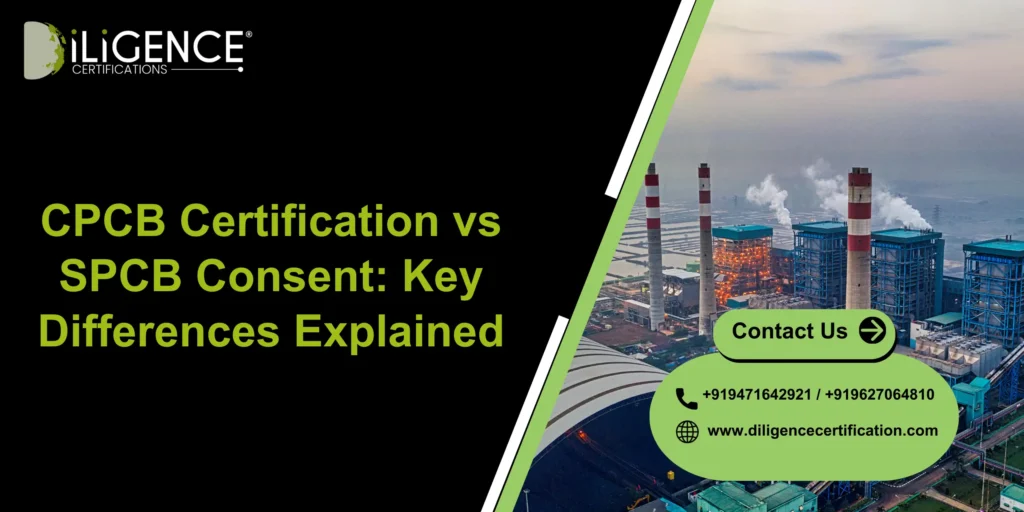
Different Regulatory Authorities: The Central Pollution Control Board is the one that issues the CPCB Certification vs SPCB Consentwhich is a national level measure while the State Pollution Control Boards are the ones who give the SPCB consent which is a state-based measure.
Scope of Compliance Varies: CPCB Certification is concerned with waste management, EPR obligations, and recycling authorization while on the other hand, SPCB Consent oversees air, water, and local pollution control.
Applicability to Businesses: The CPCB Certification is mainly for producers, recyclers, importers, and waste handlers, and the SPCB Consent is applicable to all manufacturing and industrial units.
Separate Legal Requirements: To set up and run a plant (CTE/CTO), SPCB Consent is mandatory while for CPCB Certification it is not unless the waste which is regulated is handled legally and producer responsibilities are met.
Both Often Required Together: The majority of the industries are required to get both CPCB Certification and SPCB Consent in order to be completely ecologically compliant and not face penalties or be closed down.

Introduction
In India, environmental compliance is one of the most important obligations for the industry sector. Due to the growing regulatory oversight, companies are required to comply with the norms set by both Central and State Pollution Control boards. Nevertheless, a lot of industries are still unclear about the requirement of CPCB Certification vs SPCB Consent or both.
A case in point is a manufacturing plant that may have obtained Consent to Operate from the Central Pollution Control Board (SPCB) but still is subjected to regulatory action for not securing CPCB Certification for waste disposal or EPR obligations. Such situations lead to the issuance of show-cause notices, imposition of penalties, or even a halt in operations sometimes.
In this post, we will be discussing the differences between CPCB Certification vs SPCB Consent along with their respective applicability, and significance so that the businesses can stay compliant with the regulations and avert legal troubles.
What is CPCB Certification vs SPCB Consent?
CPCB Certification vs SPCB Consent signifies the legitimacy of activity from the Central Pollution Control Board (CPCB) by means of approvals, registrations, or authorizations under different environmental laws and waste management rules.
It guarantees that the activities which have an impact on the environment across the country are in line with the central regulations.
CPCB Certification involves:
- Registration for Extended Producer Responsibility (EPR)
- Licensing for recyclers, dismantlers, and refurbishers of waste
- Regulation for the disposal of Plastic, E-Waste, Battery Waste, and Hazardous Waste and compliance with the rules governing them
- Surveillance of pollution control standards on the national scale
In the absence of CPCB Certification vs SPCB Consent, organizations managing regulated waste or having EPR responsibilities might suffer severe punishments or be totally banned from carrying out their business.
What is SPCB Consent?
The SPCB Consent is a permit that gets handed out by the State Pollution Control Board (SPCB) and it is a requisite for the creation and running of industrial units in that particular state.
The approval is given under:
- Water (Prevention and Control of Pollution) Act
- Air (Prevention and Control of Pollution) Act
- Environment Protection Act
SpCB Consent categories:
Consent to Establish (CTE): Necessary prior to the installation of an industrial unit
Consent to Operate (CTO): Mandatory before the start of operations
The SPCB Consent system is mainly about regulating the local pollution, discharge into the air, water, and land site cleanup, and acceptable waste disposal methods.
CPCB Certification vs SPCB Consent – Key Differences
| Feature | CPCB Certification | SPCB Consent |
| Regulatory Authority | Central Pollution Control Board | State Pollution Control Board |
| Scope | National-level compliance | State-level compliance |
| Focus | Waste management, EPR, authorization | Air, water, and local pollution control |
| Applicability | Producers, recyclers, importers | Manufacturing and processing units |
| Legal Basis | Waste Management Rules, EPR laws | Air & Water Acts |
| Validity | Up to 5 years (category-based) | 1–5 years depending on state |
Why Both CPCB Certification and SPCB Consent Are Important
Simultaneous approval is a must in many sectors.
- SPCB Consent guarantees that the industrial unit is polluting the state to the extent allowed by the state.
- CPCB Certification vs SPCB Consent provides the assurance that the waste management, recycling, and producer responsibilities are in line with the law at the national level.
They have united to offer complete environmental compliance and to shield companies against regulatory measures.
Importance and Benefits of CPCB & SPCB Compliance
| Importance | Benefits |
| Legal compliance | Avoids penalties and shutdowns |
| Environmental protection | Reduces pollution impact |
| Business continuity | Prevents operational disruption |
| Regulatory trust | Builds credibility with authorities |
| Market access | Enables lawful expansion |
Step-by-Step Compliance Process
Step 1: Identify Applicability
Determine the need for SPCB Consent, CPCB Certification, or both considering operations and the waste category of your business.
Step 2: Documentation
Prepare technical documents, details of pollution control, and compliance records.
Step 3: Application Submission
Submit an application for SPCB Consent via the respective state portals and for CPCB Certification through the CPCB online system.
Step 4: Inspection & Scrutiny
The authorities might carry out on-site inspections and might also validate the documents.
Step 5: Approval & Monitoring
After getting the approval, the process of continuous monitoring and reporting will be obligatory.
Step 6: Renewal & Amendments
Make sure the renewal is done on time and further the approvals are updated in case of any change in the capacity or process.
Documents Required CPCB Certification vs SPCB Consent
For SPCB Consent:
- Company incorporation documents
- Process flow diagram
- Pollution control system details
- Environmental monitoring reports
For CPCB Certification:
- EPR plans or waste authorization documents
- Recycling or disposal agreements
- Compliance reports
- Authorization letters (if applicable)
Timeline, Validity & Renewal
Processing Timeline: 30–60 working days
Validity: 1–5 years (depends on the category)
Renewal: Necessary before the expiration date along with updated compliance data
Conclusion
Knowing CPCB Certification vs SPCB Consent difference is mandatory for companies working in environmentally regulated sectors. Even though local industrial pollution is managed by SPCB Consent, waste management and producer responsibilities are ruled by CPCB Certification vs SPCB Consent nationally.
Noncompliance with either of the two is not only a legal issue but a tactical approach that safeguards operational stability, environmental responsibility, and longevity of the business. Companies that are managing CPCB and SPCB requirements on a proactive basis gain the trust of the regulators, minimize risks and enhance their market reputation.
Frequently Asked for Questions
What is CPCB Certification?
It is an authorization granted at the central level that certifies the compliance of the waste management, EPR, and recycling sector.
What is SPCB Consent?
SPCB Consent allows factories to set up and run under the condition of minimizing their pollution of air and water.
Is CPCB Certification mandatory for all industries?
It is not; it is mostly for waste handlers, recyclers, and producers taking part in EPR.
Is SPCB Consent required for manufacturing units?
SPCB Consent is indeed required for all industrial units as it is the only way to operate legally.
Can a company require the approval of both CPCB and SPCB?
The answer is yes, there are several industries that need both for total environmental compliance.
Who issues CPCB Certification?
The CPCB Certification is issued by the Central Pollution Control Board.
Who gives SPCB Consent?
The SPCB Consent is given by the corresponding State Pollution Control Board.
What will happen if the SPCB Consent is not acquired?
The unit can undergo closure, face fines or even get into legal trouble.
Does the CPCB Certification include EPR obligations?
CPCB Certification indeed governs the EPR compliance of regulated products.
How long do the CPCB and SPCB approvals last?
The validity can be anywhere from 1 to 5 years depending on the category and state regulations.