

 BIS Certification
 CDSCO
CDSCO
 CPCB
CPCB
 LMPC
LMPC
 WPC Approval
 Global Approvals
 TEC
TEC
 ARAI
ARAI
 BEE
BEE
 ISO Certification
 DGCA Certification
 NOC For Steel













 Business Registration












 Legal Services
 Trademark Registration
 Copyright Registration
 Patent Registration
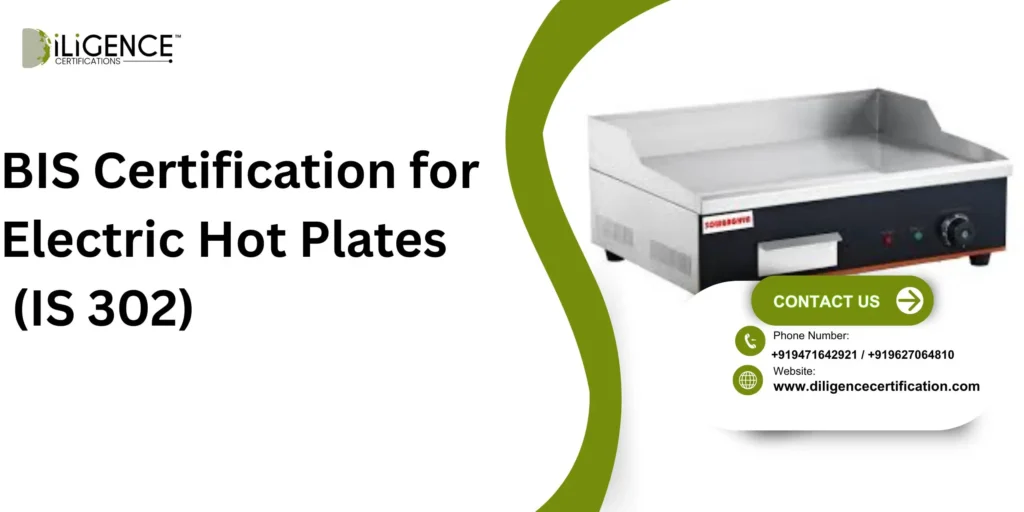
- Mandatory Compliance: Hot electric plates with a voltage less than 250V intended for household and similar uses are required to have a BIS certificate before being sold in India.
- Safety Standards: Protect the user from electric shock, overheating, fire, and abnormal operation of the appliance, etc.
- Particular Requirements: IS 302 (Part 2/Sec 207): 1994 specifies safety rules for electric hot plates to be read together with the general requirements of IS 302 (Part 1).
- Product Testing: The appliances are tested in BIS-recognized laboratories for insulation resistance, temperature rise, leakage current, and mechanical strength.
- ISI Mark Permission: The products that are certified are allowed to bear the ISI mark which is a guarantee of conformity to the law, safety assurance, and consumer confidence.
Introduction
Electric hot plates are one of the most convenient and portable household appliances that are frequently used for cooking and heating purposes. In order to keep the users safe and to ensure that the appliances perform reliably, the Bureau of Indian Standards (BIS) has made it mandatory for electric hot plates to be certified according to IS 302 (Part 2/Sec 207): 1994, read along with IS 302 (Part 1).These standards lay down the basic safety requirements that include protection against electric shock, overheating, risk of fire, and abnormal operating conditions. BIS Certification is a testimony to the fact that electric hot plates are in conformity with Indian safety standards and thus, the manufacturers and importers of such products are allowed to market their products in India legally, thereby, increasing the trust of the customers and making the products more reliable.
What is IS 302: 1994?
ISI 302:1994 is a standard set by the Bureau of Indian Standards (BIS) that defines the safety requirements of household and similar electrical appliances that work on electricity. In short, it is a safety standard that provides the utmost protection to the user by considering different hazards to the user, such as the risk of electric shock, overheating, fire, mechanical injury, and safe operation even under abnormal conditions. The norm is organized around two main components. IS 302 (Part 1):1994 defines the overall safety features that are considered necessary for all household and similar electrical appliances, with the general requirements of the standard mutually binding for all, and advice and instruction being the only exceptions. These include general provisions on construction, insulation, earthing, leakage current, temperature conditions, and resistance to moisture and mechanical stress.
IS 302 (Part 2) details the specific safety features for certain kinds of devices that serve as a supplement or a modification to the general requirements given in Part 1 so as to focus on the particular types of risks associated with the specific appliances. In other words, the requirements of Part 1 stay in force except when modified by those of Part 2.
Key points
- IS 302:1994 is the safety standard for household and similar electrical appliances that is signed off by the Bureau of Indian Standards (BIS)
- First a general and second a specific: The standard is made up of Part 1 (general safety requirements) and Part 2 (particular requirements for specific appliances).
- Help and safety for the user: The standard takes care of the protection of the user against electric shock, fire hazards, overheating, and mechanical risks
- Such goods as household appliances should meet the standard requirements: The appliances may be constructed so that they conform to the requirements concerning construction, insulation, earthing, temperature rise, and abnormal operation.
- Essential qualification: Certification of the Bureau of Indian Standards (BIS) requires that the products comply with IS 302:1994, thus they will be ISI marked and can be legally sold in India.
Why is BIS Certification Mandatory
BIS Certification is a must-have to assure the products that are made, brought, or sold in India are in accordance with the Indian safety, quality, and performance standards set by the authorities. It is a regulatory tool that keeps the consumers safe from products that are unsafe, of low quality, or even dangerous, mainly in those product categories, such as electrical appliances, where the risks of electric shock, fire, and overheating are considerable.BIS certification for electrical and household appliances is a statement of compliance of the products with the corresponding Indian Standards, which is proven through stringent testing in laboratories that are recognized by BIS. The tests in these labs include the assessment of safety aspects such as insulation resistance, leakage current, temperature rise, mechanical strength, and performance under normal and abnormal operating conditions. In this way, it is ensured that accidents, equipment breakdown, and the loss of life and property do not occur.
Key points
- Consumer Safety: A major aspect of the technology is to keep the consumer safe from situations such as electric shock, fire hazard, and overheating, etc
- Quality Assurance: Ensures the products meet the Indian Standards set for them in terms of their functionality, lifespan, and stability.
- Legal Compliance: BIS rules make it compulsory and without certification, the products cannot be made, imported, or sold in India.
- Product Testing & Verification: Product tests conducted in BIS-recognized laboratories are part of the process used to establish safety and quality features.
- Market Trust & Acceptance: As an ISI-marked product is consumer-friendly, it helps to increase consumer trust, brand credibility, and acceptance in the Indian market.
Importance and Benefits of BIS Certification
| Importance | Benefits |
| Ensures Legal Compliance: BIS certification is a must if one has a plan to produce, bring in or sell electric hot plates in India as per the IS 302 standards. | Assured Safety Standards: In fact, the certification acts as a single reference source, indicating that the product meets the tested electrical, thermal, and mechanical safety requirements given in IS 302 (Part 1) as well as other safety aspects for a particular appliance, which come from Section 207.. |
| Mandatory Safety Regulation: Accordingly, compliance through the use of such products confirms that national safety requirements for household electrical appliances have been fulfilled and, therefore, the users are safe. | Reliable Product Performance: As a device, I understand that it means the device will not only be safe under normal but also under abnormal situations. For example, temperature rise and overload protection can be found. |
| Consumer Protection: Consumers turn out to be the most protected because they are shielded from such disaster as electric shocks, overheating, and fire, along with dangerous operation. | Reduced Risk of Accidents: The risks during short circuits, insulation failure, overheating, and fire are at their lowest levels. |
| Market Authorization: BIS is the only organization that has the authority to allow the marketing of electric hot plates that meet the requirements, as evidenced by the ISI mark which is the hallmark carried on the product. | Builds Consumer Trust: The ISI mark is a trust badge in the eyes of the consumers, market product genuineness, and brand stability being the main points that the mark draws attention to. |
| Regulatory Accountability: In doing so, manufacturers are required to follow the set safety, testing, and quality control standard procedures as per BIS and should be recognized as being accountable for them. | Competitive & Market Advantage: The electric hot plates possessing the BIS certification are allowed to go in the market through various channels such as institutional supply, organized or unorganized trade, and e-commerce. |
Step-by-Step Process of BIS Certification
Step1:Documentation
- Collect required technical documents
- Prepare product specifications
- Gather company registration details
- Ensure documents follow BIS format
Step2:Product Testing
- Send samples to a BIS-approved lab
- Conduct safety and quality tests
- Receive test reports
- Confirm compliance with BIS standards
Step3:Application Submission
- Fill out the BIS application form
- Upload all required documents
- Attach valid test reports
- Pay the necessary BIS fees
Step4:Scrutiny and Inspection
- BIS reviews submitted documents
- Authority verifies test results
- Factory/product inspection may occur
- Clarifications requested if needed
Step5:Grant of License
- BIS approves the application
- License number is issued
- Product can carry BIS mark
- Renewal required before expiry
Documents Required for BIS Certification
| Category | Documents Required |
| Business Documents | Business license/registration, ISO certificate, organizational details |
| Manufacturer Details | Factory layout, process flow chart, machinery list, production details |
| Product Documents | Product specifications, component list, user manual, model details |
| Testing Documents | Test report from BIS-recognized lab, sample details, test request form |
| Legal & Compliance | Authorization letter, brand ownership proof, trademark certificate (if any) |
| Import/Foreign Manufacturer (If applicable) | AIR (Authorized Indian Representative) details, contract agreement, overseas manufacturer documents |
Timelines, Costs, Validity & Renewal
- Timelines: Usually from 20 to 30 days, with only 7-15 days for the testing.
- Costs: The cost of the government and the test varies depending on the product. There can be some additional charges though.
- Validity: The validity period is 2 years in most situations.
- Renewal: The renewal is done before the expiration; there should be updated documents/tests; the renewal
Why Choose Diligence Certifications
Diligence Certifications is a reliable compliance and certification consultancy which mainly focuses on BIS certification as well as other regulatory approvals in India. Diligence Certifications, being well-versed with the Indian Standards and regulatory frameworks, assists producers, importers, and brands throughout the entire journey to make the certification process easy and free of any kind of trouble.The firm injects its expertise into the venture from the very beginning to the end, such as product classification, preparation of the documents, communication with the BIS recognized labs, submission of the application, and BIS authorities follow-up. In this way, clients get the certification quickly because of lessening the wait time and mistakes. At the same time, they are sure that they are abiding by all the requirements of the standards that apply to them.
Conclusion
BIS certification is a major factor that guarantees safety, quality, and product reliability that are new to the Indian market. For household and other similar electrical appliances, conformity to relevant Indian Standards is instrumental in preventing risks such as electric shock, overheating, and fire hazards, at the same time, it guarantees performance stability under both normal and abnormal conditions. In addition to that, the compulsory certification serves as a guarantee of compliance with the law at the level of national regulations, thus, making a legal framework that is safe for both consumers and manufacturers. Manufacturers and importers, by complying with BIS requirements, are showing their readiness to safety, quality assurance, and regulatory obligation.
Frequently Asked Questions (FAQs)
Is BIS certification mandatory for electric hot plates in India?
In order to be allowed in the market of electric hot plates, a product must be certified by B.I.S. whether the products are manufactured, imported, or sold in India.
What Indian Standards apply to electric hot plates?
Electric hot plates must comply with IS 302 (Part 2/Sec 207):1994 along with IS 302 (Part 1):1994.
What safety aspects are covered under IS 302 standards?
The standards cover protection against electric shock, overheating, fire hazards, mechanical risks, and abnormal operating conditions.
Where are electric hot plates tested for BIS certification?
Performing tests on electric hotplates which are aimed at BIS certification is done in laboratories that are authorized by BIS for the parameters of electrical, thermal, and mechanical safety that are evaluated.
What tests are commonly performed during certification?
Tests include insulation resistance, leakage current, temperature rise, earthing continuity, and mechanical strength.
What is the duration of BIS certification?
BIS certification is usually valid for two years. The period can however be extended if the renewal is done on time.
Is factory inspection required for BIS certification?
In addition to product and laboratory inspection, BIS may sometimes also conduct factory visits to check production and quality control procedures.
Can imported electric hot plates be sold without BIS approval?
No. Without BIS certification, imported electric hot plates cannot be sold in India.
What is the ISI mark?
The ISI mark indicates compliance with Indian safety standards and assures product safety and legal conformity.
What happens if a product is sold without BIS certification?
In the case of a hot electric plate seller who is without the required certification, the offenders will be liable to a great variety of actions, among which the penalization of the offenders, the seizure of their goods, and the initiation of court proceedings under BIS regulations are the most prominent ones.