

 BIS Certification
 CDSCO
CDSCO
 CPCB
CPCB
 LMPC
LMPC
 WPC Approval
 Global Approvals
 TEC
TEC
 ARAI
ARAI
 BEE
BEE
 ISO Certification
 DGCA Certification
 NOC For Steel











 Business Registration












 Legal Services
 Trademark Registration
 Copyright Registration
 Patent Registration
- Knowing the basics of the Bureau of Indian Standards (BIS) certification will help you a lot in figuring out if the metals used in the structures of the buildings are both safe and of good quality.
- Flat steel pipes are one of the lightest structural materials, which is why they are perfect for the creation of the structural frameworks of houses, commercial buildings, and industrial buildings.
- Flat Steel tubes for construction with BIS Certificate under IS 1161:2014 assure compliance with Indian standards, thus giving the consumers confidence in the product’s longevity and performance.
- To keep a certificate, the manufacturers and suppliers have to go through the strict test requirements such as those for the material’s mechanical properties, dimensions, and surface finish.
- Besides, the proper documentation and the steel traceability will be the construction companies’ safety against the law and a tool for keeping the quality assurance throughout the project lifecycle.
Introduction | Flat Steel tubes
BIS Certificate for Flat Steel tubes for structural purposes Under IS 1161:2014. This certification is a guarantee that flat steel tubes conform to the stringent mechanical and dimensional standards laid down for structural applications. Bureau of Indian Standards The principle idea of the certification for engineers and builders is that the strength, longevity and safety of the product have been verified. Apart from conforming to regulations, the market is also safeguarded against instances of material failure which can derail the whole project. Knowing the details of BIS certification is no longer an option in the fast expanding construction industry of India but rather a requirement. This manual is a complete professional handbook on Flat Steel tubes for structural purposes Under IS 1161:2014. It explains testing, quality standards, and how to select certified suppliers for a hassle-free project completion.
What is IS 1161:2014?
IS 1161:2014 means the Indian Standard specification for the steel tubes that are made for the structural field as per the Bureau of Indian Standards (BIS). In particular, it is the regulation that guides the manufacturing, testing, and quality requirements of the steel tubes for structural purposes, thus, ensuring the constructions’ safety and the customer’s confidence.
Key points
- Mechanical properties: These are tensile strength, yield strength, and elongation, which demonstrate how the metal tube will be capable of resisting the structural load without fracturing.
- Dimensional accuracy: Standardised width, thickness and length are used to make the construction more accurate and the integration into the structural frameworks more easy.
- Surface quality: It should not have any defects like cracks, laminations, or heavy rust that can make the structure weaker on the surface.
- Testing protocols: The standard also defines the various destructive and non-destructive tests such as flattening, bending, and hydrostatic tests, which are to be done to identify the compliance.
Why is BIS Certification Mandatory?
BIS certification goes beyond being a mere regulatory requirement, it is an essential feature that ensures the quality, safety, and stability of structural materials in India. In the case of Flat Steel tubes for structural purposes Under IS 1161:2014, the reasons for which certification is especially significant are as follows: Safety Compliance: The use of structural steel is central to the safety of buildings, bridges, and industrial frameworks. BIS certification thus guarantees that the tubes adhere to strict mechanical and dimensional standards which in turn greatly lowers the possibility of structural failures.
Key points
- Legal Requirement: The use of BIS-certified steel is a prerequisite in government and private construction projects in India. Uncertified materials usage will result in fines, project delays, or legal liabilities.
- Quality assurance: To begin with, the certification serves as a guarantee that the different structural parts have been made under the specified controlled conditions and have been tested for properties like strength, flattening, bending, and surface integrity, as per IS 1161:2014.
- Sourcing Trust: It becomes easier for engineers and contractors to find suppliers by simply checking for BIS certification hence, the problem of suppliers who provide low-quality and counterfeit steel disappears.
- Cost Efficiency of the Long-Term: The use of certified steel might require a little increment in the initial cost, nevertheless, it is cheaper in the long run since it reduces the cost of maintenance, structural repairs, and project downtime.
Importance and Benefits of BIS Certification
| Importance | Benefits |
| Safety of the structure is ensured in case of buildings and infrastructural facilities | The risk of structural failure and accidents is significantly reduced |
| Conformity with Indian laws and standards related to construction | Saving from penalties and stoppages of the project |
| Also, confirmation of the quality of manufacturing and the consistency of the materials through the BIS standard is provided | Performance under load, being quite, is also ensured by the material |
| Recognition of the most reliable and certified suppliers | Engineers, contractors, and clients gaining on the trust and confidence |
| Keeping up with the current best practices in construction | Minimizes maintenance costs and long-term project risks |
Step-by-Step Process of BIS Certification
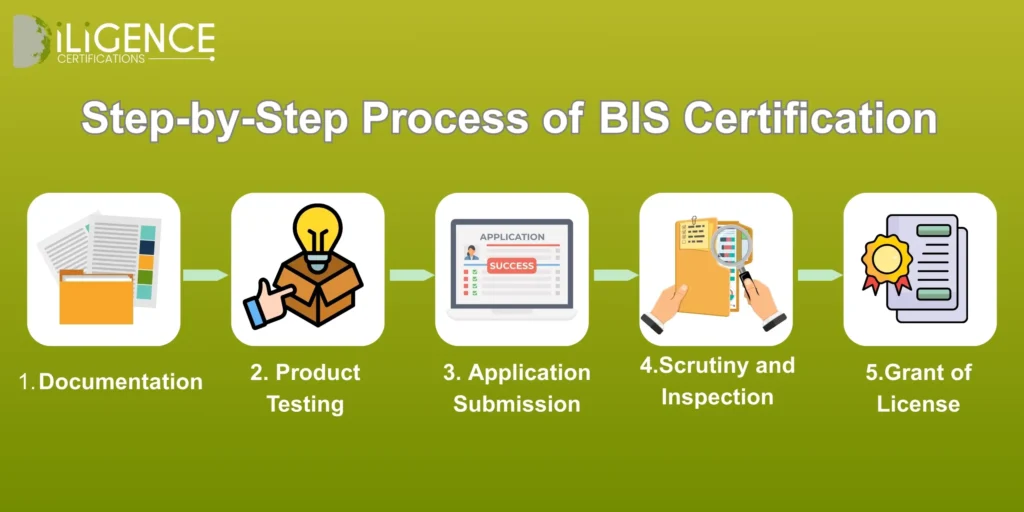
Step1:Documentation
- Collect required technical documents
- Prepare product specifications
- Gather company registration details
- Ensure documents follow BIS format
Step2:Product Testing
- Send samples to a BIS-approved lab
- Conduct safety and quality tests
- Receive test reports
- Confirm compliance with BIS standards
Step3:Application Submission
- Fill out the BIS application form
- Upload all required documents
- Attach valid test reports
- Pay the necessary BIS fees
Step4:Scrutiny and Inspection
- BIS reviews submitted documents
- Authority verifies test results
- Factory/product inspection may occur
- Clarifications requested if needed
Step5:Grant of License
- BIS approves the application
- License number is issued
- Product can carry BIS mark
- Renewal required before expiry
Documents Required for BIS Certification
| Category | Documents Required |
| Business Documents | Business license/registration, ISO certificate, organizational details |
| Manufacturer Details | Factory layout, process flow chart, machinery list, production details |
| Product Documents | Product specifications, component list, user manual, model details |
| Testing Documents | Test report from BIS-recognized lab, sample details, test request form |
| Legal & Compliance | Authorization letter, brand ownership proof, trademark certificate (if any) |
| Import/Foreign Manufacturer (If applicable) | AIR (Authorized Indian Representative) details, contract agreement, overseas manufacturer documents |
Timelines, Costs, Validity & Renewal
- Timelines: Usually from 20 to 30 days, with only 7-15 days for the testing.
- Costs: The cost of the government and the test varies depending on the product. There can be some additional charges though.
- Validity: The validity period is 2 years in most situations.
- Renewal: The renewal is done before the expiration; there should be updated documents/tests; the renewal
Why Choose Diligence Certifications
- Expertise in Compliance: Diligence Certifications has undergone a lot of situations with manufacturers and suppliers to acquire a BIS Certificate for Flat Steel tubes for structural purposes Under IS 1161:2014 in the right way, thus ensuring regulatory compliance fully.
- End-to-End Support: We are there every step of the way with you in the certification process from filing the document, guiding you in it, and coordinating the testing, thereby saving you time and preventing mistakes.
- Trusted by Leading Brands: The top construction companies and steel suppliers have turned to Diligence Certifications for the most reliable, trouble-free certification, thus being able to deliver their projects with confidence.
- Up-to-Date Knowledge: We always keep ourselves updated on the latest changes of BIS and IS 1161:2014 so that our clients will always comply with the current standards.
- Quality Assurance Advisory: Apart from the certification, we offer advisory services on how to sustain the quality of manufacturing, the traceability of the material, and the compliance of the products in the long run, thus giving you more than just structural projects.
Conclusion
Being authorized with a BIS Certificate for Flat Steel tubes for structural purposes Under IS 1161:2014 is more than just a mandate – it is an emblem of credibility, quality, and safety in the construction domain. Certified flat steel tubes facilitate structural stability, thus, lowering the chances of risks at the project level and conferring a sense of security to engineers, contractors, and stakeholders, thereby, the same. Addressing the issue with Diligence Certifications will make the procedure less complicated, as they have the know-how, full support, and conformity with the most recent BIS standards. The use of BIS-certified steel is a wise decision that guarantees safety, compliance, and long-term savings for any construction endeavor , be it a small residential complex or a massive industrial framework.
Frequently Asked Questions
What is a BIS Certificate for Flattened Steel Tubes?
A flat steel tube is certified to be compliant with IS 1161:2014 when it is used for structural purposes.
Why is a BIS certificate so essential?
It is safety, quality, and reliability that a BIS certificate assures for the construction projects where the steel is used.
Is BIS certification a must for structural steel?
It is required by many government and private projects for security and legal compliance.
What is IS 1161:2014 about?
The main points are the mechanical properties, dimensional accuracy, surface quality, and testing protocols.
What kind of tests are done for certification?
Flattening, bending, hydrostatic, and other mechanical and quality tests are performed.
How long is BIS certification?
The whole period is usually 20–30 days that include 7–15 days for lab testing.
What are the necessary documents?
Business registration, manufacturer details, product specifications, and laboratory test reports are some of the documents.
What is the validity period of the certificate?
The certificate is generally valid for 2 years, and the renewal is done before the expiry date.
Can foreign manufacturers obtain a BIS certificate?
Certainly, upon proper documentation and through an Authorized Indian Representative (AIR).
How can certification help construction companies?
Firstly, it guarantees the quality of the materials used. Secondly, it lowers the chances of structural failure. Thirdly, it makes it easier to spot reliable suppliers.