



 BIS Certification
 CDSCO
CDSCO
 CPCB
CPCB
 LMPC
LMPC
 WPC Approval
 Global Approvals
 TEC
TEC
 ARAI
ARAI
 BEE
BEE
 ISO Certification
 DGCA Certification
 NOC For Steel
 APEDA Registration













 Business Registration
 FSSAI Mark Certification











 Legal Services
 Trademark Registration
 Copyright Registration
 Patent Registration
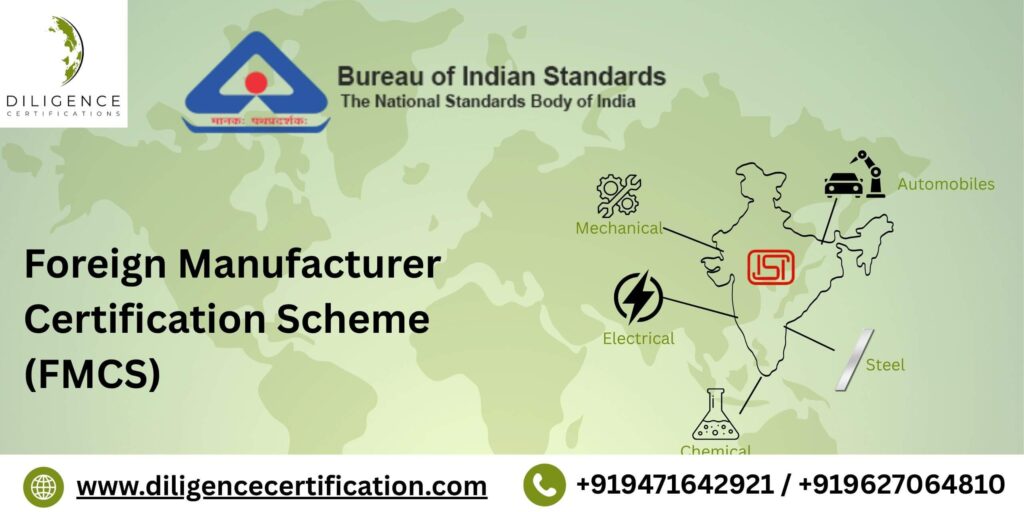
- BIS certification for foreign manufacturer enables compliance with Indian quality and safety laws for imports.
- This blog explains the BIS FMCS certification process step by step, with a realistic view of client challenges.
- Also covers required documents, timelines, and best practices for a seamless BIS licence grant under FMCS.
- Shows the business potentials on the one hand for securing FMCS certification and smooth market access in India.
- Gives the roadmap that can be acted upon for FMCS certification with professional support and best practices.
Introduction
When a global brand once known for its premium household electrical appliances tried to enter the Indian market, it was stunned by what seemed an endless wall of compliance. This manufacturer, headquartered in Germany, had no clue about the complexities of the BIS certification for foreign manufacturer under India’s legal framework. Containers were stuck at port, the customs department refused clearance, and the importer faced enormous storage penalties.
Diligence Certifications, an experienced compliance consultancy, stepped in to unravel the mess. Their experts guided the client through the FMCS (Foreign Manufacturers Certification Scheme), handling document gaps, factory audits, and technical clarifications. What looked impossible became a realistic route to market with a BIS licence in under 8 months.
Such real-world examples are common. India’s safety and quality laws are among the strictest globally, so manufacturers abroad cannot simply ship products in without proving compliance. BIS certification for foreign manufacturer, especially through the FMCS route, is mandatory for many items — from electronics to construction materials — under India’s Compulsory Registration Scheme (CRS).
What is FMCS Certification and Why Does It Matter?
Bureau of Indian Standards (BIS) is India’s national standards body under the BIS Act, 2016. BIS certification for foreign manufacturer guarantees a product meets the relevant Indian Standard (IS) for safety, quality, and performance. It is required for a large list of products notified under mandatory certification.
For foreign manufacturers, BIS operates the Foreign Manufacturers Certification Scheme (FMCS), which allows you to apply for a licence to use the BIS Standard Mark (ISI Mark) on your products exported to India.
The key highlights:
- Product certification is mandatory if your category is on BIS’s notified schedule.
- Factory audits and product sampling are part of the process.
- The scheme ensures imported goods match the same standards as Indian-made goods.
The intent is to protect Indian consumers while maintaining a level playing field.
How the FMCS Scheme Works
Take the case of a Chinese cables manufacturer approached by Diligence Certifications. The company was excited to tap India’s growing infrastructure sector. But its first shipment was rejected due to lack of a BIS licence. The FMCS certification was the only route to move ahead.
From their factory in Suzhou, they needed to send samples, prove the testing capabilities, and satisfy BIS that their processes aligned with the Indian Standard for cables. Their project engineer said:
“It felt like rewriting our entire quality manual to match India’s system.”
Yet, with guided preparation, their BIS FMCS certification was granted, and shipments resumed within 7 months.
Process of FMCS Certification for Foreign Manufacturers

BIS FMCS certification process involves a set of systematic steps for the grant of BIS licence to foreign manufacturers. This is a critical part of achieving BIS certification for foreign manufacturer. Here is the framework in practical language:
Submit Application
- Gather all required documents (explained in the next section).
- Submit through the BIS online portal, plus a physical copy to the FMCD (Foreign Manufacturers Certification Department).
- BIS verifies completeness of the application.
- If any deficiencies are found, BIS will email the applicant to resolve them.
- After satisfying the checklist, BIS records your application and issues an acknowledgement number.
Audit and Inspection
- BIS fixes a factory audit date after confirming fee remittance.
- A BIS officer visits the manufacturing site abroad.
- They verify production capacity, test labs, quality controls, and collect product samples.
- Those samples are sealed and sent to a BIS-approved independent laboratory.
Sample Testing
- The independent lab tests the sample as per the relevant IS code.
- Charges for testing are borne by the manufacturer.
- The BIS (FMCS) receives the lab report for review.
Grant of Licence
- If the audit report and lab test report both meet requirements, BIS processes the grant of licence.
- You must pay the licence fee, advance minimum marking fee, and clear any outstanding dues.
- Finally, BIS issues the formal Letter of Grant of Licence, which allows you to use the ISI mark for your product.
In practice, these steps can take 6–9 months depending on factory readiness and how fast documents and test samples move through BIS.
Mandatory Documents Required for FMCS Mark Certification
The documentation part under the foreign manufacturer certification scheme is not overly complex if you plan carefully. Under the BIS online application system, you must submit:
- Factory or company registration papers
- Flowchart of manufacturing process
- In-house manufacturing capability documents, or outsourced agreements if applicable
- Quality control procedures and records
- List of machinery and testing equipment
- Layout of the factory with photographs
- Product testing reports from an accredited lab
- Acceptance of the Scheme of Testing and Inspection (STI)
- Details of annual marking fee payment arrangements
It is wise to engage a BIS consultant like Diligence Certifications to verify every document before filing, to avoid repeated clarifications from BIS.
Costs Involved in BIS FMCS Certification
It is equally important to understand the costs behind BIS FMCS certification. Clients often ask:
- Application fee
- Audit fee (travel, stay, etc.)
- Sample testing fee
- Licence fee
- Minimum marking fee
Beyond these, you might face:
- Translation costs for documents
- Possible consultant fee
- Internal employee time for preparation
For a mid-scale manufacturer, an all-inclusive BIS FMCS Certification can run from INR 6–12 lakhs over the licensing cycle.
Timeline for BIS Certification for Foreign Manufacturer
Realistically, you should plan 6 to 9 months for the entire process. Here’s a sample timeline many clients experience:
- Week 0–2: Document collection
- Week 3–6: Application submission + clarifications
- Week 7–12: Audit scheduling and preparation
- Week 13–20: Sample testing
- Week 21–28: Licence grant
Delays are common if your factory quality system is not in line with the BIS scheme.
Benefits of BIS Certification for Foreign Manufacturer
Why bother? Here’s what global brands gain:
- Seamless market access — products cleared by customs
- Trust factor with Indian buyers
- Competitive advantage
- Avoid legal disputes over mandatory certification
- One-time standard alignment that can serve multiple Indian buyers
If you wish to do business in India long-term, BIS certification for foreign manufacturer is an investment, not an expense.
Challenges in FMCS Certification
Clients also face hurdles, which are real:
- Language barriers in preparing technical documents
- Different test standards compared to IEC or EN
- Factory design and layout might need upgrades
- Sample shipping delays
- Interpretation differences between Indian and foreign testing practices
But working with a dedicated BIS consultant such as Diligence Certifications smoothens these issues because they understand BIS mindsets from prior audits.
From Rejection to BIS Certification
An American kitchenware brand was launching high-end pressure cookers in India. But the Indian BIS standard required an additional safety valve and a thicker base thickness, compared to US standards. Their first attempt at BIS FMCS certification was rejected.
Diligence Certifications helped them redesign the product, guided the factory through a second audit, and finally obtained BIS licence. They now sell nearly 500,000 units a year in India with a proud ISI mark.
How to Maintain FMCS Licence After Approval
Post-licensing is not to be ignored. The BIS licence for foreign manufacturer under FMCS needs:
- Annual renewal
- Payment of annual marking fees
- Periodic surveillance audits
- Adherence to the accepted Scheme of Testing and Inspection
Non-conformities or changes in manufacturing location can lead to suspension or cancellation of the licence. Plan compliance resources accordingly.
Conclusion
Although it may seem like a bureaucratic formality, BIS certification for foreign manufacturers is the basis for establishing trust, compliance, and confidence in one of the world’s most exciting consumer markets. The FMCS framework ensures that all foreign-origin products meet India’s high-quality standards and protect public health and safety by ensuring foreign and local manufacturers compete fairly.
Of the hundreds of international brands we have worked with, those that put in the time to understand the BIS through the FMCS framework tend to have less customs clearance hassles, fewer disputes with channel partners, and an overall good impression of their brand in the Indian market, more sustainably! It is absolutely the difference between building a sustainable, profitable brand in India and constant process headaches everywhere you encounter a port or customs official.
If you are a foreign manufacturer looking to sell in India, think about the BIS certification process as a strategic compliance project, not just an item on a checklist. With the right record keeping, purposeful product design that meets Indian Standards, and a positive and constructive mindset while being audited, you will have your BIS certification in no time.
In today’s competitive marketplace, where consumers are more quality-conscious than ever, a BIS-certified product will always attract better consideration for shelf space, a better relationship with distributors, and a substantial competitive advantage. Whether it’s a simple appliance, or a complex industrial product, the Indian market rewards those who are proactive in meeting its compliance requirements.
If you are on the path toward BIS FMCS certification, then start with a frank assessment of your product and quality systems. Make sure you engage a reputable compliance partner like Diligence Certifications, and familiarize yourself with the applicable Indian Standards and audit requirements. Also, think about the resources you need to prepare for the audit, testing of samples and any ongoing surveillance requirements.
key with confidence, start your BIS FMCS certification journey today — the right way, with the right expertise, and a future-ready mindset.
Frequently Asked Questions
Is it mandatory for foreign manufacturers to obtain BIS FMCS certification?
Yes, if your product is under the compulsory certification scheme, then under the foreign manufacturer certification scheme, the BIS FMCS Certification is mandatory for all foreign manufacturers. Without this, the products cannot be legally exported to India.
What happens if my factory fails the first BIS FMCS audit?
If the factory fails the first BIS FMCS certification audit, it can then rectify identified non-conformities and then apply for a re-audit under the foreign manufacturer certification scheme to meet full compliance
How long does a BIS FMCS Certification license last?
In general, BIS FMCS Certification licenses for foreign manufacturers are valid for one year and are renewable each year provided the license holder performs satisfactorily and passes surveillance audits.
What happens in case BIS decides to change the relevant Indian Standards?
If the Indian Standards are changed or updated by BIS, the product under BIS FMCS Certification has to be immediately brought into acceptance with the changed standard within a reasonable time, else the suspension or cancellation of the license may come to take place.
Is Diligence certifications the same as BIS FMCS Certification?
No. Diligence Certifications is a consultancy service provider guiding you through the various requirements of BIS FMCS Certification, while BIS (Bureau of Indian Standards) is the government authority which issues licenses under the Foreign Manufacturer Certification Scheme.
Can BIS reject my product samples after testing?
Yes, BIS has the full legal authority to reject your product samples if found not to be in conformity with the specified requirements stipulated in the relevant Indian Standard in the testing procedure for BIS FMCS Certification.
What if I change my raw material vendors after getting BIS FMCS Certification?
You are required to immediately inform BIS about the change in raw material vendors, as they, on their part, may require a sample revalidation to continue maintaining the BIS FMCS Certification for foreign manufacturers under the Foreign Manufacturer Certification Scheme.