


 BIS Certification
 CDSCO
CDSCO
 PESO
PESO
 CPCB
CPCB
 LMPC
LMPC
 WPC Approval
 Global Approvals
 TEC
TEC
 ARAI
ARAI
 BEE
BEE
 ISO Certification
 DGCA Certification
 NOC For Steel
 APEDA Registration














 Business Registration
 FSSAI Mark Certification











 (32).jpg)
 Legal Services
 Trademark Registration
 Copyright Registration
 Patent Registration
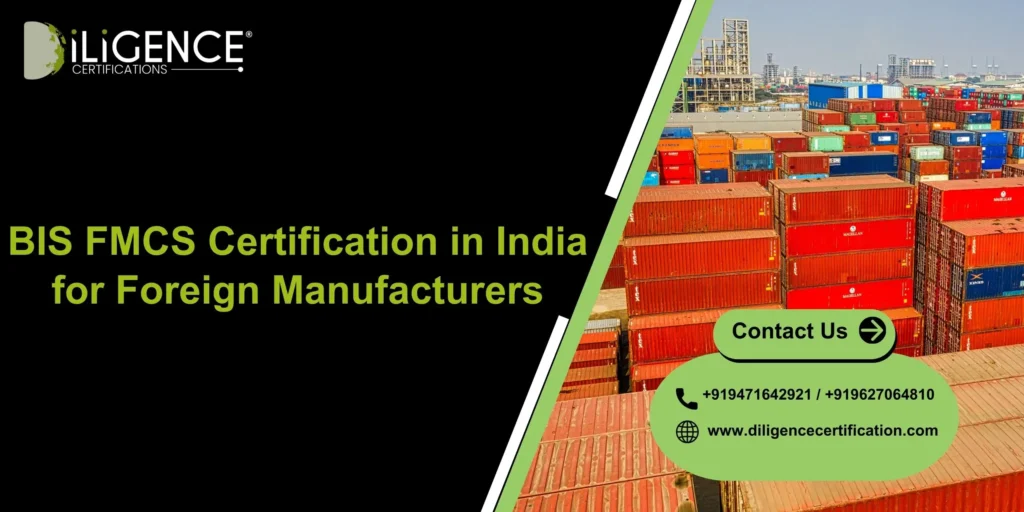
- FMCS for Foreign Manufacturers allows foreign manufacturers to legally sell products in the Indian market that fall under mandatory BIS standards.
- The certification is issued by the Bureau of Indian Standards (BIS) under the Foreign Manufacturers Certification Scheme (FMCS).
- It ensures that imported products meet Indian quality, safety, and performance standards.
- Foreign manufacturers must appoint an Authorized Indian Representative (AIR) to apply for the certification.
- BIS officials conduct factory inspections and product testing before granting the FMCS license.
Introduction | FMCS for Foreign Manufacturers
India is one of the swift- growing requests in the world, attracting manufacturers from across the globe. still, before foreign companies can sell certain regulated products in India, they must misbehave with the country’s quality and safety norms. One of the most important nonsupervisory conditions for foreign manufacturers is BIS FMCS Certification.
The Foreign Manufacturers Certification Scheme( FMCS) is designed to ensure that products imported into India meet the same quality norms as those manufactured domestically. This Certification is obligatory for several product orders, including electrical appliances, chemicals, cement, sword products, and more. For foreign manufacturers planning to expand their business into India, carrying BIS FMCS Certification in India is n’t just a nonsupervisory demand but also a mark of trust and trustability. It demonstrates that the products meet Indian Standards and are safe for consumers.
What is FMCS for Foreign Manufacturers?
FMCS for Foreign Manufacturers stands for Bureau of Indian Standards (BIS) – Foreign Manufacturers Certification Scheme. It’s a Certification system that allows foreign manufacturers to use the ISI Mark on their products after complying with Indian Standards .
Under this scheme, manufacturers located outside India can apply for a BIS license to vend their products in the Indian request. Once the Certification is granted, the manufacturer is authorized to mark their products with the ISI mark, which indicates that the product meets the required Indian Standard( IS).
Key Features of BIS FMCS Certification
- Applicable to manufacturers located outside India
- Allows use of the ISI mark on pukka products
- Requires plant examination by BIS officers
- Product samples must be tested in BIS- honored laboratories
- Requires appointment of an sanctioned Indian Representative( AIR)
Why is FMCS for Foreign Manufacturers Required?
FMCS for Foreign Manufacturers is obligatory for foreign manufacturers who want to sell certain products in India. It ensures compliance with Indian Standards and promotes product safety.
1. obligatory Regulatory demand For numerous products, BIS Certification is mandatory under Indian regulations. Without an FMCS Certification, foreign manufacturers can not fairly sell their products in India.
2. Ensures Product Quality and Safety The Certification ensures that imported products meet strict quality norms and are safe for consumers.
3. Consumer Trust Products with the ISI mark are trusted by Indian consumers because they represent trustability and quality.
4. Facilitates Smooth request Entry carrying BIS Certification helps foreign companies enter the Indian request easily and expand their business.
5. Prevents Import Restrictions Products that bear BIS Certification may be stopped at Indian anchorages if they do n’t have the necessary blessing.
Importance and Benefits of BIS FMCS Certification
| Importance | Benefits |
| Ensures compliance with Indian standards | Helps foreign manufacturers legally sell products in India |
| Maintains product quality and safety | Builds strong brand credibility in the Indian market |
| Protects consumers from substandard products | Increases consumer confidence in the product |
| Mandatory for many regulated products | Prevents delays in customs clearance |
| Encourages fair competition in the market | Improves market acceptance and sales |
FMCS for Foreign Manufacturers Process
Obtaining BIS FMCS Certification involves several steps, and foreign manufacturers must follow the process carefully to avoid delays.
Step 1: Identify Applicable Indian Standard
The first step is to determine whether the product falls under mandatory BIS certification and identify the relevant Indian Standard (IS).
Step 2: Appoint an Authorized Indian Representative (AIR)
Foreign manufacturers must appoint an Authorized Indian Representative who will communicate with BIS and handle the certification process in India.
Step 3: Application Submission
The manufacturer must submit the FMCS application along with required documents such as:
- Company registration documents
- Manufacturing unit details
- Quality control procedures
- Product specifications
- Test reports
Step 4: Factory Inspection
BIS officials visit the foreign manufacturing unit to verify:
- Production process
- Quality control systems
- Testing facilities
- Product compliance with Indian standards
Step 5: Product Testing
Samples collected during the inspection are sent to BIS-recognized laboratories for testing.
Step 6: Grant of BIS License
If the product meets all the requirements, BIS grants the FMCS license, allowing the manufacturer to use the ISI mark on the product.
Step 7: Ongoing Compliance and Surveillance
Even after certification, BIS may conduct periodic inspections and testing to ensure continued compliance.
Challenges of Getting This Certification Without a Consultant
FMCS for Foreign Manufacturers process is easily defined, numerous foreign manufacturers face difficulties when applying without professional guidance.
1. Complex Attestation The operation requires detailed specialized documents and compliance reports, which can be delicate to prepare without experience.
2. Understanding Indian Standards Foreign companies may find it grueling to interpret and misbehave with Indian Standard specifications.
3. Factory Inspection Preparation Preparing for BIS plant examinations requires proper attestation, quality systems, and testing procedures.
4. Communication walls Foreign manufacturers frequently face communication challenges with Indian nonsupervisory authorities.
5. Detainments in operation Processing Incorrect attestation or deficient operations can lead to significant detainments.
Why Choose Diligence Certification for FMCS for Foreign Manufacturers?
Selecting the right consultant can make the BIS certification process much easier and faster. Diligence Certification is a trusted consultancy that helps foreign manufacturers obtain BIS FMCS Certification smoothly.
1. Expert Regulatory Knowledge Diligence Certification has deep knowledge of BIS regulations and Indian Standards accurate guidance throughout the process.
2. End- to- End Certification Support From attestation to final license blessing, the platoon provides complete backing at every stage.
3. Faster blessing Process Their experience helps reduce crimes and detainments, icing a hastily Certification process.
4. backing with Attestation They help prepare and review all needed documents, icing compliance with BIS conditions.
5. Support During plant examination Diligence Certification assists manufacturers in preparing for BIS examinations and laboratory testing.
6. Reliable Authorized Indian Representative( AIR) Support They can also help in appointing or acting as the sanctioned Indian Representative for foreign manufacturers.
Conclusion
BIS FMCS Certification is an essential demand for foreign manufacturers who want to sell regulated products in India. It ensures that imported products meet the same quality and safety norms as those manufactured domestically.
The Certification process includes several way similar as relating the applicable standard, appointing an sanctioned Indian Representative, submitting the operation, plant examination, and product testing. While the process may feel complex, it becomes much easier with the help of educated advisers . carrying BIS FMCS Certification in India for Foreign Manufacturers not only ensures nonsupervisory compliance but also builds consumer trust and strengthens brand character in the Indian request.
Frequently Asked Questions (FAQs)
What is BIS FMCS Certification?
It is a certification scheme that allows foreign manufacturers to use the ISI mark for products sold in India.
Who issues BIS FMCS Certification?
The certification is issued by the Bureau of Indian Standards (BIS).
Is BIS FMCS Certification mandatory for foreign manufacturers?
Yes, it is mandatory for certain products that fall under BIS compulsory certification.
What is an Authorized Indian Representative (AIR)?
AIR is a representative in India who handles the BIS certification process on behalf of foreign manufacturers.
How long does BIS FMCS Certification take?
The process usually takes around 4–6 months depending on documentation and inspection.
Can foreign manufacturers apply directly for BIS certification?
Yes, but they must appoint an Authorized Indian Representative in India.
What is the ISI mark?
The ISI mark indicates that the product meets Indian quality and safety standards.
Does BIS conduct factory inspections?
Yes, BIS officials inspect the manufacturing facility before granting certification.
Can BIS FMCS Certification be renewed?
Yes, the certification must be renewed periodically to maintain compliance.
Why should foreign manufacturers hire a BIS consultant?
A consultant simplifies documentation, speeds up the process, and ensures compliance with BIS regulations.