

 BIS Certification
 CDSCO
CDSCO
 CPCB
CPCB
 LMPC
LMPC
 WPC Approval
 Global Approvals
 TEC
TEC
 ARAI
ARAI
 BEE
BEE
 ISO Certification
 DGCA Certification
 NOC For Steel










 Business Registration




 Legal Services
 Trademark Registration
 Copyright Registration
 Patent Registration
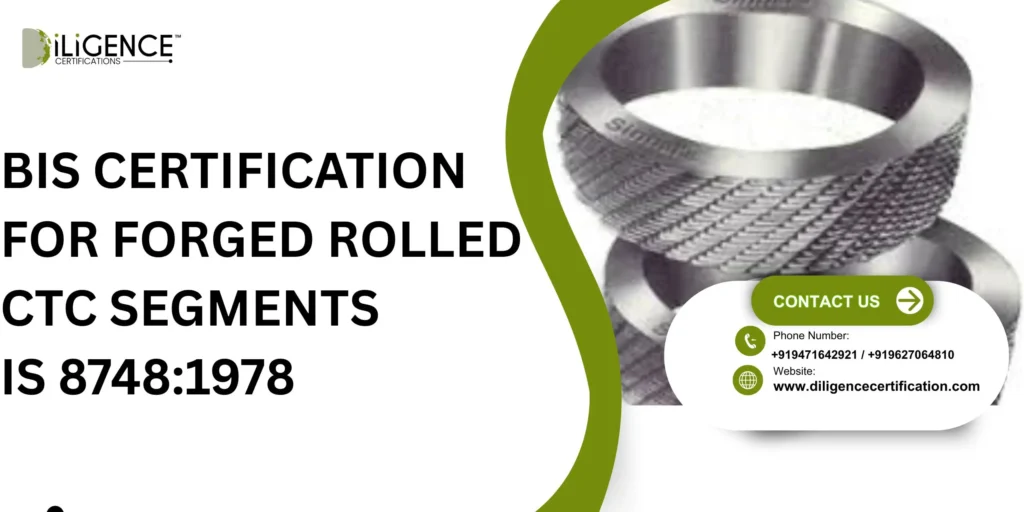
- Mandatory Compliance: In India, BIS certification FORGED ROLLED CTC SEGMENTS under IS 8748:1978 is a must for forged or rolled CTC (Continuous Transposed Conductor) segments that are employed in electrical applications.
- Quality Standard: The standard involves the specification of the requirements of the material, the composition, the dimensions, the workmanship, and the mechanical properties so as to ensure the products reliability.
- Application Use: The CTC segments are the ones that are most involved in power transformers and electrical devices where the main point of efficient current distribution is crucial.
- Product Testing: The segments have to undergo tests in laboratories that are recognized by BIS for their dimensional accuracy, mechanical strength, and material quality.
- ISI Mark Authorization: The manufacturers who have a license from the Bureau of Indian Standards can put the ISI mark which is a guarantee of conformity to law and acceptance by the market.
Introduction | FORGED ROLLED CTC SEGMENTS
BIS certification confirms that the standard of the forged or rolled CTC segments FORGED ROLLED CTC SEGMENTS under IS 8748:1978 is maintained in the use of CTC segments in transformers and electrical equipment. The segments are the main source of the efficient transmission of the current, the mechanical strength, and the thermal stability. The standard specifies the requirements for the quality of the material, the dimensions, the workmanship, and the testing. Conforming to IS 8748:1978 as monitored by the Bureau of Indian Standards is a guarantee for product quality, safety, and market access in India.
What is IS 8748:1978?
IS 8748:1978 is an Indian Standard published by the Bureau of Indian Standards that defines the technical specifications for forged or rolled CTC (Continuous Transposed Conductor) segments FORGED ROLLED CTC SEGMENTS employed in the electrical equipment, mainly power transformers. The standard specifies the necessary attributes regarding material, size, manufacturing, and testing in order for the CTC segments to deliver efficient electrical characteristics, adequate mechanical strength, and good thermal stability. Observance of IS 8748:1978 is one of the prerequisites for the safety, reliability, and endurance of transformer parts in the Indian power sector.
Key Points:
- Standard Scope: IS 8748:1978 defines the specifications for the forged or rolled CTC (Continuous Transposed Conductor) segments that are used in electrical and transformer applications.
- Material Quality: The standard lists the materials that are allowed to be used in order to achieve good electrical conductivity, mechanical strength, and wear resistance.
- Dimensional Requirements: The standard establishes size and shape tolerances that are necessary for the correct fitting and even current distribution.
- Workmanship & Finish: The standard among other things, prohibits lamination, cracks, and other surface irregularities CTC segments.
- Testing & Inspection: The standard requires regular inspection and testing as a prerequisite for issuing the certificate of conformity for safe and reliable use.
Why is BIS Certification Mandatory
BIS Certification is a must to be able to sell the products in India that have to meet quality, safety, and performance standards as prescribed. It is a system that safeguards consumers, facilitates fair trade, and assures that producers adhere to the same uniform technical specifications set by the Bureau of Indian Standards. Implying the certification as a must also aids in conforming to the regulations and gaining confidence in the local market.
Key Reasons:
- Consumer Safety: Products that meet the minimum safety and quality standards have less chances of risks and failures.
- Legal Compliance: It is governed by Indian Standards, and getting out of line may result in fines or prohibition of products.
- Quality Assurance: Enables surety of the manufacturing process, materials used, and production being controlled.
- Market Acceptance: Products with an ISI label are more trusted and have a bigger market both in the government and private sectors.
- Fair Trade Practices: It avoids the influx of poor quality goods into the market, thus ensuring the predominance of healthy competition.
Importance and Benefits of BIS Certification
| Importance | Benefits |
| Quality Assurance: Provides confirmation that forged/rolled CTC segments meet the requirements laid down by IS 8748:1978 in terms of material quality, dimensions, and workmanship. | Consistent Performance: Helps to lower failure and rejection rates by making electrical conductivity and mechanical strength more uniform. |
| Legal Compliance: The certification is a must for manufacturers to be in the safe side and avoid fines, product seizure, and sale restrictions in India. | Enhanced Safety & Durability: Helps to increase the thermal stability, load, bearing capacity, and the overall long, term service life of the components of a transformer. |
| Electrical & Mechanical Reliability: It is the main factor that brings about the continuous performance of CTC segments that are the parts of transformers and other electrical equipment that are vital. | Market Acceptance: Helps to become more qualified for government tenders, PSUs, utilities, and large infrastructure projects. |
| Prevention of Substandard Products: It is a measure against low, quality or non, conforming CTC segments that are allowed to enter the power and transformer supply chain. | Brand Credibility: Products with ISI mark create buyer trust and help to strengthen the brand reputation in the electrical industry.. |
| Standardized Manufacturing: It is the main feature that brings about the uniform production, testing, and inspection as per the Bureau of Indian Standards are being followed. | Business Expansion: Facilitates the growth of the business to be more profitable through the acquisition of new customers and retention of existing ones as well as by gaining their trust and through the continuous adherence to quality standards. |
Step-by-Step Process of BIS Certification
Step1:Documentation
- Collect required technical documents
- Prepare product specifications
- Gather company registration details
- Ensure documents follow BIS format
Step2:Product Testing
- Send samples to a BIS-approved lab
- Conduct safety and quality tests
- Receive test reports
- Confirm compliance with BIS standards
Step3:Application Submission
- Fill out the BIS application form
- Upload all required documents
- Attach valid test reports
- Pay the necessary BIS fees
Step4:Scrutiny and Inspection
- BIS reviews submitted documents
- Authority verifies test results
- Factory/product inspection may occur
- Clarifications requested if needed
Step5:Grant of License
- BIS approves the application
- License number is issued
- Product can carry BIS mark
- Renewal required before expiry
Documents Required for BIS Certification
| Category | Documents Required |
| Business Documents | Business license/registration, ISO certificate, organizational details |
| Manufacturer Details | Factory layout, process flow chart, machinery list, production details |
| Product Documents | Product specifications, component list, user manual, model details |
| Testing Documents | Test report from BIS-recognized lab, sample details, test request form |
| Legal & Compliance | Authorization letter, brand ownership proof, trademark certificate (if any) |
| Import/Foreign Manufacturer (If applicable) | AIR (Authorized Indian Representative) details, contract agreement, overseas manufacturer documents |
Timelines, Costs, Validity & Renewal
- Timelines: Usually from 20 to 30 days, with only 7-15 days for the testing.
- Costs: The cost of the government and the test varies depending on the product. There can be some additional charges though.
- Validity: The validity period is 2 years in most situations.
- Renewal: The renewal is done before the expiration; there should be updated documents/tests; the renewal
Why Choose Diligence Certifications
Diligence Certifications is a dependable BIS compliance and certification consultancy located in India. Diligence Certifications offers complete solutions to the clients for BIS Certification and Registration. They take care of the documentation, testing coordination, factory inspection support and approval processes so that the manufacturers get their certifications quickly, without any hassle and in full compliance with the rules.
Conclusion
BIS Certification is crucial for product quality, safety, and compliance with regulations in the Indian market. By following Indian Standards, manufacturers are able to make trustworthy and lasting products, stop the flow of inferior products, and get easier acceptance in the market. Conformance to standards helps safety of the consumers and fair trading conditions which along with other benefits such as increased trust, long, term business growth and easy access to government and big infrastructure projects are the results of this process.
Frequently Asked Questions (FAQs)
Is BIS Certification mandatory for forged/rolled CTC segments?
Yes. It is mandatory to have BIS Certification under IS 8748:1978 for the production and selling of forged or rolled CTC segments in India used in the electrical and transformer industries.
What are forged or rolled CTC segments used for?
Primarily, they find their use in power transformers and electrical devices for safe and reliable current conduction, mechanical strength, and thermal stability.
Who issues BIS Certification for CTC segments?
BIS Certification is issued by the Bureau of Indian Standards, the national authority responsible for standardization and certification in India.
What are the key requirements under IS 8748:1978?
The standard defines the requirements for the quality of material, sizes, workmanship, mechanical properties, and must, testing of CTC segments.
Is product testing compulsory for BIS Certification?
Indeed. Product samples have to be tested in a laboratory recognized by BIS in order to certification.
Is factory inspection part of the certification process?
Yes. Factory inspection may be done by BIS to confirm manufacturing processes, quality control systems, and production uniformity.
How long is the period to get BIS Certification for CTC segments?
The process usually takes 20, 30 days which testing (normally 7, 15 days), document scrutiny, and approval are included and it is subject to complete and correct submissions.
What is the validity period of BIS Certification?
BIS Certification generally lasts for two years after which a renewal is required before expiry to be able to continue manufacturing and selling legally.
What is the outcome if CTC segments are sold without BIS Certification?
Unlawful selling of products without certification may cause monetary penalties, product confiscation, cancellation of sales orders, and legal proceeding as per Indian laws.
What advantages do CTC segments get when using the ISI mark?
ISI mark is a trustful sign of conformity to Indian Standards which leads to increased buyer confidence, ease of market acceptance, and allows involvement in government, PSU, and big infrastructure projects.