



 BIS Certification
 CDSCO
CDSCO
 CPCB
CPCB
 LMPC
LMPC
 WPC Approval
 Global Approvals
 TEC
TEC
 ARAI
ARAI
 BEE
BEE
 ISO Certification
 DGCA Certification
 NOC For Steel














 Business Registration














 Legal Services
 Trademark Registration
 Copyright Registration
 Patent Registration
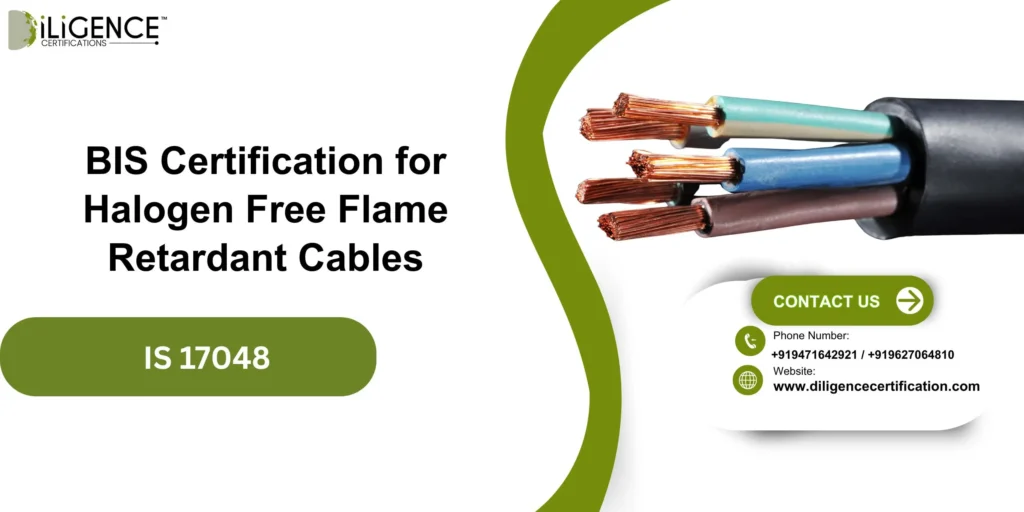
BIS Certification for Halogen Free Flame Retardant Cables – IS 17048 specifies the fire resistance and other requirements the cables need to adhere to, such as a halogen-free composition, mechanical strength, electrical performance, and dimensional accuracy. BIS certification indicates product quality which is a certificate of safety, reliability, and performance in tough situations. The ISI mark is mandatory for manufacturers who want to produce HFFR cables in India and thus can be regarded as the mark of safety, regulatory compliance, and consumer trust.
Obtaining a BIS certificate is like a well-structured compliance process where each stage—documentation, product testing, factory inspection, approval, and licence issuing—is equally important. Cables that have been certified as per IS 17048 are beneficial for the brand as they enhance the brand’s credibility, also make a guarantee if the system is used, it will be safe, and provide industrial applications with security and safety.
Introduction
BIS Certification for Halogen Free Flame Retardant Cables – IS 17048 is the standard that details the fire resistance features and other conditions from which HFFR cables, among others, must meet. These include halogen-free composition, mechanical strength, electrical performance, and dimensional accuracy. BIS certification for Halogen Free Flame Retardant Cables is a signal of a product’s quality, its reliability, and its capability to perform under challenging conditions. The ISI mark is a must-have for the manufacturers who are willing to have their HFFR cables BIS certified in India. It thus works as a mark of safety, adherence to regulations, and consumer trust. Bureau of Indian Standards
What Are Halogen Free Flame Retardant Cables IS 17048?
HFFR Cables – IS 17048 is an Indian Standard that sets out the detailed requirements for halogen-free flame retardant cables. It includes:
Halogen-Free Composition – The material is free of chlorine, bromine, fluorine, and other halogens
- Flame Retardancy – The capability of the material to resist fire extend
- Mechanical Strength – These include tensile strength, elongation, and flexibility tests
- Electrical Properties – Some of the properties are insulation resistance, voltage withstand, and conductivity
- Dimensional Accuracy – Thickness, conductor size, and tolerance are all measured
- Testing and Inspection Methods – It is a way of maintaining quality from one batch to another in production
By following the provisions of IS 17048, HFFR cables confer safety, fire resistance, and long-term performance.
ISI Mark Certification for HFFR Cables
ISI Mark Certification Scheme for HFFR cables should conform to the standard IS 17048 if they are to be marketed in India. Certificate ensures:
- Compliance with fire safety and halogen-free requirements
- Good mechanical and electrical properties
- Accuracy of dimensions for easy installation
- Quality at the level of the batch to ensure performance is the same for every batch
After securing a valid BIS licence, which confirms full compliance with IS 17048, manufacturers are allowed to put the ISI mark on their products.
Why BIS Certification is Necessary for HFFR Cables
If the HFFR cables are not up to standard, there might be the following unfortunate consequences:
- Fast fire spreading and the release of poisonous gases in the event of fire
- Failures or short circuits in the electrical system caused by poor insulation of the cables
- The reduction of the cable’s lifetime in industrial or commercial use
- Fines imposed by the regulatory bodies and loss of credibility in the market
BIS certification solves these problems:
- Ensures full compliance with IS 17048 standards
- Fire safety and electrical reliability
- The protection of health and property from hazards
- A strong brand image and consumer loyalty
Being of such major importance in safety and the general welfare of the society, HFFR cables merits not only a legal requirement, but an essential measure for risk control and industry trust.
Importance and Benefits of BIS Certification
| Importance | Benefits |
| Compliance with IS 17048 | Ensures fire safety and halogen-free standards |
| Standardized production | Maintains consistent mechanical and electrical properties |
| Electrical and mechanical reliability | Reduces risk of failure in critical systems |
| Regulatory compliance | Prevents legal issues and market rejection |
| Brand credibility | Builds trust with clients, consumers, and industries |
Step-by-Step BIS Certification Process
Step 1: Documentation
Prepare details of your company, information about the manufacturing facility, specifications of the cables, and quality control procedures as per IS 17048.
Step 2: Product Testing
Samples of HFFR cables are tested in labs recognized by BIS to confirm that the products are free of halogen, flame retardant, and good both electrically and mechanically.
Step 3: Application Submission
The application along with test reports and supporting documents should be submitted through the BIS online portal.
Step 4: Scrutiny & Factory Inspection
BIS staff visits the site to see the production processes, quality control methods, and conformity to the IS 17048 standard.
Step 5: Licence Issuance
If everything is in order, BIS issues a licence, giving manufacturers the green light to put the ISI mark on HFFR cables with their seal of approval.
Documents Required for BIS Certification
- Company registration certificate
- Details of the manufacturing unit
- Technical specifications of HFFR cables
- Test reports from BIS-recognized laboratories
- Documentation related to fire safety and electrical compliance
- Brand authorization (if applicable)
Timeline, Validity & Renewal
Certification Timeline: 20–30 working days
Licence Validity: 1–2 years
Renewal: Updated documents submission and confirmation of ongoing compliance
Conclusion
BIS Certification for Halogen Free Flame Retardant Cables – IS 17048 represents that the cable products are of high quality, fire-safe, and reliable. HFFR certified cables ensure that they are fire-resistant, stable both mechanically and electrically, and provide a safe environment that is free of halogens. For producers, obtaining a BIS certificate is not merely a regulation to be followed, but it also serves as a commitment
Adherence to IS 17048 enhances a product’s trustworthiness, facilitates acceptance by the market, and is a guarantee of long-term consistency in the most essential of the electrical and industrial applications.
Frequently Asked for Questions
What is BIS Certification for HFFR cables?
In general, it is a standard system which fire-safety wise, halogen-free-wise, and electrically-wise the HFFR cables should meet.
Is BIS certification mandatory for HFFR cables in India?
Certainly, it is a law that requires the fulfillment of IS 17048 together with a BIS certificate.
What does IS 17048 cover?
The features mentioned in the paper were primarily the fire resistance features, use of halogen-free material, and the electrical and mechanical properties.
Who needs BIS certification under IS 17048?
It is the manufacturers of HFFR cables who want to sell their products in the Indian market that are obliged to obtain this certification.
How long does BIS certification take?
Usually, it will be around 20–30 working days.
What is the ISI mark for HFFR cables?
It is that mark which assures that the product complies completely with the safety standards set by BIS.
Are product tests required for BIS certification?
Without a doubt. Testing in laboratories has to be performed in those that are BIS approved.
Can imported HFFR cables be sold without BIS certification?
Such cables should comply with IS 17048 and BIS whether they are locally produced or imported.
What documents are required for BIS certification?
The most important ones are the company registration certificate, technical specification document, laboratory test report, and brand authorization letter.
Why is BIS certification important for HFFR cables?
Among the main reasons, it keeps the wires safe, makes sure that the product conforms to the standards, gives the brand trustworthiness, and is a very good way for the manufacturer to inform the consumer of the product's long-lasting nature.