

 BIS Certification
 CDSCO
CDSCO
 CPCB
CPCB
 LMPC
LMPC
 WPC Approval
 Global Approvals
 TEC
TEC
 ARAI
ARAI
 BEE
BEE
 ISO Certification
 DGCA Certification
 NOC For Steel









 Business Registration











 Legal Services
 Trademark Registration
 Copyright Registration
 Patent Registration
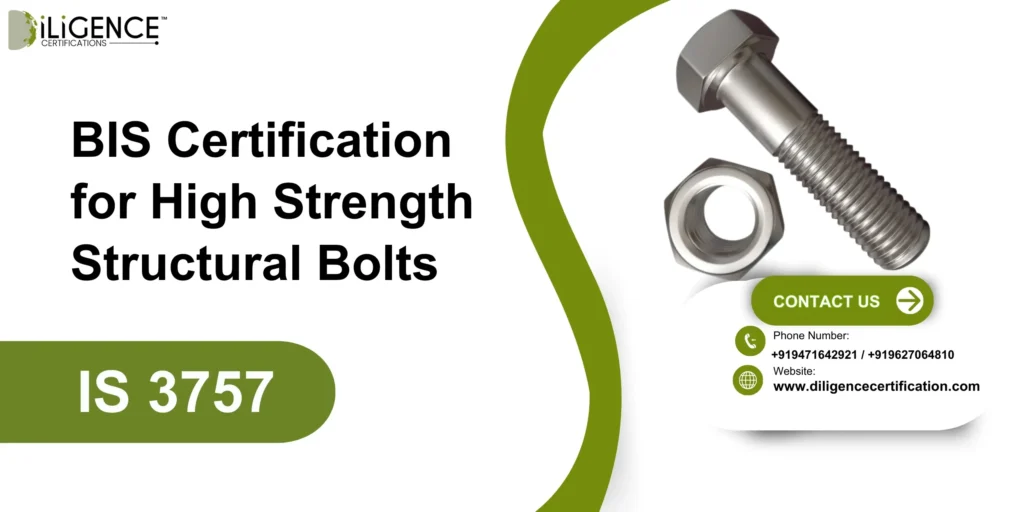
- High Strength Structural Bolts are heavily relied on load-bearing fasteners that are used in situations such as bridges, metro projects, power plants, and heavy steel structures where it is essential that the joint does not fail.
- In India, High Strength Structural Bolts must meet the requirements of IS 3757 and have a BIS (ISI Mark) certification if they are to be legally manufactured, supplied, or used in infrastructure and EPC projects.
- Such fasteners are subjected to a battery of tests of tensile strength, proof load, hardness, elongation, and chemical composition, among others to guarantee their structural performance.
- The BIS marking for High Strength Structural Bolts is only given to producers; thus, traders, distributors, or stockists cannot be the licence holders.
- The usage of uncertified High Strength Structural Bolts may result in the worksite rejecting the materials, disqualification of tenders, delays in the projects, and the imposition of fines as per Indian regulatory norms.
Introduction | High Strength Structural Bolts
High Strength Structural Bolts are not normal fasteners; they are precisely engineered components that provide the framework for the most important steel structures in India. Basically, these bolts are everywhere, from bridge decks over highways, metro corridors, and power plants to industrial sheds, and are built to resist tensile forces, vibration, and fatigue for a long time without a rupture. In real project conditions, the correctness of a structural joint is sometimes even more dependent on the bolt than the steel member. Just a slight difference in the strength of the bolt or its heat treatment can result in poor load transfer and unstable joints. Therefore, High Strength Structural Bolts in India are subject to very rigorous technical standards and regulations mainly under Bureau of Indian Standards IS 3757.Knowing their use, performance, and conforming to the requirements is very important to manufacturers, EPC contractors, and project consultants who are engaged in structural steel works.
What is High Strength Structural Bolts IS 3757
High Strength Structural Bolts IS 3757 is an abbreviated term of Indian Standard that defines detailed technical and qualitative criteria necessary for the high tensile bolts used in the connections of structural steel. These fasteners are built to deliver heavy axial and sheer load in a safe manner in the most heat controlled applications like bridges, power plants, metro rail projects, and big industrial structures. IS 3757 guarantees even strength, factory control, and performance resistance of the fasteners in safety concern joints.
Key Points
- IS 3757 specifies the physical properties and the chemical makeup, and also the heat treatment of high-strength structural bolts for the steel structures.
- The standard is mainly limited to property class 8.8 and 10.9 bolts, which are generally used in load-bearing and friction-type structural connections.
- Fasteners produced in accordance with IS 3757 have to be tested vigorously and these tests include tensile strength, proof load, hardness, and chemical analysis.
- BIS (ISI Mark) certification is a must for High Strength Structural Bolts in India which are conforming to IS 3757.
- Observance of IS 3757 is required very much for EPC contracts, government projects, and infrastructure works where attaining certified fasteners is not only a legal but also a technical requirement.
Why is BIS Certification Mandatory | (IS 3757)
BIS Certification is a must for High Strength Structural Bolts under IS 3757 because these are the components that, directly, ensure the safety and stability of critical steel structures. A bolt malfunction can result in joint slippage, structural distress, or even a disastrous collapse of the whole structure, thus, the case of bridges, metro systems, and industrial installations is especially dangerous.The Government of India has decided to impose BIS certification as a requirement for High Strength Structural Bolts so as to avoid quality inconsistency and ensure uniform performance of the products across the board of manufacturers. Certification is evidence that the bolts have been manufactured, tested, and inspected, in all respects, in accordance with IS 3757.
Key points
- Increases overall safety of structures through verification of tensile strength, proof load, hardness, and material composition in accordance with IS 3757.
- Helps public infrastructure and heavy engineering projects free from the use of substandard bolts.
- Government and EPC projects, where only BIS-certified High Strength Structural Bolts are accepted, make it compulsory.
- It offers legal market access in India as non-certified bolts are liable to be rejected or subjected to penalties by the BIS Act.
- Creates a bond and confidence which are supported by the traceability of batch-wise testing and factory inspections, thus, ensuring consistent quality.
Importance and Benefits of BIS Certification (IS 3757)
| Importance | Benefits |
| Ensures High Strength Structural Bolts that provide good mechanical properties meet Indian safety and performance standards that are mandatory. | Guarantees uniform tensile strength, proof load, and usage in structural applications that can be trusted. |
| Prevents the installation of substandard or non-tested bolts in the primary load-bearing structures of steel constructions. | Reduces the occurrence of structural failure, joint slippage, and expensive rework at project sites. |
| Mandatory compliance for government, PSU, and EPC infrastructure projects. | Enables tender eligibility and facilitates client and inspector approvals. |
| Introduces regulatory monitoring via factory inspections and surveillance testing. | Attracts the trust of EPC contractors, consultants, and auditors through market positioning. |
| Ensures the implementation of quality control measures throughout production batches from which the bolts are manufactured. | Reduces rejection, project delays, and fines imposed under the BIS Act. |
| Adjusts bolt manufacturing to meet the IS 3757 technical and metallurgical specifications. | Contributes to the improvement of the structural connections’ performance and durability over time. |
| During audits and third-party inspections, it may be used as legal evidence of conformity. | Enhances brand image as a fastener manufacturer that is compliant and trustworthy. |
Step-by-Step Process of BIS Certification
Step1:Documentation
- Collect required technical documents
- Prepare product specifications
- Gather company registration details
- Ensure documents follow BIS format
Step2:Product Testing
- Send samples to a BIS-approved lab
- Conduct safety and quality tests
- Receive test reports
- Confirm compliance with BIS standards
Step3:Application Submission
- Fill out the BIS application form
- Upload all required documents
- Attach valid test reports
- Pay the necessary BIS fees
Step4:Scrutiny and Inspection
- BIS reviews submitted documents
- Authority verifies test results
- Factory/product inspection may occur
- Clarifications requested if needed
Step5:Grant of License
- BIS approves the application
- License number is issued
- Product can carry BIS mark
- Renewal required before expiry
Documents Required for BIS Certification
| Category | Documents Required |
| Business Documents | Business license/registration, ISO certificate, organizational details |
| Manufacturer Details | Factory layout, process flow chart, machinery list, production details |
| Product Documents | Product specifications, component list, user manual, model details |
| Testing Documents | Test report from BIS-recognized lab, sample details, test request form |
| Legal & Compliance | Authorization letter, brand ownership proof, trademark certificate (if any) |
| Import/Foreign Manufacturer (If applicable) | AIR (Authorized Indian Representative) details, contract agreement, overseas manufacturer documents |
Timelines, Costs, Validity & Renewal
- Timelines: Usually from 20 to 30 days, with only 7-15 days for the testing.
- Costs: The cost of the government and the test varies depending on the product. There can be some additional charges though.
- Validity: The validity period is 2 years in most situations.
- Renewal: The renewal is done before the expiration; there should be updated documents/tests; the renewal
Why Choose Diligence Certifications
- Specialised expertise in BIS Certification (IS 3757)
Diligence Certifications is well equipped with a lot of technical and regulatory knowledge and experience through their certification of B.I.S for the High Strength Structural Bolts. This enables them to ensure the accurate interpretation of IS 3757 requirements. - End-to-end certification management
- It is a great process handled by Diligence Certifications from application filing, laboratory testing, BIS inspections, to licence approval.
- Manufacturing-focused approach
- We sync production and quality teams of your factory with shop-floor practices of BIS standards hence, the possibility of test failure or inspection objection is very low.
- Faster approvals with minimal rework
- Our pre-inspection readiness checks, therefore, help in avoiding delays, repeat testing, and unnecessary compliance costs.
- Reliable post-certification support
- Diligence Certifications are always on the side of the clients with licence renewals, scope extensions, and ongoing BIS compliance requirements.
Conclusion
High Strength Structural Bolts are the major elements that ensure the safety and stability of metal constructions that are the bases of infrastructural and industrial projects. Following IS 3757 and being BIS certified is not just a regulatory ritual, but it is a necessary guarantee of strength, safety, and stability of the application under the load. BIS certification by the manufacturer and the project stakeholders is a passport to the site without rejection, tender without disqualification, and risk-free legal space while resulting in trust-building with EPC contractors and consultants. Certified with the correct technical and regulatory knowledge, it can be a strategic leverage rather than a hindrance.Working with Diligence Certifications means that the BIS Certification process for High Strength Structural Bolts is conducted accurately, transparently, and with industry expertise, hence, you remain compliant, competitive, and confident in every project.
Frequently Asked Questions
What are High Strength Structural Bolts?
High Strength Structural Bolts are the heavy metal parts that tightly hold together the steel sections of the core structure of steel bridges, metros, or industrial buildings.
What norm is used for high-strength structural bolts in India?
Their requirements are regulated by the standard IS 3757, which specifies the mechanical, chemical, and shooting standards.
Their requirements are regulated by the standard IS 3757, which specifies the mechanical, chemical, and shooting standards.
A BIS Certificate conforming to IS 3757 is definitely needed for production, distribution, and usage in India.
Who is eligible to apply for BIS Certification?
Only factory owners can apply; thus, traders, distributors, or resellers cannot get the license.
What bolt grades are included in IS 3757?
The paper mainly refers to property class 8.8 and 10.9 bolts that are used in friction or bearing-type connections.
What tests are necessary for BIS approval?
A variety of tests like tensile strength, proof load, hardness, elongation, dimensional inspection, and chemical composition should be done.
How long does BIS Certification take?
The BIS Certification period varies from 2 to 3 months and depends upon the factory, the testing, and the inspection schedules.
Is it possible for one license to cover various bolt sizes?
As a matter of fact, a single license can cover multiple sizes if all the sizes are IS 3757 compliant and have undergone the testing phase.
What happens if non-certified bolts are used?
Use of non-certified bolts may result in the removal of these from the site, tender disqualification, and the imposition of fines under the BIS Act.
Are foreign manufacturers allowed to supply bolts to India without BIS certification?
Before exporting IS 3757 compliant bolts to India, foreign producers are required to obtain BIS FMCS approval.