



 BIS Certification
 CDSCO
CDSCO
 CPCB
CPCB
 LMPC
LMPC
 WPC Approval
 Global Approvals
 TEC
TEC
 ARAI
ARAI
 BEE
BEE
 ISO Certification
 DGCA Certification
 NOC For Steel












 Business Registration














 Legal Services
 Trademark Registration
 Copyright Registration
 Patent Registration
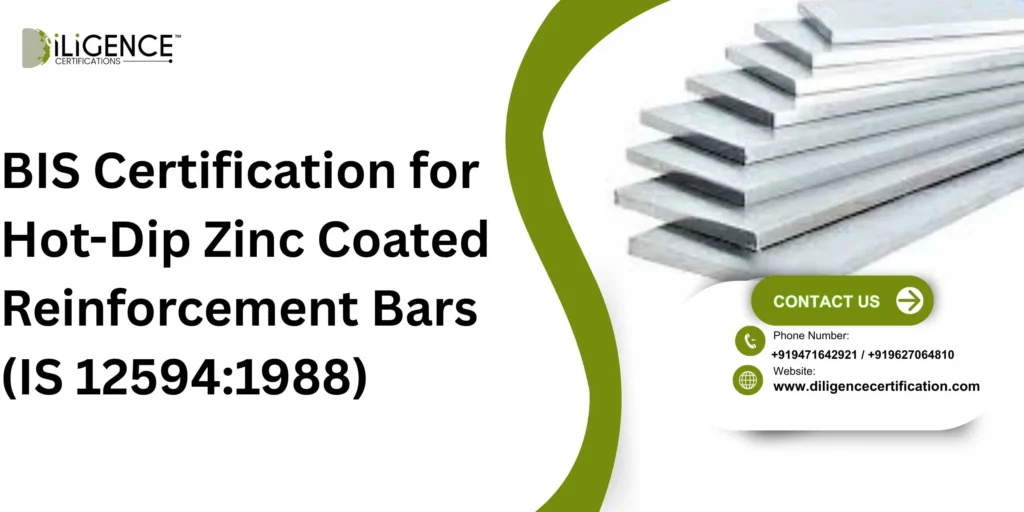
- Mandatory Compliance: Hot, dip zinc coated structural steel bars for concrete reinforcement should follow IS 12594:1988 if they are intended to be used in Hot-Dip Zinc Coated Reinforcement Bars
- Corrosion Protection: The zinc layer imparts an improved resistance to rust, thus, the service life of the steel bars used as reinforcement in concrete gets extended.
- Quality Standards: The standard lays down the determining factors for the thickness of the coating, the adhesion, the uniformity, and the surface finishing of the product.
- Product Testing: Bars are measured for the amount of the coating, the continuousness, and the performance in line with the directions issued by the Bureau of Indian Standards.
- Market Acceptance: Conformity is a prerequisite for trustworthiness, structural safety, and is thus welcomed by the infrastructure and construction projects..
Introduction | Hot-Dip Zinc Coated Reinforcement Bars
Hot, dip zinc coated structural steel bars are the main metal parts of the concrete, which are used to make the structure strong, the steel is also protected from rust by these bars, Hot-Dip Zinc Coated Reinforcement Barse specially in a harsh environment. As per IS 12594:1988, the bars are given a uniform zinc layer by the hot, dip galvanizing method, which makes the metal resistant to moisture, chemicals, and the atmosphere. The confirmation of this standard implies that the quality of the coating will be up to the mark, the coating will be properly adhered, and the reinforcement bars will be good for a long time. Hence, safety, strength, and service life of the reinforced concrete structures aregreatly influenced in a positive manner.
What is IS 12594:1988?
IS 12594:1988 is an Indian Standard that was released by the Bureau of Indian Standards. It defines the requirements for the application of hot, dip zinc coating (galvanizing) on the surface of structural steel bars that are used to reinforce concrete. The objective of the standard is to enhance the anti, corrosion property and the service life of the reinforcement steel in the first place, in tough and wet type environments.
Key Points:
- Scope of Standard: Feature a description of hot, dip galvanized coating layer, which is made by bars and sections of steel, are then used as reinforcements in concrete structures.
- Coating Requirements: It provides the minimum values for the zinc coating mass/ thickness that are required to give a good corrosion resistance.
- Coating Quality: The article point out the requirements for the coating uniformity, adhesion, continuity, and surface finish.
- Testing Methods: These are the tests for coating mass, adherence, and visual inspection, which are used to check the conformity.
- Durability Assurance: Keeps the service life of reinforced concrete at a high level by decreasing the corrosion, the main cause of the breakdown.
Why is BIS Certification Mandatory
BIS Certification is required by law to make sure that hot, dip zinc, coated structural steel bars for concrete reinforcement are in conformity with IS 12594:1988 Hot-Dip Zinc Coated Reinforcement Bars and meet the Indian safety and quality requirements. Reinforcement bars are the most decisive factors in the structural stability of a building. Still, if there is any compromise in the quality of the coating or corrosion protection, it can result in the early aging of concrete structures. The imposition of BIS certification as a compulsory requirement guarantees that only those products that meet the standards specified for coating thickness, adhesion, and wear resistance are allowed in the Indian market, thus ensuring the safety of the public, the dependability of the infrastructure, and consumer trust.
Key Reasons:
- Structural Safety: Makes sure that the steel bars are capable of giving the desired performance and strength over a long period in concrete constructions
- Corrosion Resistance: Checks for the correct zinc coating that helps the steel to be resistant to corrosion even when placed in a harsh and moisture, rich environment
- Quality Assurance: Helps to ensure that the materials, coating, and testing are in accordance with the requirements of IS 12594:1988
- Legal Compliance: A compulsory certificate is necessary for the production, import, and sale of these products in India
- Consumer & Project Trust: Works to the advantage of builders, engineers, and government agencies by creating a higher level of confidence in the certified products.
Importance and Benefits of BIS Certification
| Importance | Benefits |
| It is necessary that the hot, dip zinc, coated rebar meets the requirements of IS 12594:1988 in terms of coating thickness, adhesion, and uniformity | Adherence to laws in line with criteria established by the Bureau of Indian Standards, thus, no fines, seizure of products, or limitations on the market will be imposed. |
It is the main parameter to ensure that steel reinforcement in concrete is effectively protected against corrosion. | Better durability and lesser maintenance expenditure as a result of improved corrosion resistance. |
| It is a compulsory requirement for the production, import, and sale of galvanized rebar in India. | Greater acceptance in infrastructure, marine, coastal, and aggressive environmental projects. |
| It stops the entry of poorly performing or insufficiently coated bars into the construction and infrastructure supply chain | More trust of constructors, engineers, and government officials. |
| Structural safety, durability, and service life of reinforced concrete structures are ensured. | Improved brand reputation, opportunities for government and big projects, and business growth in the long run. |
Step-by-Step Process of BIS Certification
Step1:Documentation
- Collect required technical documents
- Prepare product specifications
- Gather company registration details
- Ensure documents follow BIS format
Step2:Product Testing
- Send samples to a BIS-approved lab
- Conduct safety and quality tests
- Receive test reports
- Confirm compliance with BIS standards
Step3:Application Submission
- Fill out the BIS application form
- Upload all required documents
- Attach valid test reports
- Pay the necessary BIS fees
Step4:Scrutiny and Inspection
- BIS reviews submitted documents
- Authority verifies test results
- Factory/product inspection may occur
- Clarifications requested if needed
Step5:Grant of License
- BIS approves the application
- License number is issued
- Product can carry BIS mark
- Renewal required before expiry
Documents Required for BIS Certification
| Category | Documents Required |
| Business Documents | Business license/registration, ISO certificate, organizational details |
| Manufacturer Details | Factory layout, process flow chart, machinery list, production details |
| Product Documents | Product specifications, component list, user manual, model details |
| Testing Documents | Test report from BIS-recognized lab, sample details, test request form |
| Legal & Compliance | Authorization letter, brand ownership proof, trademark certificate (if any) |
| Import/Foreign Manufacturer (If applicable) | AIR (Authorized Indian Representative) details, contract agreement, overseas manufacturer documents |
Timelines, Costs, Validity & Renewal
- Timelines: Usually from 20 to 30 days, with only 7-15 days for the testing.
- Costs: The cost of the government and the test varies depending on the product. There can be some additional charges though.
- Validity: The validity period is 2 years in most situations.
- Renewal: The renewal is done before the expiration; there should be updated documents/tests; the renewal
Why Choose Diligence Certifications
Diligence Certifications is a trusted advisory and consulting firm that provides end, to, end solutions to clients for acquiring BIS Certification and other regulatory approvals in India. The organization makes it easy for producers and importers to get their paperwork done, have their products tested, coordinate factory inspections, and get the ISI license for hassle, free compliance with the standards of the Bureau of Indian Standards. With the help of skilled guidance, transparent process, and reliable service from Diligence Certifications, businesses can get legal compliance, enhance their brand value, and grow in a sustainable way.
Conclusion
BIS Certification for hot, dip zinc coated reinforcement bars as per IS 12594:1988 is instrumental in facilitating resistance to corrosion, safety of the structure, and its lifespan in general for metal, reinforced concrete constructions. Observance of this standard is a good preventive measure against the use of inferior materials, it is a great support to construction projects in their quality consistency and it is a guarantee of compliance with Indian regulatory requirements. By requiring BIS Certification, the powers that be protect public infrastructure, increase trust in building practices, and encourage the use of good, quality reinforcement materials in the different sectors such as residential, commercial, and infrastructure developments in India.
Frequently Asked Questions (FAQs)
Is BIS Certification mandatory for hot-dip zinc coated reinforcement bars in India?
Yes, certification is mandatory to comply with IS 12594:1988.
What products are covered under IS 12594:1988?
Hot-dip galvanized structural steel bars and sections used for concrete reinforcement
What is the main purpose of hot-dip zinc coating?
To protect steel reinforcement from corrosion and extend service life.
Who issues IS 12594:1988 certification?
The Bureau of Indian Standards.
What tests are required under this standard?
Tests for coating mass, adhesion, uniformity, continuity, and visual inspection.
Is factory inspection required for BIS Certification?
Yes, BIS may conduct factory audits to verify manufacturing and quality control systems.
How long does the BIS Certification process take?
Typically 20–30 days, depending on testing and documentation readiness.
What is the validity of BIS Certification?
Usually valid for 2 years, subject to renewal before expiry.
Is BIS Certification required for imported galvanized reinforcement bars?
Yes, imported products must also comply with IS 12594:1988 before sale in India.
What happens if products are sold without BIS Certification?
Non-compliance can lead to penalties, product seizure, and market restrictions.