

 BIS Certification
 CDSCO
CDSCO
 CPCB
CPCB
 LMPC
LMPC
 WPC Approval
 Global Approvals
 TEC
TEC
 ARAI
ARAI
 BEE
BEE
 ISO Certification
 DGCA Certification
 NOC For Steel
 APEDA Registration









 Business Registration
 FSSAI Mark Certification


 Legal Services
 Trademark Registration
 Copyright Registration
 Patent Registration
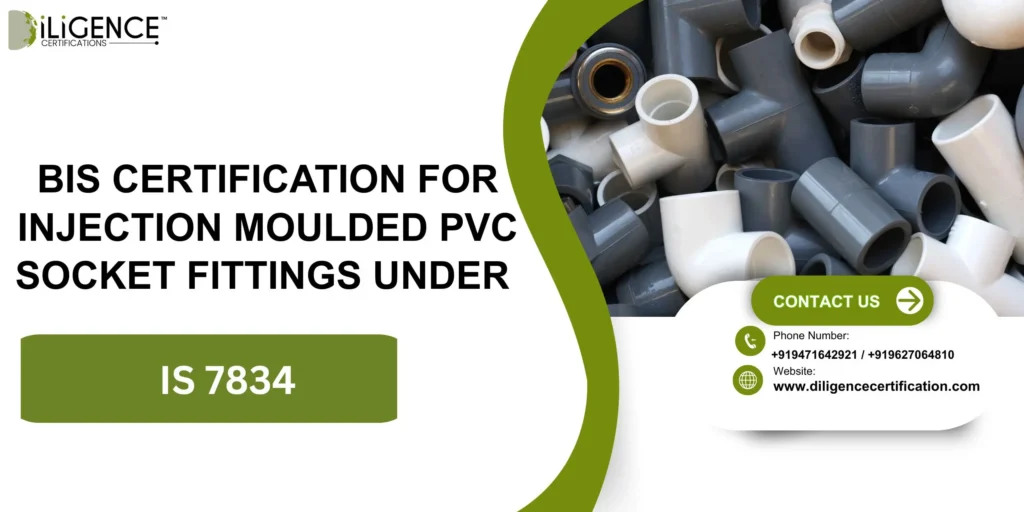
Required Compliance – Indicates that PVC socket fittings are safe and of good quality as per Indian standards given by BIS.
Confirms Product Strength & Longevity – Certification is resistance of the product to pressure, cracking and deformation.
Stops System Failures & Leakage – Fittings used for plumbing, irrigation, and water distribution networks, local, ensure safe and trouble-free operation.
Attracts More Customers – Contractor, government and large project officials prefer using BIS-certified fittings.
Required to Make & Sell – A factory without IS 7834 can neither legally produce nor market these fittings in India.
Introduction
BIS Certification for Injection Moulded PVC Socket Fittings – IS 7834 is necessary in India to guarantee the safety, longevity, and the proper functioning of PVC piping systems that are used for water supply, plumbing, irrigation, and industrial purposes. The absence of such a certificate turns a manufacturer into a potential source of producing fittings that may break, leak, or be unable to withstand pressure resulting in water losses, damages to systems, and expensive maintenance.
BIS certification is the main instrument that assures the quality of every fitting from the point of view of the standard requirements such as material strength, dimensional accuracy, and resistance to internal pressure. This permission is very important to PVC fitting manufacturers, plumbing product suppliers, contractors, and vendors of government projects who are obliged to follow Indian regulations and provide the equipment of piping systems that are safe and have a long service life. Bureau of Indian Standards
What is BIS Certification for Injection Moulded PVC Socket Fittings – IS 7834?
BIS Certification for Injection Moulded PVC Socket Fittings under IS 7834 is a formal permission given by the Bureau of Indian Standards (BIS), that PVC fittings utilized in plumbing, irrigation, and water supply systems are up to the mark in terms of quality, safety, and performance.
IS 7834 describes the material, construction, and testing methods for PVC socket fittings that are capable of holding water pressure, being leakage resistant, and working fairly for a long time.
The presence of the ISI mark on a product is indicative of the fittings having undergone and passed rigorous laboratory testing and being produced in compliance with a quality system under control. This certification is compulsory in India for manufacturers who wish to produce or sell PVC socket fittings legally, thus providing consumers with safe and high-quality products.
Why BIS Certification for Injection Moulded PVC Socket Fittings – IS 7834 Is Necessary and Significant in India
BIS Certification according to IS 7834 is essential in India as it guarantees that PVC socket fittings utilized in plumbing and water distribution systems are safe, durable, and meet the performance standards laid down by the government. In accordance with BIS rules, producers are not allowed to manufacture, sell or distribute such fittings without an ISI mark. Hence, it stops low-quality and unsafe fittings that eventually lead to leakages, pipe bursts, contamination of water, or breakdown of the system.
With BIS certification, businesses become more trustworthy and get the confidence of contractors, government departments, and big project developers. Products with certification are more likely to be chosen in tender processes, infrastructure projects, and contracts for municipal water supply. Besides, it lessens the risks that exist in the long run, enhances the brand image, and ensures that the manufacturer remains in line with the national quality laws, thereby, avoiding fines or bans of his products.
Step-by-Step Process — BIS Certification (IS 7834) for Injection Moulded PVC Socket Fittings
1. Confirm product scope and classification
Identify the exact product (socket fitting size range, pressure class, PVC grade, single-socket vs coupling) and verify that it is covered by the scope of IS 7834 to decide the appropriate test matrix and application route.
2. Preparation of a technical product dossier
Prepare product drawings, material specifications (PVC resin grade and additives), moulding process details, bill of materials, dimensional drawings, and production flowchart. These are the documents necessary for the BIS application and factory audit.
3. Compilation of documents for the quality system & legal framework
Factory registration certificate, GST, ISO/QMS certificates (if available), quality control procedures, calibration records, and an authorization letter for the BIS signatory should be collected.
4. Choosing a qualified test laboratory
Select a laboratory recognized by BIS / accredited by NABL for type testing. Make sure that the lab can perform all the tests of IS 7834 (dimensional checks, hydrostatic pressure, tensile, impact, thermal ageing, leakage).
5. Preparation of representative production samples
Manufacture and label samples of the typical production batches (sizes and pressure ratings as per IS 7834). Make sure that the samples are molded using the normal production tooling and process parameters.
6. Carrying out mandatory type tests
Samples for type tests should be sent: dimensional verification, hydrostatic pressure (burst/pressure endurance), tensile strength, impact resistance, thermal stability/ageing, leak test, and visual/appearance. Get the test reports with signatures.
7. Perform routine/acceptance tests locally
Routine checks for every batch or reel should be set—dimensional checks, visual inspection, and pressure/leak tests if necessary. Record the results in the production test register.
8. Calibration and documentation of test equipment
All test instruments should be calibrated and have valid certificates. Calibration records and instrument lists should be uploaded to support the application and the factory inspection.
9. Submit BIS application along with documents
Fill in the BIS application (or FMCS for imports) on the BIS portal. Upload the technical dossier, type test reports, legal documents, quality manuals, and sample identification details.
10. Pay the fees and wait for the technical evaluation
As requested, application, and testing/inspection fees should be paid. The BIS technical section, which is in charge of the review, scrutinizes the test reports and other documents submitted to confirm compliance with IS 7834.
11. Get the factory ready for the inspection
Material receipts (e.g., PVC resin MTCs), production records, in-process QC logs, test records, calibrated equipment, and trained staff should all be organized for the inspection. Sample traceability from raw material to finished fitting should be indicated.
12. The BIS factory inspection and hosting it
Help the BIS inspector to do his task: show the production line, allow witnessing routine tests if the inspector asks for it, provide records, and demonstrate marking/packaging procedures. Note down any non-conformity remarks.
13. Link non-conformities (if any) and resubmit proof
Inspection findings should be addressed with corrective actions, re-tests, updated procedures, and photographic evidence. Send the closure proof to BIS without delay.
14. Obtain a BIS license and begin licensed production
Subsystem BIS provides the license issued specifying permitted products and conditions. Start products marking with the ISI mark, BIS license number, batch/date, and product designation as required.
15. Surveillance, renewal, and record keeping
Continuous production and test records should be maintained. BIS will conduct periodic surveillance inspections and sample testing. Calibration, QMS documents should be maintained, and a license renewal application should be submitted before the license expiry date.
16. For foreign manufacturers / importers (FMCS)
If you import goods, you should designate an Authorized Indian Representative (AIR), provide documents of the foreign factory, and follow the FMCS submission route. Also, make sure the samples for imports and type tests are in line with IS 7834, and AIR holds the traceability records.
Documents Required for BIS Certification for Injection Moulded PVC Socket Fittings – IS 7834
If you want to obtain the BIS Certification (ISI Mark) for Injection Moulded PVC Socket Fittings, you will be required to provide various technical, legal, and quality-related documents. By presenting these documents, the Bureau of Indian Standards will be able to ascertain that the fittings comply with the standards specified in IS 7834 and that they are made in accordance with standard manufacturing practices
1. Documents Required from Indian Manufacturers
A. Company & Legal Documents
- Factory registration certificate
- GST certificate
- MSME/Udyam registration (if available)
- Company PAN and proof of address
- Factory layout plan with the details of the production area
- Authorization letter for the BIS signatory
- Undertaking for compliance with BIS rules
B. Technical Product Documents
- Complete product specification sheet
- Material specifications (PVC resin grade, additives, stabilizers)
- Each fitting size dimensional drawing
- Manufacturing process flow chart (injection moulding steps)
- Bill of Materials (BOM)
- Product catalogues or datasheets
- Sample identification details (sizes/pressure class prepared for testing)
C. Quality Management & Production Documents
- Quality Control (QC) plan
- An inventory of in-house testing instruments with serial numbers
- Calibration certificates for all testing instruments
- Raw material inspection records
- In-process QC logs
- Finished product inspection reports
- Routine test records (dimensional, pressure, visual inspection)
- Acceptance sampling procedure
- Internal test logbook
D. Testing Documents
- Type test reports from a BIS-recognized / NABL-accredited lab
- Hydrostatic pressure test results
- Tensile, impact, thermal ageing, and leak test reports
- Routine & acceptance test records
- Sample preparation/identification slip
- Previous compliance reports (if any)
E. BIS Application Documents
- BIS registration application form duly filled
- Marking scheme (how ISI mark will be printed on fittings)
- Packaging & labeling information
- Follow-up inspection agreement
- Application fee payment proof
2. Documents Required from Importers / Foreign Manufacturers (FMCS)
(Products manufactured outside India are considered.)
A. Foreign Manufacturer Documents
- Business license of the foreign manufacturer
- Factory registration certificate
- Documents showing the manufacturing capability
- Organization chart / factory structure
- Production flow chart (injection moulding line)
- List of test equipment available at the foreign factory
- Foreign lab instrument calibration certificates
- Authorization letter appointing an Authorized Indian Representative (AIR)
B. Authorized Indian Representative (AIR) Documents
- Valid Indian ID proof (Aadhaar, Passport, etc.)
- Address proof
- AIR–Manufacturer agreement
- Undertaking to act on behalf of the foreign manufacturer
- Responsibility acceptance letter as required by BIS
C. Technical & Product Documents
- Specification of PVC material and compound
- Dimensional and construction drawings
- Product datasheets/catalogues
- Raw material test certificates
- Production & inspection procedures
- Quality Management System documents (ISO 9001 if available)
D. Testing Documents
Type test reports from a laboratory accredited by BIS/NABL/ILAC
- Sample testing records
- Factory test logs
- Equipment calibration certificates
- Sample identification details
- E. BIS Application Documents (FMCS Route)
- FMCS application form
- Marking & labeling scheme
- Declaration of conformity to IS 7834
- List of products/variants for the license
- Fee payment proof
3. Optional Supporting Documents (Nice-to-Have for Faster Approval)
- ISO 9001 certification
- Supplier material test certificates
- Internal audit reports
- Safety & process evaluation reports
- Previous BIS or international certification documents
Importance and Benefits of BIS Certification for Injection Moulded PVC Socket Fittings – IS 7834
| Importance | Benefits |
| Provides assurance that the product meets the quality and safety standards set by India | Provides assurance that the product meets the quality and safety standards set by India |
| Makes it difficult for bad quality and unsafe PVC socket fittings to be in the market | Makes it difficult for bad quality and unsafe PVC socket fittings to be in the market |
| AIDS water supply and plumbing systems for longer durability | Reduces frequent expenses of repairs alongside long-term operational risks |
| Required if intending to produce, sell, or use the fittings in India | Leads to easier access to government tenders and big infrastructure projects |
| Ensures fittings have met the performance, material, and durability standards of IS 7834 | The improved system becomes more reliable,safe and efficient in field operations |
Common Challenges in Applying for BIS Certification for Injection Moulded PVC Socket Fittings – IS 7834
The journey of filing for BIS Certification for Injection Moulded PVC Socket Fittings – IS 7834 is full of pitfalls that can make the process difficult for manufacturers. Without the proper documentation, such as type test reports, quality control records, and factory registration certificates, the submitted application is incomplete or wrong. The use of a wrong or non-accredited testing laboratory and the submission of incorrectly prepared samples can make the tests result in failure. Many applicants are also unfit and unprepared for the inspection of the factory, lacking instruments, traceability logs, or skilled staff. They are also in the dark about the requirements of BIS marking, labeling, and routine testing and thus non-conformities. Strict preparation and following BIS guidelines lead to less time to approval and compliance.
Conclusion
It is essential to have a BIS Certification for Injection Moulded PVC Socket Fittings – IS 7834 to ensure the safety of the users and the compliance of the product with standards besides reliability in the systems of plumbing, irrigation, and water supply. The certification does not only protect the end-users but also accentuates your brand reputation and opens doors to government tenders and big projects. Because of the thorough documentation, testing, and factory inspections involved, there are many businesses that would benefit from the professional guidance in navigating the certification process efficiently. The collaboration with skilled consultants or certification experts can be a great help in terms of the timely approval, full compliance, and relaxation of mind allowing you to concentrate on the production of high-quality PVC fittings that meet IS 7834 standards and get customer loyalty.
Frequently Asked for Questions
What is BIS Certification for PVC Socket Fittings?
A quality assurance tag from the Bureau of Indian Standards (BIS) that certifies the compliance of PVC fittings with safety, quality, and durability standards.
Why is IS 7834 important to PVC fittings?
This standard specifies the material, construction, and testing areas which are necessary to avoid leaks or any other failure of the system.
Who must have a BIS certification in India?
The manufacturers and importers as well as the suppliers of injection-moulded PVC socket fittings are required to have BIS certification.
Am I allowed to sell PVC fittings if I don't have BIS certification?
The answer is no. It is illegal to sell unlicensed PVC fittings in India.
What are the tests for IS 7834 compliance?
Tests include hydrostatic pressure, tensile, impact, thermal ageing, leakage, and dimensional tests.
What are the necessary documents for BIS Certification?
The documents include product specifications, test reports, quality control records, factory registration, and legal documents.
Does BIS Certification increase customer loyalty?
Definitely, as a matter of fact, the contractors, government agencies, and large projects are the most significant buyers of certified fittings and thus they feature a very high trust in quality products.
How long is BIS Certification valid?
Usually from 2 to 6 months is the period of time pending on document preparation, testing and inspection of factory until the certificate is issued.
Is BIS certification necessary for the imports of fittings?
Yes. FMC rules should be followed by foreign manufacturers through an Authorized Indian Representative (AIR).
What are the advantages of BIS certification for PVC fittings?
It is an assurance of product safety, reliability, long service life, compliance with Indian standards, and opening up the government tenders market.