

 BIS Certification
 CDSCO
CDSCO
 CPCB
CPCB
 LMPC
LMPC
 WPC Approval
 Global Approvals
 TEC
TEC
 ARAI
ARAI
 BEE
BEE
 ISO Certification
 DGCA Certification
 NOC For Steel










 Business Registration











 Legal Services
 Trademark Registration
 Copyright Registration
 Patent Registration
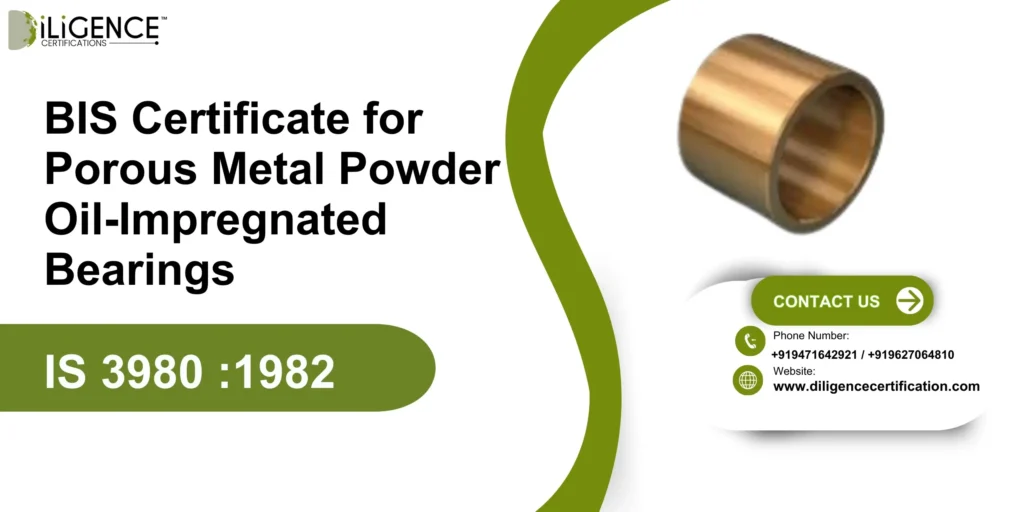
- Oil-impregnated porous metal bearings are self-lubricating components made through powder metallurgy, widely used in motors and industrial machinery.
- IS 3980 : 1982 defines strict requirements for material composition, porosity, oil content, and performance to ensure reliability and safety.
- Porous Metal Powder Oil-Impregnated BearingsUnder IS 3980 : 1982 require mandatory BIS certification for manufacturing, sale, or supply in India.
- BIS compliance involves factory inspection, sample testing in approved laboratories, and ongoing surveillance after licence grant.
- Non-compliance can lead to product seizure, penalties, and rejection by OEMs and institutional buyers.
Introduction | Porous Metal Powder Oil-Impregnated Bearings
Some years back, a bearing manufacturer who was the supplier to a local pump OEM in Maharashtra had to cease his dispatches suddenly—not due to a quality failure, but because a routine buyer audit of their facility found that there was no valid BIS licence. The product involved was a self-lubricating sintered bearing, quite innovative and already widely used in several installations. What was lacking was the formal aspect of compliance.Performing BIS certification for Porous Metal Powder Oil-Impregnated BearingsUnder IS 3980 : 1982 should not be considered as an optional approval or a buyer-driven preference. Instead, it is a legal requirement according to Indian law. This standard is about the design, manufacture, testing and marking of such bearings that, in turn, assure the same safety and performance level in different industrial applications. By gaining knowledge of the certification system, producers can keep their line running, stay out of court and maintain their valuable OEM relationships.
What is IS 3980 : 1982?
IS 3980 : 1982 is a standard set by the Bureau of Indian Standards (BIS) that defines the technical requirements for porous metal powder oil-impregnated bearings for use in industries and mechanical applications. IS 3980:1982 aims at those porous metal bearings that are made and supplied in India to perform efficiently, be of a long service life, and operate safely without the need of external lubrication. Meeting this standard is also the requirement to get the BIS certificate for Porous Metal Powder Oil-Impregnated Bearings (PMPOIB), which is necessary for the lawful manufacturing and selling of PMPOIB in India.
key points
- Material composition of metal powders used in sintered bearings
- It controls the porosity levels that are necessary for oil retention effectively.
- Oil impregnation is necessary to ensure self-lubrication during operation
- Dimensional tolerances and workmanship for consistent fit and performance
- Performance and endurance tests to verify load capacity, wear, and temperature behaviour
Why is BIS Certification Mandatory?
BIS certification is mandatory because porous metal powder oil-impregnated bearings are very important mechanical components, whose failure can cause equipment safety, reliability, and service life to be directly impacted. To take care of this risk, the Government of India has put IS 3980:1982 under the compulsory certification regime of the Bureau of Indian Standards.
Key points
- Safety and performance guarantee: Certification is a safety measure that the bearings will live up to the requirement standards in porosity, oil retention, load capacity, and wear resistance, hence the chance of overheating or seizure during the exercise is minimal.
- Observance of the law: As per the BIS Act, 2016, the production, selling, or supplying of such bearings without a valid BIS license is a breach of law even if the product is of good quality.
- Standard quality throughout the market: Mandatory certification is a measure that ensures substandard or inconsistent bearings cannot find their way into the industrial supply chains.
- Requirements of OEM and PSU: Most big buyers, e.g., automotive OEMs and public sector units, require BIS-certified bearings as a prerequisite for procurement.
- Responsibility and traceability: BIS certification records certain manufacturing processes, regular surveillance, and market inspections, thus ensuring that compliance will be maintained beyond the initial approval.
Importance and Benefits of BIS Certification
| Importance | Benefits |
| It is a mandatory legal compliance under the BIS Act and IS 3980 : 1982 for porous metal oil-impregnated bearings. | Protects the business from legal action, product seizure, fines, and unexpected production stoppages. |
| Maintains the safety, performance, and durability standards that have been specified. | Helps in lowering the probability of operational failures, overheating situations, and early bearing wear due to the application of the end-use. |
| First of all, OEMs, PSUs, and large industrial buyers require it as a basic eligibility criterion. | Helps in getting access to high-value contracts, approved vendor lists, and long-term supply agreements. |
| Allows the implementation of quality control, testing, and documentation procedures that are well-organized. | Enables an organization to improve process discipline, repeatability, and overall manufacturing efficiency. |
| Ongoing BIS surveillance and market monitoring | Help in improving brand value, customer loyalty, and long-term market acceptance. |
Step-by-Step Process of BIS Certification
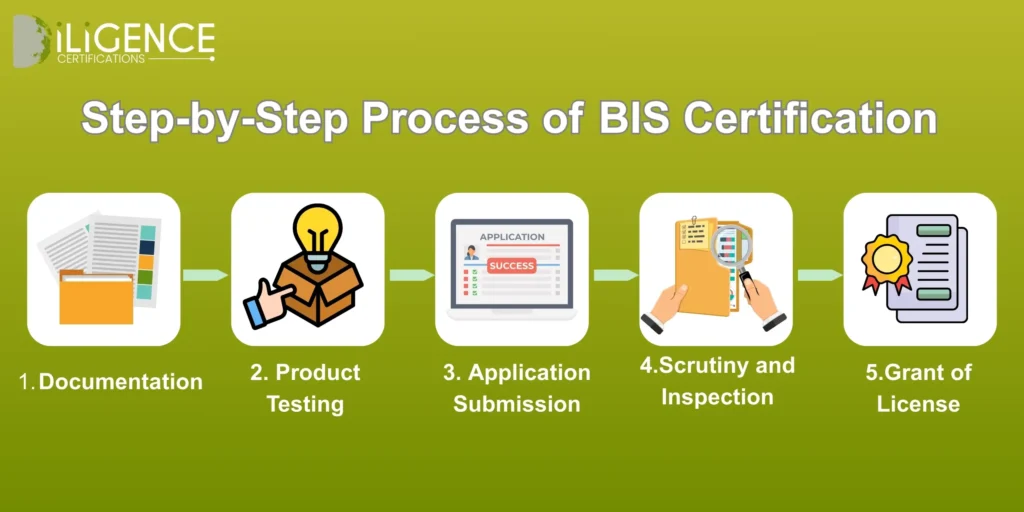
Step1:Documentation
- Collect required technical documents
- Prepare product specifications
- Gather company registration details
- Ensure documents follow BIS format
Step2:Product Testing
- Send samples to a BIS-approved lab
- Conduct safety and quality tests
- Receive test reports
- Confirm compliance with BIS standards
Step3:Application Submission
- Fill out the BIS application form
- Upload all required documents
- Attach valid test reports
- Pay the necessary BIS fees
Step4:Scrutiny and Inspection
- BIS reviews submitted documents
- Authority verifies test results
- Factory/product inspection may occur
- Clarifications requested if needed
Step5:Grant of License
- BIS approves the application
- License number is issued
- Product can carry BIS mark
- Renewal required before expiry
Documents Required for BIS Certification
| Category | Documents Required |
| Business Documents | Business license/registration, ISO certificate, organizational details |
| Manufacturer Details | Factory layout, process flow chart, machinery list, production details |
| Product Documents | Product specifications, component list, user manual, model details |
| Testing Documents | Test report from BIS-recognized lab, sample details, test request form |
| Legal & Compliance | Authorization letter, brand ownership proof, trademark certificate (if any) |
| Import/Foreign Manufacturer (If applicable) | AIR (Authorized Indian Representative) details, contract agreement, overseas manufacturer documents |
Timelines, Costs, Validity & Renewal
- Timelines: Usually from 20 to 30 days, with only 7-15 days for the testing.
- Costs: The cost of the government and the test varies depending on the product. There can be some additional charges though.
- Validity: The validity period is 2 years in most situations.
- Renewal: The renewal is done before the expiration; there should be updated documents/tests; the renewal
Why Choose Diligence Certifications
- Expertise in IS 3980 : 1982 – Technical guidance on porosity, oil impregnation, and performance tests.
- Complete certification support – Documentation, application filing, lab coordination, and factory inspection preparation.
- First-time approval focus – Pre-inspection gap analysis to minimise rejections and retesting.
- Experience with Indian manufacturers – Practical compliance solutions aligned with production realities.
- Post-certification assistance – Surveillance audits, scope extensions, and licence renewals.
Conclusion
Obtaining the BIS Certificate for Porous Metal Powder Oil-Impregnated BearingsUnder IS 3980 : 1982 is not just a regulatory formality—it is a critical step to ensure legal compliance, product reliability, and access to OEM and PSU supply chains. Manufacturers who delay or overlook certification risk production halts, penalties, and lost business opportunities. Diligence Certifications specialises in guiding manufacturers through every stage of BIS compliance, from documentation and factory inspection readiness to sample testing and licence renewal. With our expertise, your Porous Metal Powder Oil-Impregnated BearingsUnder IS 3980 : 1982 can achieve first-time approval, reduce audit risks, and maintain uninterrupted operations, giving your business the credibility and market advantage it deserves.
Frequently Asked Questions
What is IS 3980:1982?
It is the Indian Standard defining the technical specifications for porous metal powder oil-impregnated bearings.
What if a bearing without BIS certification is sold?
An unverified product can cause the user to be penalized, their products seized, legal action taken against them, and they would be rejected by buyers.
Is BIS certification mandatory?
Absolutely, any manufacturer or seller of these bearings without a BIS certificate would be violating Indian law and committing a criminal offense.
Who gives the BIS certificate?
Bureau of Indian Standards (BIS) grants the certificate after testing and inspection have been completed.
What is the duration of BIS certification?
As a rule, the license is good for 2 years and also has a renewal clause.
Which tests are necessary?
The test parameters are porosity, oil retention, load capacity, wear resistance, and dimensionality, and they should all be conducted in a laboratory that is BIS certified.
Can foreign manufacturers submit their applications?
Yes, if they have an Authorized Indian Representative (AIR) and proper documentation.
What are the documents required?
Some of the documents are a business license, factory layout, product specifications, test reports, and legal authorizations.
How long does it take to get certified?
Usually, the whole process from the very beginning to the end is about 20-30 days, whereas lab testing takes 7-15 days.
What are the advantages of BIS certification?
The key advantages of such a certification are that it assures compliance with the law, product trustworthiness, OEM acceptance, and brand reputation.