




 BIS Certification
 CDSCO
CDSCO
 CPCB
CPCB
 LMPC
LMPC
 WPC Approval
 Global Approvals
 TEC
TEC
 ARAI
ARAI
 BEE
BEE
 ISO Certification
 DGCA Certification
 NOC For Steel





















 Business Registration















 Legal Services
 Trademark Registration
 Copyright Registration
 Patent Registration

- Reinforcement Couplers represent one of the most advanced mechanical splicing systems, which not only connect the steel bars of the reinforcement but also ensure that the load is fully transferred across the joint.
- With the help of these devices, it becomes possible to do away with the use of long lap lengths which in turn facilitates the reduction of steel congestion and the improvement of concrete compaction at structural areas that are of great significance.
- Such systems are generally found in skyscrapers, bridges, metros, and earthquake-resistant buildings where the stability of the system is a must.
- Adhering to IS 16172:2023 helps mechanical splices comply with the set criteria in terms of strength, slip, and durability.
- As a result, those splices which are certified in terms of their mechanical properties become a tool for the easy acceptance by project consultants and regulatory authorities, hence, the chance of getting a rejection during inspections is minimal.
Introduction | Reinforcement Couplers
The method of connecting reinforcing steel bars, which is the main focus of the next generation concrete work, has a great impact on the safety of the structures, the way of construction, and the long-term performance. Mostly lap splicing leads to congestion of the steel, increase of the material consumption, and difficulties of the execution at the points of intersection, especially in high-rise and infrastructure projects. Bureau of Indian Standards As a solution to these disadvantages, Reinforcement Couplers give a mechanical connection that transfers the load directly between bars, makes structural continuity better, and gives more freedom in design and site execution. Currently mechanical splicing systems performance and quality requirements have been set by the adoption of IS 16172:2023, which is the basis for the use of such systems in India.
What is Reinforcement Couplers Under IS 16172:2023 ?
Reinforcement Couplers under IS 16172:2023 are explained as one set of components among them are called mechanical devices. They serve as agents that link two reinforcing steel bars end-to-end thus the load is passed on to the other side of the joint without any use of lap length. The standard lays down the requirements for performance, tests, and quality necessary for the given unit to be at least as reliable as the parent reinforcement bar in concrete structures.
Key Points
- The standard is for mechanical splices that are part of RC structures e.g. the buildings, bridges, and infrastructure projects. It establishes the minimum levels of tensile strength, slip, and deformation that are necessary to guarantee the safety of the structure.
- The performance of the coupler assembly must be at the same level or better than that of the reinforcement bars that are connected.
- Tests and confirmation are done at laboratories that are recognised by BIS and in accordance with the methods detailed in the standards.
- conformity with present IS 16172:2023 will be a trust factor for the engineers, consultants, and regulatory authorities facilitating smooth working of Indian construction projects.
Why is BIS Certification Mandatory | ( IS 16172:2023)
BIS certification under IS 16172:2023 is essential to verify that one of the most important types of the components of mechanical splicing, which are the parts that go inside the reinforced concrete structures, satisfy the safety, strength, and performance requirements that have been set up. As these joints are the elements through which the load transfer and the structural reliability depend, independent certification is the means that helps to sustain the quality level that is uniform and the respect of the regulations especially in large-scale and government construction projects involving reinforcement couplers.
Key Points
- Mechanical splices are load-bearing elements, and their failure can compromise the safety of an entire structure.
- IS 16172:2023 specifies standardized criteria for strength, slip, and deformation under load.
- BIS certification is contingent upon third-party laboratory testing and confirmation of manufacturing controls.
- Certain public-sector and infrastructure tenders require certified products as a condition of acceptance.
- Certification is an instrument that facilitates the trust by the engineers, consultants, and approving authorities.
Importance and Benefits of BIS Certification (IS 16172:2023)
| Importance | Benefits |
| It makes certain that mechanical splices are in conformity with safety and structural standards that are necessary. | Construction obtains the benefit of quality and reliability that are of a consistent level, without having to be constantly checked. |
| The possibility of the joint failing in a reinforced concrete structure is lowered. | Project consultants and regulatory authorities get facilitated in the acceptance process. |
| It is a requirement for participation in tenders and a pre-requisite for Indian regulations. | It allows the businesses that have the license to supply government and big infrastructure projects. |
| It is a step in the direction of full transparency of the production process and complete traceability of the materials. | Delays in a project caused by the rejection of non-compliant products are reduced to a minimum. |
| Consistency is achieved in the performance of the reinforcement couplers that are used in different projects. | The company gains in reputation and the confidence of its clients and contractors. |
Step-by-Step Process of BIS Certification
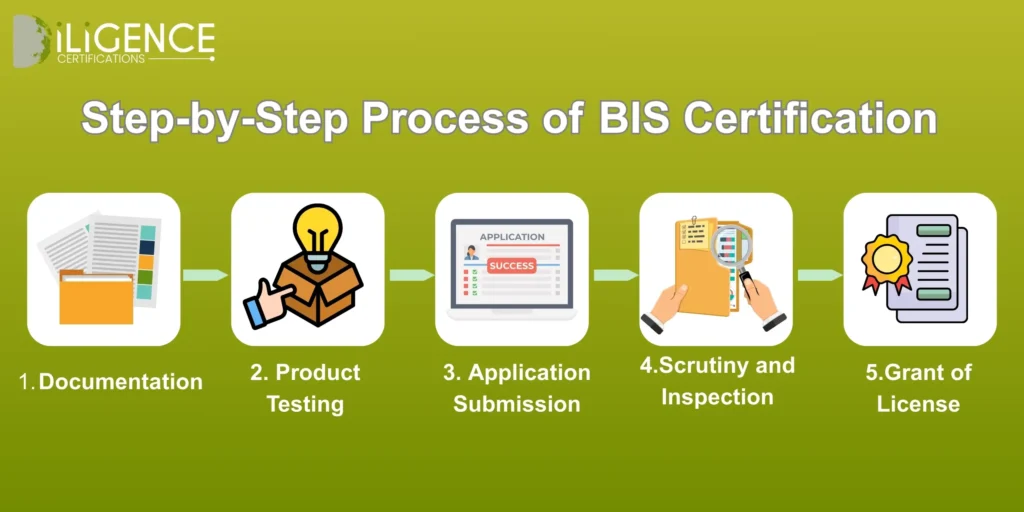
Step1:Documentation
- Collect required technical documents
- Prepare product specifications
- Gather company registration details
- Ensure documents follow BIS format
Step2:Product Testing
- Send samples to a BIS-approved lab
- Conduct safety and quality tests
- Receive test reports
- Confirm compliance with BIS standards
Step3:Application Submission
- Fill out the BIS application form
- Upload all required documents
- Attach valid test reports
- Pay the necessary BIS fees
Step4:Scrutiny and Inspection
- BIS reviews submitted documents
- Authority verifies test results
- Factory/product inspection may occur
- Clarifications requested if needed
Step5:Grant of License
- BIS approves the application
- License number is issued
- Product can carry BIS mark
- Renewal required before expiry
Documents Required for BIS Certification
| Category | Documents Required |
| Business Documents | Business license/registration, ISO certificate, organizational details |
| Manufacturer Details | Factory layout, process flow chart, machinery list, production details |
| Product Documents | Product specifications, component list, user manual, model details |
| Testing Documents | Test report from BIS-recognized lab, sample details, test request form |
| Legal & Compliance | Authorization letter, brand ownership proof, trademark certificate (if any) |
| Import/Foreign Manufacturer (If applicable) | AIR (Authorized Indian Representative) details, contract agreement, overseas manufacturer documents |
Timelines, Costs, Validity & Renewal
- Timelines: Usually from 20 to 30 days, with only 7-15 days for the testing.
- Costs: The cost of the government and the test varies depending on the product. There can be some additional charges though.
- Validity: The validity period is 2 years in most situations.
- Renewal: The renewal is done before the expiration; there should be updated documents/tests; the renewal
Why Choose Diligence Certifications
- Proven Expertise: Long time practice of leading manufacturers and importers through the BIS product certification and compliance process has been the experience of the Diligence staff.
- End-to-End Support: The team will be with you from the pre-audit readiness stage, through documentation, sample testing, up to the final factory inspection.
- Faster Approvals: The shortening of approval timelines accounts for the streamlined processes and audit preparation thus project delays that are costly can be avoided.
- Regulatory Compliance: The Certification in IS 16172:2023 guidelines for products ensures they are safe and accepted without any limitation both in government and private infrastructure projects, including Reinforcement Couplers.
- Trusted by Clients: The company has been the driving force behind the success of several enterprises like Larsen & Toubro (L&T), resulting in faster market entry and a higher level of client trust.
Conclusion
It is essential for mechanical splices in reinforced concrete structures to have a BIS certification conforming to IS 16172:2023 in order to maintain safety, quality, and performance. Manufacturers and suppliers will find that meeting the requirement is not only a regulatory formality but also a strategic move that facilitates their access to government and big infrastructure projects. Completing the process with Diligence Certifications will make it easier for you as they will be the expert guides through testing, documentation, and factory audits ensuring that the approval is obtained on time. Obtaining Reinforcement Coupler certification is a vehicle for companies to elevate their status, win the confidence of consultants and the regulatory authorities, and be in a position to take part in attractive construction projects that are of high value not only in their locality but also outside.
Frequently Asked Questions
What are Reinforcement Couplers?
Reinforcement couplers are one of those mechanical devices by which ends of steel bars are connected directly in concrete structures so that the full load can be transferred.
Is BIS certification mandatory for Reinforcement Couplers?
Yes, it is necessary especially for government and big infrastructure projects in India.
Which standard covers the Reinforcement Couplers in India?
IS 16172: 2023 details the specification, testing, and quality requirements.
Can one license cover multiple coupler designs?
No, each design and size range must be separately certified.
Are foreign test reports accepted by BIS?
Mostly, they are not; the testing should be done at the laboratories recognised by the BIS in India.
How long is the BIS license valid?
The first period is generally one year. Renewal depends on the surveillance visit and continuous compliance.
Why choose Diligence Certifications for BIS approval?
Their service is complete - from start to finish they give guidance to the client which results in faster approvals and compliance with IS 16172:2023.
What tests are needed for BIS certification?
BIS certification needs the conduct of tensile strength, slip, dimensional accuracy, and durability tests in labs recognized by the BIS.
Who is eligible to seek BIS certification?
The local manufacturers, importers, and traders of Reinforcement Couplers in India may apply for BIS certification.
What is the duration of BIS certification?
BIS certification is typically 8-12 weeks long, the time being determined by the preparedness and the testing of the samples.