



 BIS Certification
 CDSCO
CDSCO
 CPCB
CPCB
 LMPC
LMPC
 WPC Approval
 Global Approvals
 TEC
TEC
 ARAI
ARAI
 BEE
BEE
 ISO Certification
 DGCA Certification
 NOC For Steel














 Business Registration













 Legal Services
 Trademark Registration
 Copyright Registration
 Patent Registration
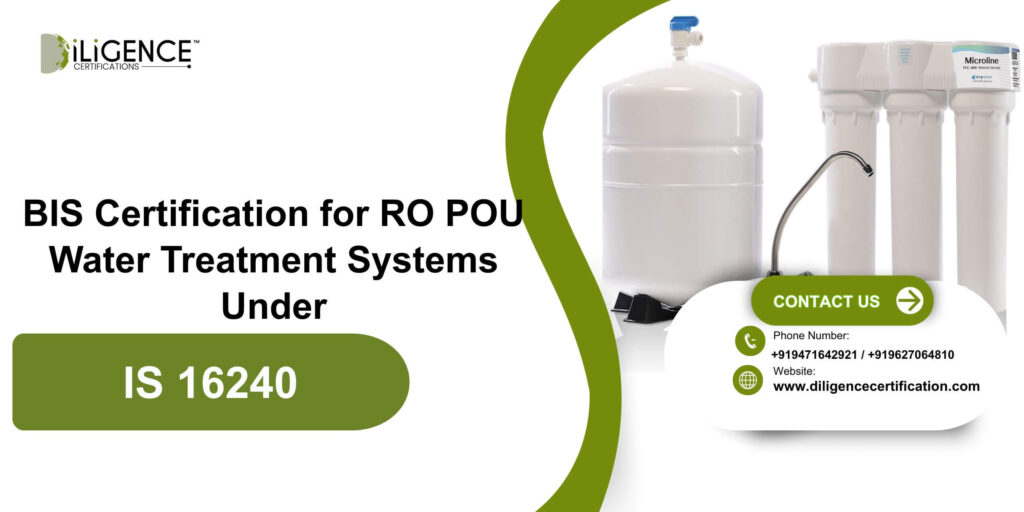
RO run POU water treatment systems standards are outlined in detail by IS 16240 covering aspects such as their performance, safety, material quality, and efficiency. A BIS certification is proof that the product is capable of providing safe, clean, and hygienic drinking water that meets the set quality standards. The ISI mark is a must-have for the manufacturers who intend to produce and sell RO POU water treatment systems in India.
The process of obtaining a BIS certificate is like a perfectly timed relay race where each stage—documentation, product testing, factory inspection, approval, and licence issuance—is vital for the final successful outcome. BIS-certified systems improve brand trust, ensure that consumers get safe water, and provide stability in the system’s longevity.
Introduction
RO POU Water Treatment Systems are the most necessary devices in the living places, working spaces, and institutions to provide safe and purified drinking water. These systems remove contaminants, improve taste, and protect users from waterborne diseases. The compliance to IS 16240 is a guarantee that RO POU systems can withstand tough requirements in terms of their performance, durability, and safety, even if the quality of the water varies greatly. Bureau of Indian Standards
What are RO POU Water Treatment Systems Under IS 16240?
IS 16240 is a standard of India that describes the technical requirements for point of use (POU) reverse osmosis (RO) POU water treatment systems and establishes the following standards:
Material Quality – Materials that are safe, corrosion-resistant, and non-toxic.
Performance of Filtration – The removal of impurities, dissolved salts, and microorganisms, is to be done effectively.
Water Recovery & Efficiency – The water output is to be maximum with the minimum wastage of water.
Safety Features – Backflow, leakage, or electrical hazards are prevented.
Testing and inspection methods – To ensure product performance is consistent in all units.
By following IS 16240, RO POU units can produce potable water of premium quality while being efficient in their operations for the entire duration of their service life.
ISI Mark Certification for RO POU Water Treatment Systems
To be legally sold in India, RO POU water treatment systems under the ISI Mark Certification Scheme need to be in conformity with IS 16240. Certification is a guarantee:
- That the product complies with the performance and safety standards.
- That the product has reliable filtration efficiency and long-term durability.
- That the product is made of safe materials suitable for potable water.
- That there is quality assurance across production batches.
It is only after manufacturers have been issued a valid BIS licence that they are allowed to put the ISI mark on their products, which is a signal to consumers of product safety and reliability.
Why BIS Certification is Mandatory for RO POU Water Treatment Systems
Non-certified RO POU systems can lead to some risky situations, including:
- Contaminated water as a result of inadequately filtered water.
- Health risk due to some harmful microorganisms or chemicals that may be present in the water.
- The system will break down quickly and the maintenance expense will go up.
- If the company does not comply with regulations, it will lose the trust of consumers and have legal problems.
BIS Certification is a guarantee to:
- Ensure full compliance with the IS 16240 standard.
- Be able to resist performance under mechanical and environmental stress.
- Brand image is getting better and customer loyalty is getting stronger.
- Reliable water treatment that is safe, and suitable for homes and establishments.
Importance and Benefits of BIS Certification
| Importance | Benefits |
| Compliance with IS 16240 | Ensures water is safe, filtered, and potable |
| Standardized production | Maintains consistent quality and performance |
| Operational reliability | Reduces risk of system failure and downtime |
| Regulatory compliance | Avoids legal and market issues |
| Brand credibility | Builds trust with customers and industry partners |
Step-by-Step BIS Certification Process
Step 1: Documentation – Have ready information about the company, the manufacturing plants, and the RO POU system technical details.
Step 2: Product Testing – Samples are tested in laboratories recognized by BIS to confirm filtration performance, material safety, and electrical efficiency.
Step 3: Application Submission – Upload test reports and other supporting documents on the BIS portal for the department to review them.
Step 4: Scrutiny & Inspection – Factory inspections to check production quality, safety from fire, and measures of quality control are carried out by BIS.
Step 5: Grant of Licence – On a successful inspection, BIS provides the licence, which enables the manufacturer to put the ISI mark on the certified RO POU systems.
Documents Required for BIS Certification
- Certificates of company registration.
- The factory or manufacturing unit details.
- Technical details of the RO POU system.
- Test reports from laboratories recognized by BIS.
- Brand authorization (if applicable).
Timeline, Validity & Renewal
- Certification Timeline: 20–30 working days.
- Licence Validity: 1–2 years.
- Renewal: Updated documents submission along with the proof of continued compliance before the expiry
Conclusion
BIS certification for RO POU Water Treatment Systems under IS 16240 is a mark of a product that is safe, trustworthy, and efficient. Filtered systems yield regular filtration performance, materials that are safe, and operational life. BIS certification for producers is a regulatory requisite plus a tactical step to increase customer loyalty, brand prestige, and ease of entry to the market. Following IS 16240 standards is a wise move that ensures quality, dependability, and business advantages over time.
Frequently Asked for Questions
What is BIS Certification for RO POU Water Treatment Systems?
BIS certification is an indicator of compliance with IS 16240 of RO POU systems that deliver safe drinking water.
Why is IS 16240 Mandatory for RO POU Systems in India?
The standard IS 16240 is a guarantee of performance, safety, and material quality for RO POU water treatment systems.
Is the ISI Mark Compulsory for RO POU Water Purifiers?
Certainly, the ISI mark is a prerequisite for the manufacturing and trading of RO POU systems in India.
Who Grants BIS Certification for RO POU Systems?
Upon testing and verification, the Bureau of Indian Standards (BIS) is the one to grant the certificate.
How Long Does BIS Certification for RO POU Systems?
The certification usually requires 20 to 30 working days.
Which Tests Are Performed Under IS 16240?
The tests could be filtration efficiency, material safety, water recovery, and electrical safety.
Are There Any Restrictions on BIS Certification for Imported RO POU Systems?
Yes, an imported RO POU system requires a BIS certification before it is allowed to be sold in India.
How Long Is BIS Licence for RO POU Systems Valid?
BIS licence is typically valid from 1 to 2 years.
What Happens If RO POU Systems Are Sold without BIS Certification?
The unaccredited systems are subject to legal actions, fines, and product bans.
What Are the Benefits of BIS Certified RO POU Water Treatment Systems?
Their benefits come from ensuring safe drinking water, product reliability, compliance with regulations, and consumer confidence.