



 BIS Certification
 CDSCO
CDSCO
 CPCB
CPCB
 LMPC
LMPC
 WPC Approval
 Global Approvals
 TEC
TEC
 ARAI
ARAI
 BEE
BEE
 ISO Certification
 DGCA Certification
 NOC For Steel
















 Business Registration















 Legal Services
 Trademark Registration
 Copyright Registration
 Patent Registration
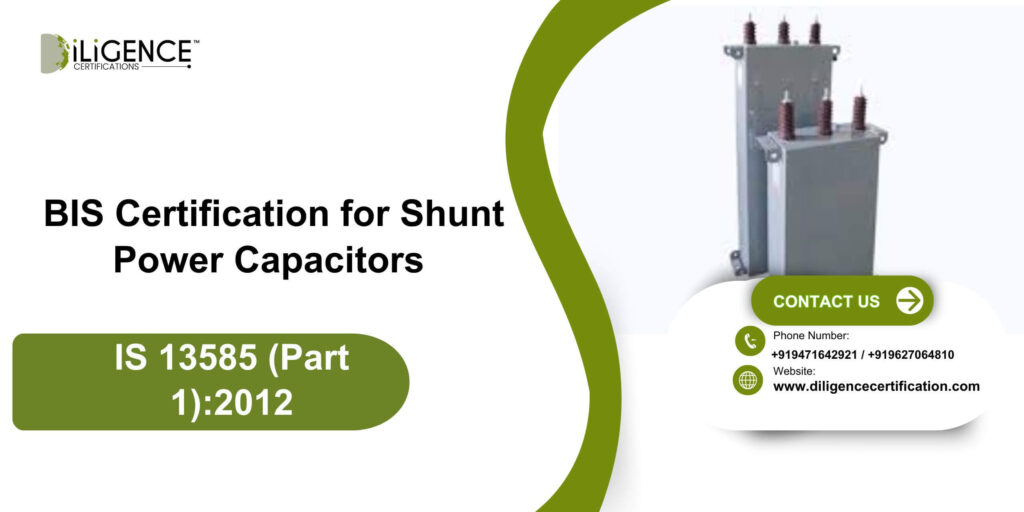
- Guarantees the shunt power capacitors perform to the required specifications as defined in the standards – IS 13585 (Part 1):2012.
- It is mandatory to have an ISI mark for manufacturing as well as for the sale of capacitors in India.
- Provides assurance for long life, stability, and efficiency in an AC power system.
- Assists manufacturers in ensuring regulations are complied with and thus earns them acceptance in the market.
- It improves the credibility of the brand on account of certified quality.

Introduction
Shunt Power Capacitors play an important role in the industrial and commercial power system as they increase the value of the power factor, decrease losses, and maintain the voltage. Since the Shunt Power Capacitors work under continued exposure to electrical stress, temperature changes, and varying loads, it is important to follow the standard IS13585 (Part 1):2012.
The Bureau of Indian Standards (BIS) has defined specific standards for regulating the design, electrical properties, and testing of the shunt power capacitors. This ensures that the device is capable of functioning effectively in the power distribution, industrial, and commercial sectors, without the fear of a breakdown or danger to the user.
What is Shunt Power Capacitors IS 13585 (Part 1):2012?
IS 13585 (Part 1):2012 is an Indian Standard that details requirements for shunt power capacitors applied in AC systems. It includes, inter alia:
- Electrical Specifications:
- The rated voltage, capacitance tolerance, and reactive power.
- Dielectric & Insulation Properties: Provides safety against electricity, preventing breakdown.
- Thermal Performance: Caps are resistant to heating and overload.
- Self-healing and Reliability Features: Enables internal fault isolation without complete failure.
- Test or Inspection Procedures: Ensures consistency of quality in every batch of
- Marking & Packaging: Assists in safe handling as well as identification.
Satisfaction of the requirements of IS 13585 (Part 1):2012 ensures higher performance, low maintenance, and a longer life.
ISI Mark Certification for Shunt Power Capacitors
Under the ISI Mark Certification Scheme, shunt power capacitors shall be manufactured and sold in India conforming to IS 13585 (Part 1):2012. The ISI mark confirms :
- Adherence to electrical and safety standards
- Performance – reliable operation under the rated conditions
- Long service life and low rate of failure.
- Quality-controlled production processes
Only then it is that the manufacturer can affix with the ISI mark on the shunt power capacitors after acquiring a valid BIS license.
Why is BIS Certification Mandatory for Shunt Power Capacitors?
Unqualified and poor-quality capacitors can result in the following:
- Electrical system malfunctions and voltage instability
- Heating and fire dangers
- Frequent breakdowns & Rising maintenance costs
- Lower energy efficiency and higher costs of operation
BIS Certification ensures:
- IS 13585 (Part 1):2012 standards compliance
- Dependable performance and safety in AC power systems
- Market acceptance and regulatory compliance
- “Long-term operational reliability and consumer trust can be made compatible
Importance and Benefits of BIS Certification
| Importance | Benefits |
| Compliance with IS 13585 (Part 1):2012 | Guarantees electrical safety and performance |
| Standardized manufacturing | Delivers uniform quality across batches |
| Operational reliability | Reduces risks of capacitor failures and downtime |
| Regulatory compliance | Avoids legal penalties and market rejection |
| Brand credibility | Builds trust among buyers and industrial clients |
Step-by-Step BIS Certification Process
Step 1: Documentation
Ready details about the companies, manufacturing process details, and capacitors specifications based on IS 13585 (Part 1):2012.
Step 2: Product Testing
Electrical, thermal, insulation, and reliability characteristics of samples are tested in BIS-recognized labs.
Step 3 – Application Submission
Submit application and test reports at the BIS portal along with required documents.
Step 4: Scrutiny & Factory Inspection
Officials from BIS examine the manufacturing unit for the verification of quality control measures and production standards.
Step 5: Grant of Licence
After inspecting and evaluating, BIS releases the license to put the ISI mark on the shunt power capacitors.
Documents Required for BIS Certification
- Company incorporation or Registration Certificate
- Manufacturing unit details
- Technical Specifications of Shunt Power Capacitors
- Test reports from BIS recognized labs
- Brand Authorization Letter (if applicable)
Time, Validity, & Renewal
Timeline For Certification: 20-30 working days
Licence Validity: 1-2 years
Renewal: Provide the updated documents and verify compliance before expiration
Conclusion
BIS Certification of Shunt Power Capacitor IS 13585 (Part 1):2012 is an assurance to the user about the qualities and characteristics of the same in three critical aspects: quality, safety, and reliability. These capacitors ensure steady electrical performance along with energy efficiency, but with minimal maintenance.
Adherence to the stipulated requirements of IS 13585 (Part 1):2012 does not therefore remain a matter merely of regulatory compliance but becomes one of strategic choice in gaining marketplace credibility, operational safety, and long-term sustainability of business growth. BIS-certified shunt power capacitors protect industrial and commercial users with safer and more efficient power systems.
Frequently Asked for Questions
What does BIS Certification for Shunt Power Capacitors include?
Capacitors are ensured to meet IS: 13585 (Part 1):2012 criteria for both safety and performance.
Is ISI mark necessary for shunt power capacitors?
Yes, manufacturing and selling involve ISI marking in India.
IS 13585-1:2012 what does it specify?
Electrical, thermal, insulation, and reliability specifications for shunt capacitors.
IS 13585-1:2012 what does it specify?
Electrical, thermal, insulation, and reliability specifications for shunt capacitors.
What is the significance of BIS Certification?
It provides a long life span, efficiency, and meets the Indian electrical standards.
Are non-certified capacitors applicable to AC systems?
Technically, yes, but this might endanger safety, systems, and repercussions.
How long is the BIS license valid for capacitors?
Usually 1-2 years, with a renewal based on proof of continued compliance.
Where do BIS tests take place?
In BIS-certified labs for verification of electrical, heating, and insulation requirements.
Does BIS Certification enhance trust in brands?
Yes, certified capacitors are an indicator of quality and reliability for buyers and industries.
Will something happen if a capacitor does not comply with the BIS standards?
The final product cannot display the ISI mark and can even get rejected in the market.