


 BIS Certification
 CDSCO
CDSCO
 CPCB
CPCB
 LMPC
LMPC
 WPC Approval
 Global Approvals
 TEC
TEC
 ARAI
ARAI
 BEE
BEE
 ISO Certification
 DGCA Certification
 NOC For Steel











 Business Registration












 Legal Services
 Trademark Registration
 Copyright Registration
 Patent Registration
- To make sure that metal forming is of top notch quality, one needs to start with choosing the proper tool steel forgings that are capable of enduring heavy pressure and wear.
- BIS certification is a seal of approval that manufacturers meet the Indian standards in terms of material strength, durability, and safety.
- Tool Steel Forgings For Metal Forming (IS 13387: 1992) details the most exact specifications for hardening, toughness and suitability for machining.
- Companies with certified forgings can raise their export credibility and be able to comply with the high, quality requirements set by the clients.
- Testing and checking on a regular basis allows the enterprise to detect the origin of the defects, thus the operational downtime and production losses are lowered.
Introduction | Steel Forgings For Metal Forming
Back in 2019, an India based top, tier automotive component manufacturer was experiencing repeated failures in metal forming dies. To revive the situation, premium raw materials were sourced but with no success as the tools still wore out in a short span of time. This had a negative impact on production timelines and customer trust. After a thorough investigation, the root cause was identified as the quality of tool steel forgings and also the lack of formal certification. The situation demonstrates the importance of why following the standard specified in Tool Steel Forgings For Metal Forming (IS 13387: 1992) and obtaining a certificate from the Bureau of Indian Standards (BIS) should not be treated as an option but rather a necessity for the reasons of ensuring durability, reliability, and compliance with the regulation.
What is IS 13387: 1992 ?
IS 13387: 1992 is an Indian Standard published by the Bureau of Indian Standards (BIS), which lays down the requirements for tool steel forgings used for metal forming. The standard mainly deals with the steels to meet the exact chemical, mechanical and dimensional properties to be used in the processes of high performance manufacturing, such as die, making, stamping and forging. The conformity to the standard IS 13387: 1992 goes that the components of the tool steel will be reliable, durable and safe in heavy industrial applications
Key points
- Material Quality Standards: Define the chemical composition and purity levels with the aim of the tool steels to be able to perform under high stress without failure.
- Mechanical Properties Compliance: It describes hardness, tensile strength and impact resistance to a certain level for being consistent in metal forming applications and thus of long use.
- Dimensional Accuracy: It is aimed at forging accuracies so that the errors coming from the machining process will be minimized as well as the operational efficiency will be raised.
- BIS Certification Requirement: It is the feature that tool steel forgings adhere to the national standards, thus industrial credibility and export readiness are elevated.
Why is BIS Certification Mandatory?
BIS certification granted by the Bureau of Indian Standards is not merely a regulatory obligation. It is essentially a major benchmark for quality, safety, and security in industrial production. Specifically, the case with Tool Steel Forgings For Metal Forming (IS 13387: 1992) is that if the outcome is negative, they are even more consequential because the need for these materials becomes the core of products like dies, molds, and high, stress parts that find their application in industries such as automotive, aerospace, and heavy engineering.
Key Points
- Ensures Material Reliability: BIS certification is a confirmation that the product complies with the set chemical and mechanical standards thus the chances of fatigue, cracks, and material failure are significantly lowered.
- Regulatory Compliance: Being a compulsory requirement under Indian law, BIS certification enables manufacturers and exporters to stay clear of legal penalties and restrictions in the market.
- Enhances Industrial Credibility: Products that are certified become more trusted by the clients especially in safety, critical and high risk industries.
- Export Readiness is well Maintained: Products bearing BIS certification are the preferred products by foreign buyers hence the cross border trade requirements are easily met.
- Reduces Production Risks: Certification stages include rigorous testing which is instrumental in the early identification of defects, this is a great way to reduce rework, wastage, and operational losses.
Importance and Benefits of BIS Certification
| Importance | Benefits |
| It helps the company to follow the law and the rules that are set for pressure vessels. | Increases product reliability and creates customer loyalty and confidence among the client and stakeholders. |
| It assures the equipment used is of good quality, strong, and safe even under high pressure and temperature. | Helps in lowering the risk of product failure, accidents, and reduction of the operational hours. |
| It helps to keep the production process and the mechanical properties of the product the same from one batch to another. | Enables a business to stand out in competitive bidding for contracts and gaining export incentives. |
| It is done through the stringent testing and inspection to ensure the product is manufactured as per IS 12145:1987 standards. | Attracts more customers and thereby open up avenues for large, scale industrial projects with higher revenue potential. |
| BIS certification is helpful in industrial operations as it ensures safety of the personnel and the infrastructure. | Provides convenience in getting approvals from the authorities and quick clearance of the projects. |
Step-by-Step Process of BIS Certification
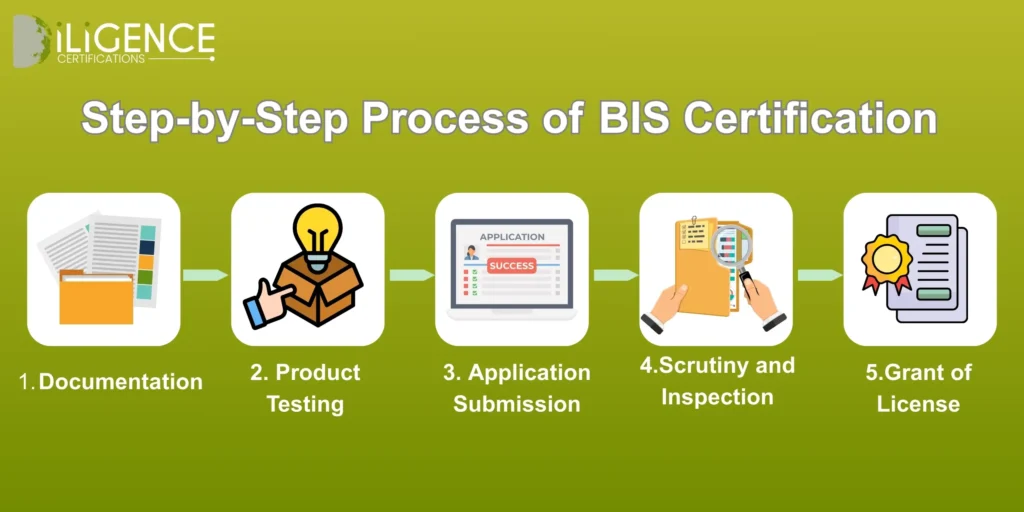
Step1:Documentation
- Collect required technical documents
- Prepare product specifications
- Gather company registration details
- Ensure documents follow BIS format
Step2:Product Testing
- Send samples to a BIS-approved lab
- Conduct safety and quality tests
- Receive test reports
- Confirm compliance with BIS standards
Step3:Application Submission
- Fill out the BIS application form
- Upload all required documents
- Attach valid test reports
- Pay the necessary BIS fees
Step4:Scrutiny and Inspection
- BIS reviews submitted documents
- Authority verifies test results
- Factory/product inspection may occur
- Clarifications requested if needed
Step5:Grant of License
- BIS approves the application
- License number is issued
- Product can carry BIS mark
- Renewal required before expiry
Documents Required for BIS Certification
| Category | Documents Required |
| Business Documents | Business license/registration, ISO certificate, organizational details |
| Manufacturer Details | Factory layout, process flow chart, machinery list, production details |
| Product Documents | Product specifications, component list, user manual, model details |
| Testing Documents | Test report from BIS-recognized lab, sample details, test request form |
| Legal & Compliance | Authorization letter, brand ownership proof, trademark certificate (if any) |
| Import/Foreign Manufacturer (If applicable) | AIR (Authorized Indian Representative) details, contract agreement, overseas manufacturer documents |
Timelines, Costs, Validity & Renewal
- Timelines: Usually from 20 to 30 days, with only 7-15 days for the testing.
- Costs: The cost of the government and the test varies depending on the product. There can be some additional charges though.
- Validity: The validity period is 2 years in most situations.
- Renewal: The renewal is done before the expiration; there should be updated documents/tests; the renewal
Why Choose Diligence Certifications
- Expertise in BIS Certification for Tool Steel Forgings Metal Forming (IS 13387 1992): Our team possesses detailed understanding of IS standards and ensures that your tool steel forgings comply with all the regulatory and quality standards in an efficient manner.
- End, to, End Support: We are with the manufacturers at every step of the certification journey from the paperwork, factory inspections, and testing.
- Money and Time Saving: Our efficient methods are instrumental in shortening approval periods, thus the production will not be delayed and money will not be wasted unnecessarily.
- Reliability in the Industry: We have contributed to the success of several Indian manufacturers and exporters in their BIS certification journeys, thus gaining trust from the clients and global partners.
- Personalized Consultation: We offer customized advice that matches the nature of your manufacturing processes, thereby facilitating you in meeting the requirements without your work being interrupted.
Conclusion
Obtaining a BIS Certification for Tool Steel Forgings For Metal Forming (IS 13387: 1992) goes beyond just being a mandate of the authorities; it is a wise decision to invest in quality, reliability, and industrial credibility. Certified tool steel forgings are the means of making your manufacturing processes safe, efficient, and able to compete globally.We at Diligence Certification are proficient in leading the manufacturers and exporters in the BIS certification pathway, thus, we are your one, stop solution from the documentation, testing to compliance verification.Firstly, by just going for the certified forgings, you lessen the possibilities of risks in your operations, secondly, client trust is enhanced and thirdly, your business is well, positioned for sustainable growth both in the domestic as well as international markets.Get your BIS, certified tool steel forgings facilitated by [Your Company Name] now and guarantee that your metal forming operations are of the highest standards in terms of performance and quality.
Frequently asked questions
What is IS 13387: 1992?
IS 13387: 1992 is the Indian standard that defines the quality and performance standards of tool steel forgings for metal forming applications.
Who issues IS 13387: 1992 certification?
The certification is awarded by the Bureau of Indian Standards (BIS).
Why is BIS certification for the tool steel forgings necessary?
It is the assurance of the material's dependability, safety, and conformance to the national quality standards.
What kind of industries need IS 13387: 1992 standard forgings?
The compliance is mandatory for the industries of automotive, aerospace, heavy engineering, and metal forming.
What properties are tested under IS 13387: 1992?
The tests performed are on the chemical composition, hardness, tensile strength, and dimensional accuracy.
Is BIS certification mandatory for exporters?
Indeed, a great number of buyers and regulatory authorities that govern exports require products with BIS certification.
How long does BIS certification take?
Usually, the entire time frame can be counted in weeks and is dependent on how ready the documentation and testing are.
Does IS 13387: 1992 apply to imported tool steel forgings?
Yes, even the import must be allowed to forgeries that comply with BIS standards if they are to be sold in India.
What will happen if a product is not BIS certified?
Products without certification can be subject to legal limitations, be refused by buyers, or have quality issues.
Can a consultant help with BIS certification?
Yes, a professional certification consultant will make it easier for you to comply and shorten the approval period.