



 BIS Certification
 CDSCO
CDSCO
 CPCB
CPCB
 LMPC
LMPC
 WPC Approval
 Global Approvals
 TEC
TEC
 ARAI
ARAI
 BEE
BEE
 ISO Certification
 DGCA Certification
 NOC For Steel
 APEDA Registration














 Business Registration
 FSSAI Mark Certification











 Legal Services
 Trademark Registration
 Copyright Registration
 Patent Registration

- Steel pipe flanges connect pipelines in critical applications.
- BIS Certification guarantees safety, durability, and standard compliance.
- IS 6392:2020 defines material, dimensions, and pressure ratings.
- Diligence Certification ensures regulatory trust in engineering projects.
Introduction
In 2022, a Surat-based engineering contractor lost a ₹2.5 crore pharma piping project due to non-compliant flanges. His supplier had no BIS certification under IS 6392:2020, making the flanges ineligible under the plant’s validation protocol. The project was delayed by 40 days, adding penalty clauses.
In industrial India, steel pipe flanges are small components with big responsibilities. When it comes to high-pressure systems, certification is not a luxury—it’s a legal and safety mandate.
What Are Steel Pipe Flanges?
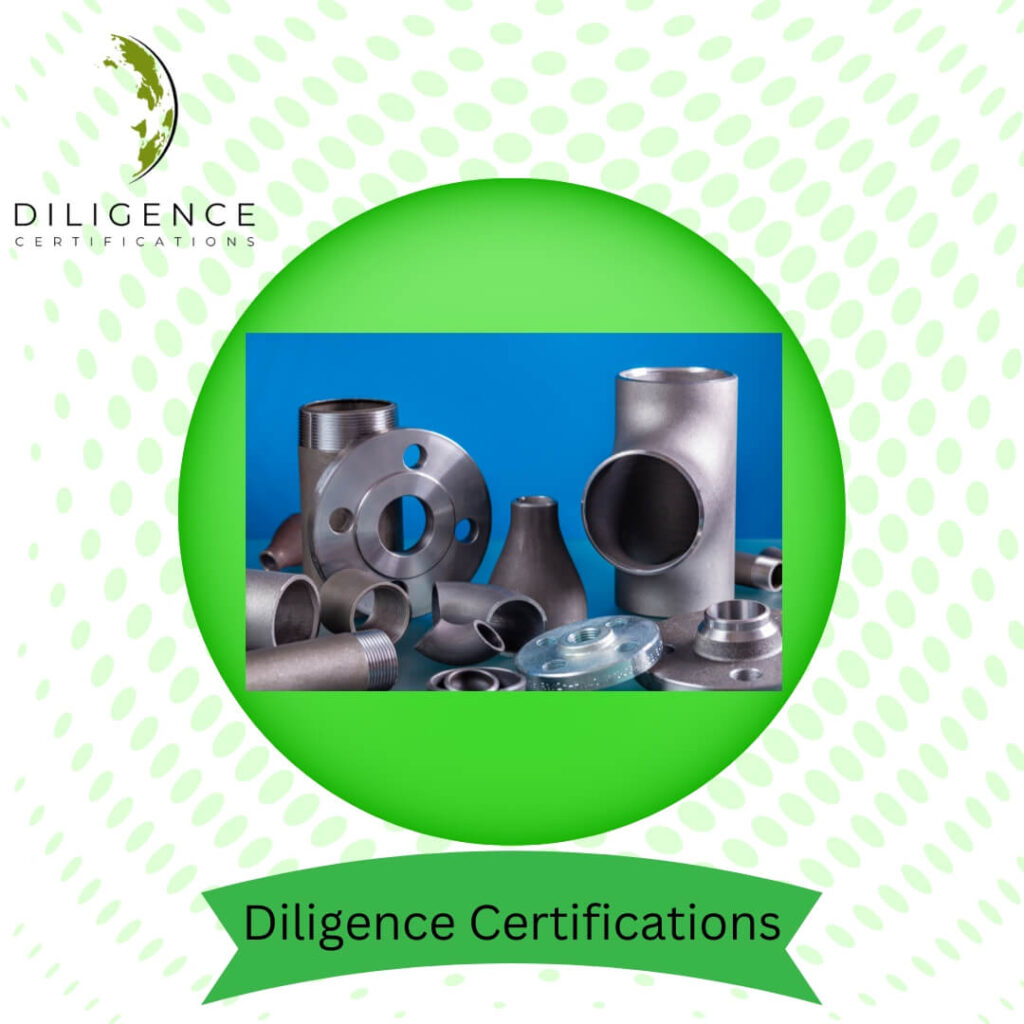
Steel pipe flanges are flat, circular discs that are used for the connection of piping systems. They make disassembly, inspecting, and pressure management through plumbing systems, chemical systems, oil and gas systems, and food-grade systems easy.
Flanges are made of carbon steel, stainless steel, or alloy steel depending on the grade, and coating for pressure, temperature, and corrosive fluid service.
Types of Steel Pipe Flanges
- Weld Neck Flange – High stress zones; critical pipelines
- Slip-On Flange – Low-pressure applications
- Blind Flange – Ends or isolates flow
- Socket Weld Flange – Small-diameter, high-pressure systems
- Lap Joint Flange – Used with stub ends, cost-saving for expensive metals
Industries Where Flanges Are Mandatory:
- Chemical and pharma plants
- Oil & gas and petrochemical refineries
- Marine and shipbuilding
- Power and boiler systems
Understanding IS 6392:2020 – BIS Certification For Steel Pipe Flanges
This standard IS 6392:2020 enormously serves BIS Certification for steel pipe flanges industries in their process of certifying according to dilution. This standard is not a paper or bureaucracy exercise, but an important framework that would ensure the quality, safety, and reliability of steel pipe flanges applied. Below is an excerpt from the blog that talks about taking a close look at IS 6392:2020‘s essential elements such as grouping guidelines, test equipment, levels of control, and schemes of inspection and testing.
IS 6392:2020 Explained – BIS Certification for Steel Pipe Flanges
Indian Standard IS 6392:2020 establishes the specifications for BIS Certification for steel pipe flanges to be used in pipelines for oil and gas, water treatment, and chemical processing, among others. Covering design, material properties, processes of fabrication, and testing trails, such norms create a boundary condition for uniformity and reliability in flange production.
BIS Certification for Steel Pipe Flanges – What and Why?

IS 6392:2020, from the Bureau of Indian Standards (BIS), requires certification for steel pipe flanges. This certification gives certainty in product reliability, dimensional tolerances and pressure ratings.
Why BIS Certification Is Crucial:
- Regulatory approval for government and industrial tenders
- Eliminates supply-chain rejection in QA audits
- Ensures dimensional tolerance and pressure compatibility
- Required for exports to standards-compliant nations
Importance of Diligence Certification
The Diligence Certification as per IS 6392:2020 indicates that the manufacturer has met the requirements of the defined quality standards and best practices during production. This certification works for the manufacturer with credibility and end user assurance on product performance and safety. Compliance with IS 6392:2020 is important for industries where piping systems have critical integrity, such as chemical processing and petrochemicals.
Grouping Guidelines
The first step towards compliance with IS 6392:2020 is understanding its grouping guidelines. These guidelines categorize BIS Certification for Steel pipe flanges based on specific criteria, simplifying the testing and certification process.
Key Considerations:
- Material Types: Steel pipe Flanges can be made from various materials, including carbon steel, stainless steel, and alloy steel. Each material has distinct properties that affect its performance in different environments.
- Size and Pressure Ratings: Flanges are classified according to their nominal sizes and pressure classes (e.g., ANSI, ASME). This classification ensures that the correct testing protocols are applied based on the expected service conditions.
- End Connections: Different types of end connections (e.g., weld neck, slip-on, blind) require different considerations in terms of design and testing.
Practical Implications of Grouping
By grouping flanges, manufacturers can streamline the testing process, reducing costs and time while maintaining high-quality standards. This also aids in inventory management, making it easier to ensure that the right flanges are available for specific applications.
List of Test Equipment
Manufacturers are required, as per the guideline contained in IS 6392:2020, to adopt a wide variety of testing equipment. The following listing outlines only the necessary quality-maintaining testing instruments in the respect of standard compliance:
Hydraulic Testing Machine: Hydrostatic testing performed by this machine gives information on the strength of the flange which means it checks if a leak would show up under high-pressure conditions or it detects any weak points that could subsequently leak.
Ultrasonic Thickness Gauge: This instrument measures flange material thickness in a non-destructive manner and thus ensures that the flange dimensions are within the specified tolerances.
Tensile Testing Machine: Checks the mechanical properties of flange materials like yield strength and elongation, thereby ensuring that they conform to specifications.
Spectrometer: Identifies the material’s chemical composition, which is necessary to confirm the specified grades. This makes it critical to ascertain the applicability of the flange in different end applications.
Leak Testing Equipment: This equipment is used for leak detection in flange connections, ensuring that flange integrity is maintained during service.
Calibration and Maintenance
Regular calibration and maintenance of testing equipment are essential to ensure accuracy and reliability in testing results. This practice not only complies with the standard but also enhances the overall quality control process.
Levels of Control
IS 6392:2020 outlines multiple levels of control to maintain stringent quality throughout the manufacturing process. These controls are vital for ensuring that every flange produced meets the required standards before it reaches the end user.
Levels Include:
- Incoming Material Inspection: Verification of the quality of raw materials is crucial. This involves checking certificates of compliance and conducting initial tests to ensure material integrity.
- In-Process Control: Continuous monitoring during manufacturing helps identify defects early in the production process. This includes regular checks on dimensions, surface finish, and welding quality.
- Final Inspection: A comprehensive assessment is conducted before flanges are dispatched. This final inspection involves visual checks, dimensional verification, and performance testing.
Step-by-Step BIS Certification Process for Steel Pipe Flanges

Getting BIS certification involves multiple stages. Here’s a breakdown tailored for Indian manufacturers and importers:
1. Choose the Correct Scheme
Steel flanges fall under Scheme I (ISI Mark Scheme) for mandatory BIS certification.
2. Submit Application via Manak Online
Include the following:
- Factory details, layout
- Quality Control (QC) plan
- Manufacturing flowchart
- BIS-recognised lab tie-up or in-house lab details
3. Documentation Required:
- Factory registration and GST
- Product drawings
- Testing reports (chemical + mechanical)
- Calibration certificates
- Internal test records
- ISO 9001 (if available)
4. Factory Audit by BIS Officer
The auditor checks:
- Testing infrastructure
- Raw material traceability
- Process control from forging to finishing
- Marking and labelling methods
5. Sample Testing at BIS Lab
Samples are collected and tested for:
Material composition
Dimensional accuracy
Pressure handling
Conclusion
The standard embodies a Diligence certification for steel pipe flanges aimed at ensuring quality and reliability. If a manufacturer categorizes pipes, employs the right test equipment, contrls the exacting levels, and accords with a disciplined inspection and testing scheme, he has complied with the Diligence certification; this is an assurance from the end-user about the integrity of the product.
Much more so, as industries grow, their demands on piping systems change, and standards such as IS 6392:2020 will not thereby be considered irrelevant in terms of safety, performance, and reliability. An understanding and application of these guidelines will be more advantageous to the industry than to the manufacturers, thereby improving general efficiencies in the industry toward safer and more effective industrial operations.
Indeed, for the manufacturers and users of piping and all systems integrated with it, IS 6392:2020 is more than a statutory requirement: it is a renunciation of the excellence of quality and performance. Through these standards, the industries will develop trust and confidence in their piping and piping systems, which may lead to technological advancement and safety.
FAQs
What is the IS standard for steel pipe flanges in India?
The Indian standard which describes flange (for piping) dimensions, pressure ratings and finishes is IS 6392:2020.
Is BIS certification required for steel pipe flanges?
Yes, BIS certification is required to provide flanges for government and public sector infrastructure projects.
How long does it take to get BIS certification for flanges?
It usually takes weeks to months depending on the factory readiness and time taken for testing.
What materials are covered under IS 6392?
The standard covers flanges made from carbon steel, stainless steel, and alloy steel.
What happens if flange fails BIS lab test?
The application would be suspended. The manufacturer has to fix the problem and re-apply with the flanges for fixture testing.
Is it possible to use the BIS mark without approval?
No. The only ones to use the BIS mark is the licensed manufacturer. Misuse is punishable under the law.
How can buyers verify that a flange is licensed by BIS?
The buyers can verify the license number on the product using the BIS portal
What documents are required to apply for renewal of a BIS licence?
Manufacturers just require the updated compliance reports, test results and audit documentation to renew their licence.
Do I need BIS certified flanges for my private industry?
No. While BIS certified products are not required for private use, it is a comfort that these products are provided to the users at an assurance of reliability, and standard compliance.
What flanges are included within the scope of IS 6392?
Weld neck, slip-on, blind, socket weld, lap joint, and threaded flanges is included in the scope of this standard.