



 BIS Certification
 CDSCO
CDSCO
 CPCB
CPCB
 LMPC
LMPC
 WPC Approval
 Global Approvals
 TEC
TEC
 ARAI
ARAI
 BEE
BEE
 ISO Certification
 DGCA Certification
 NOC For Steel














 Business Registration













 Legal Services
 Trademark Registration
 Copyright Registration
 Patent Registration
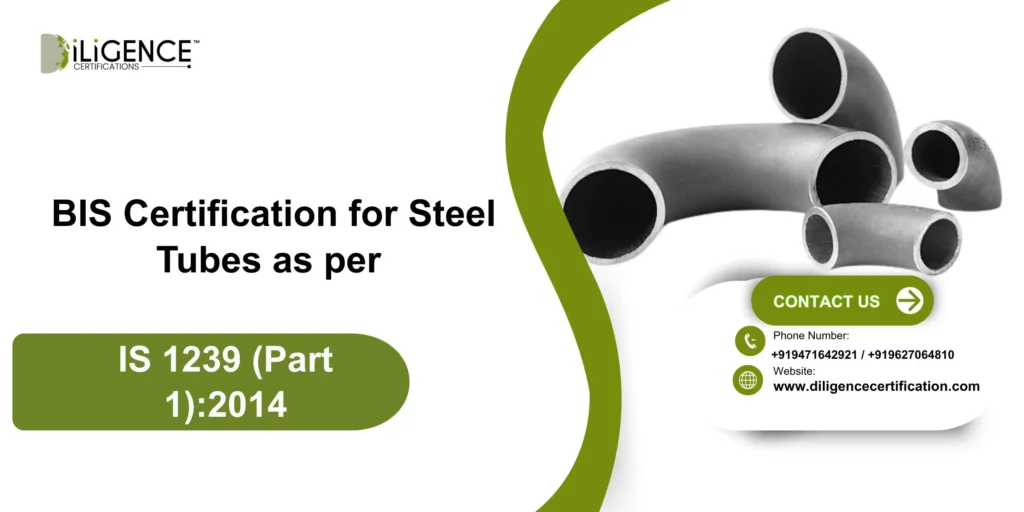
- makes sure that steel tubes conform to IS 1239 (Part 1):2014 in terms of strength, dimensional accuracy, and chemical composition.
- In India, the manufacturing and selling of steel tubes need to be certified with an ISI mark.
- Steel tubes have excellent mechanical strength and satisfactory durability, hence may be safely used in industrial and structural use.
- helps manufacturers gain market acceptance and avoid fines, while conforming to regulations.
- It increases consumer trust and brand credibility by assuring consistent performance and certified quality.
Introduction
Steel tubes serve best as construction materials owing to their strength and resilience. They find their uses in plumbing and for erection purposes because of their strength and functionality to withhold loads. The functionality impacts the durability and functionality of structures they are used in.
Quality Assurance and Safe Use: Bureau of Indian Standards has brought out IS 1239 Part 1):2014 norms regarding steel tubes. The minimum assurance of specification of steel tubes in their mechanical, chemical, and physical properties can be guaranteed if these norms are followed.
What is Steel Tubes IS 1239 (Part 1):2014?
IS 1239 (Part 1):2014 is an Indian Standard, and it gives the requirements for steel tube specifications in structural and general engineering uses. The standard encompasses the following details:
- Chemical Composition – Provides necessary strength and weldability.
- Mechanical Properties Includes tensile strength, yield strength, and elongation.
- Dimensional Accuracy – Enables standardization of outer diameter, wall thickness, and tolerance.
- Surface finish Requires that the surface of the tubes should be free from any defects.
- Methods for testing and inspection – Facilitates consistent quality levels in production lots.
- As the steel tubes abide by the standards of IS 1239 (Part 1):2014, they remain competent and efficient in terms of structural integrity and loading throughout their entire lifetime.
ISI Mark Certification for Steel Tubes
Under the ISI Mark Certification Scheme, the steel tubes shall comply with the requirements of IS:1239 (Part-1):2014 to be manufactured and marketed within India. The ISI mark certification guarantees that:
- Compatibility of the described chemical and mechanical properties
- High durability and strength
- Dimensional accuracy for precise tasks
- Quality Control During Production
Only after receiving valid BIS licensing can the ISI mark be stamped on the product by the manufacturer.
Why is BIS Certification Mandatory for Steel Tubes?
Consequences of non-standard steel tubes can include:
- Because non-standard steel tube sizes tend
- Collapse because of a lack of strength
- Poor carrying performance
- Higher maintenance and replacement prices
- Safety risks associated with construction and industrial application
BIS certification ensures that:
- IS 1239 (Part 1):2014 compliance
- Mechanical and Environmental Stress -Interrater and Test-Retest
- Consumer Confidence and Market Credibility
- Safety and performance over the long term
Importance and Benefits of BIS Certification
| Importance | Benefits |
| Compliance with IS 1239 (Part 1):2014 | Ensures strength, durability, and safety |
| Standardized manufacturing | Delivers uniform product quality |
| Mechanical reliability | Reduces risk of structural failure |
| Regulatory compliance | Prevents penalties and market rejection |
| Brand credibility | Enhances trust among buyers and contractors |
Step-by-Step BIS Certification Process
Step 1: Documentation
Prepare the company details, manufacturing process details, and specifications as per IS 1239 (Part 1):2014.
Step 2: Product Testing
Steel tube specimens are tested for chemical composition, mechanical strength, and dimensional accuracy in BIS recognized labs.
Step 3: Application Submission
Submit your application and test reports, along with necessary documents, through the BIS portal.
4. Scrutiny & Factory Inspection
The officials from the BIS check the manufacturing unit in order to confirm the presence of quality control mechanisms.
Step 5: Grant of Licence
Upon successful inspection and testing, the BIS awards the licence to imprint the ISI mark on steel tubing.
Documents Required for BIS Certification
- Company incorporation or registration certificate
- Manufacturing unit details
- Technical specifications of steel tubes
- Test reports from BIS-recognized laboratory
- Brand authorization letter (if applicable)
Timeline, Validity & Renewal
- Certification Timeline: 20–30 working days
- Licence Validity: 1–2 years
- Renewal: Submission of updated documents and continued compliance confirmation before expiry
Conclusion
Accreditations by BIS for Steel Tubes to IS 1239 [Part 1]:2014 are the assurance of quality, safety, and performance. BIS-certified steel tubes ensure reliable mechanical strength, dimensional accuracy, and long service life.
Complying with IS 1239 Part 1:2014 will not be a legal compulsion but a strategic step toward building trust, ensuring safety, and ultimately achieving sustainable business growth for any manufacturer and supplier. BIS-certification steel tubes are important for safer infrastructure, superior performance, and an enhanced market reputation in India’s competitive industrial sector.
Frequently Asked for Questions
What is BIS Certification for Steel Tubes?
It provides standards for the steel tubing manufactured according to IS 1239 Part - 1:2014 standards.
Do steel tubes need to be certified by BIS in India?
Yes, ISI mark certification is required for both the production and sale of steel tubes.
What is the standard that applies to BIS-certified steel tubes?
The steel tubes would require compliance with the specifications given in IS 1239 (Part1
Who issues BIS certification for steel tubes?
The certificate of origin and quality is issued by the Bureau of Indian Standards (BIS).
What IS 1239 (Part 1):2014 specifies?
It deals with chemical composition, mechanical properties, dimensions, and surface finish.
How long does BIS certification for steel tubes take?
Usually 20-30 working days.
How valid is a BIS license for steel tubes?
1 to 2 years.
is factory inspection mandatory for BIS certification?
Yes, BIS checks the manufacturing unit prior to issuing the license.
Why BIS certification for Steel Tubes?
It ensures hardness, safety, and durability.
Are unauthorized steel tubes allowed for sale in India?
Because the steel tubes are not certified, there might be the denial of sales or even penalization.