



 BIS Certification
 CDSCO
CDSCO
 CPCB
CPCB
 LMPC
LMPC
 WPC Approval
 Global Approvals
 TEC
TEC
 ARAI
ARAI
 BEE
BEE
 ISO Certification
 DGCA Certification
 NOC For Steel














 Business Registration












 Legal Services
 Trademark Registration
 Copyright Registration
 Patent Registration
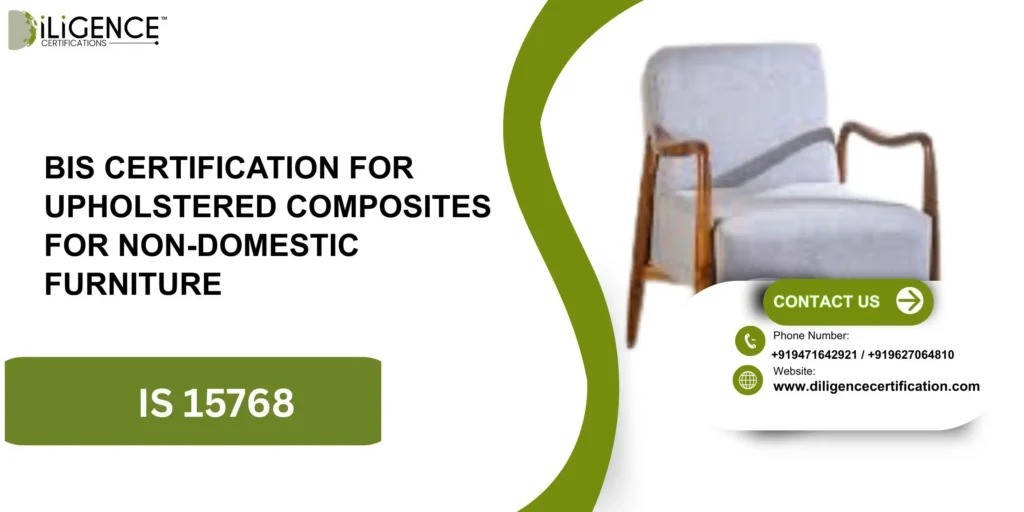
- Mandatory Compliance: Upholstered composites used in non, dwelling domestic furniture have to conform to the requirements of IS 15768, as regulated by the Bureau of Indian Standards (BIS).
- Quality & Safety Standard: The standard lays down the requirements that characterize strength, durability, fire performance, and material safety of upholstered composites.
- Application Scope: The standard is relevant to the furniture used in offices, hotels, hospitals, auditoriums, public buildings, and the like of the commercial sector.
- Product Testing: The materials are tested for performance, structural integrity, and safety parameters in laboratories recognized by BIS.
- ISI Mark Authorization: Manufacturers holding a BIS license can avail of the ISI mark that signifies conformity, quality assurance, and acceptance by the market.
Introduction
BIS certification for Upholstered Composites for Non, Domestic Furniture as per IS 15768 is an assurance that the materials used in commercial and public furniture meet the specified Indian standards in terms of quality, safety, and performance. This certification, which represents the most significant benchmarks of product quality and safety in India, is mainly about the product’s strength, durability, fire resistance, and general material stability. Certification is concerned with the use of these upholstered composites in non, domestic settings such as offices, hotels, hospitals, auditoriums, and the like to guarantee dependability, user safety, and service performance over time.
What is IS15768?
IS 15768 defines an Indian Standard that the Bureau of Indian Standards (BIS) makes binding. The document specifies quality, safety, and environmental standards for upholstered composite materials used in furniture that is non domestic in nature. Basically, the standard specifies technical requirements for furniture of commercial and public sectors. Such products include furniture for offices, hotels, hospitals, auditoriums, and institutions. Regulations are set concerning the strength, durability, fire performance, material integrity, and workmanship of the product. Compliance with IS 15768 is a sign of a product that is safe, reliable, and physically capable of being used for a long time in areas with high consumer traffic.
Key Points:
- Indian Standard: IS 15768 defines the standard for upholstered composites which are used in the non domestic furniture, set by the Bureau of Indian Standards (BIS).
- Scope of Application: The rule is valid for the furniture used in offices, hotels, hospitals, and educational institutions, etc. These are commercial or public places.
- Quality Requirements: The standards for strength, durability, and material integrity are also elevated by the finish quality of the product.
- Safety Parameters: The specification also includes fire performance and safety of the users in public environments.
- Testing & Compliance: The products must be tested in laboratories recognized by BIS in order to verify conformity before certification.
Why is BIS Certification Mandatory
BIS Certification is the main measure to check if the products that are available for sale in India are safe and reliable in terms of the quality, and the performance of these products adhere to the standards set by the Bureau of Indian Standards (BIS). It also requires product testing, factory evaluation, and regular supervision which is a way to protect consumers, ensure the observance of the law, and gain trust in the market through the ISI mark.
Key Reasons:
- Products are ensured to be in conformity with Indian safety, quality, and performance standards.
- It is compulsory for a large number of products in order to meet legal and regulatory requirements in India.
- It comprises testing in labs recognized by BIS and factory evaluation.
- The sale of substandard or unsafe products in the market is stopped.
- The ISI mark is a symbol of product reliability, compliance, and consumer trust.
Importance and Benefits of BIS Certification
| Importance | Benefits |
| Legal compliance:A legal requirement for those products that have been notified to be manufactured or sold in India. | Legal Market Access: Enables products to be legally made, imported, and sold in India. |
| Consumer safety:Makes sure that products meet the most basic safety and health requirements. | Consumer Trust: ISI mark helps to establish trust as it assures safety and quality standards have been met. |
| Quality assurance:It is a measure that guarantees the product’s quality and performance are maintained at the level of the Indian Standards. | Quality Consistency: It is a guarantee that the products conform to standardized Indian Standards in terms of performance and durability. |
| Product testing:Testing must be done in laboratories recognized by BIS for issuing compliance certificates. | Competitive Advantage: Products with certification are more easily accepted in government, institutional, and commercial sectors. |
| ISI Mark Value:The ISI mark stands for:AuthenticityReliabilityAcceptance by the market | Risk Reduction: Helps to limit the occurrences of product failures, recalls, and safety, related issues that can lead to liabilities for manufacturers. |
Step-by-Step Process of BIS Certification
Step1:Documentation
- Collect required technical documents
- Prepare product specifications
- Gather company registration details
- Ensure documents follow BIS format
Step2:Product Testing
- Send samples to a BIS-approved lab
- Conduct safety and quality tests
- Receive test reports
- Confirm compliance with BIS standards
Step3:Application Submission
- Fill out the BIS application form
- Upload all required documents
- Attach valid test reports
- Pay the necessary BIS fees
Step4:Scrutiny and Inspection
- BIS reviews submitted documents
- Authority verifies test results
- Factory/product inspection may occur
- Clarifications requested if needed
Step5:Grant of License
- BIS approves the application
- License number is issued
- Product can carry BIS mark
- Renewal required before expiry
Documents Required for BIS Certification
| Category | Documents Required |
| Business Documents | Business license/registration, ISO certificate, organizational details |
| Manufacturer Details | Factory layout, process flow chart, machinery list, production details |
| Product Documents | Product specifications, component list, user manual, model details |
| Testing Documents | Test report from BIS-recognized lab, sample details, test request form |
| Legal & Compliance | Authorization letter, brand ownership proof, trademark certificate (if any) |
| Import/Foreign Manufacturer (If applicable) | AIR (Authorized Indian Representative) details, contract agreement, overseas manufacturer documents |
Timelines, Costs, Validity & Renewal
- Timelines: Usually from 20 to 30 days, with only 7-15 days for the testing.
- Costs: The cost of the government and the test varies depending on the product. There can be some additional charges though.
- Validity: The validity period is 2 years in most situations.
- Renewal: The renewal is done before the expiration; there should be updated documents/tests; the renewal
Why Choose Diligence Certifications
Diligence Certifications is a compliant compliance consultancy that offers complete support for BIS Certification and other regulatory approvals in India. With solid technical skills and deep understanding of Indian Standards, Diligence Certifications clarifies complicated certification processes and guarantees that approvals are obtained smoothly and on time. The firm provides the whole package of help from application filing and product testing coordination to factory inspection support and final ISI mark licensing. By prioritizing accuracy, transparency, and client centric service, Diligence Certifications enables manufacturers, importers, and brands to accomplish regulatory compliance without wasting time, cut the causes of delay, and get faster market access with trust.
Conclusion
BIS Certification is essential to product safety, quality, and legal conformity in the Indian Market. It is a shield for consumers against poor quality while by what it entails help manufacturers win trust, gain credibility, and have acceptance in the market for a longer period of time. By aligning with Indian Standards and obtaining the certification, companies can be compliant with the regulations, offer products that are more reliable, and have a stronger position to compete in the local and institutional markets.
Frequently Asked Questions (FAQs)
What is BIS Certification under IS 15768?
Bureaus of Indian Standards give the certification to show that upholstered composite materials used in non domestic furniture are safe and of good quality as per Indian standards.
Is BIS Certification mandatory for upholstered composites used in commercial furniture?
Non domestic furniture with upholstery made of composites must, as a matter of necessity, comply with IS 15768 if they are to be sold or used in India.
What types of furniture are covered by IS 15768?
The standard describes office, hotel, hospital, auditorium, and educational institution furniture and any other public or commercial spaces.
What parameters does IS 15768 test?
The strength, durability, fire performance, material integrity, safety, and workmanship of the products are being tested.
What products need to be BIS, certified as per IS 15768?
Manufacturers of fabrics made from composite materials or furniture that are intended for non domestic use need to obtain a Bureau of Indian Standards (BIS) Certification.
Where is product testing carried out for BIS Certification?
The tests are done in labs that are acknowledged and authorized by the BIS.
What is the validity of Certification from BIS?
BIS License remains valid for two years, in most instances, and has to be Renewed before its Expiry Date.
Is there an opportunity for renewal of BIS Certification, even if it
Yes, this can be done through the submission of fresh documents, test reports (in case there are any), and the fee required for renewal before expiration of the license.
What is the ISI mark, and why is it important?
The ISI mark shows that a product meets the Indian Standards. The mark assures quality, safety, and compliance with the regulations.
What are the consequences when the product is sold without BIS Certification?
Distribution without the BIS Certification marked on the notified products involves the possibility of fines, seizure, lawsuits, and prohibition from the Indian marketplace.