



 BIS Certification
 CDSCO
CDSCO
 CPCB
CPCB
 LMPC
LMPC
 WPC Approval
 Global Approvals
 TEC
TEC
 ARAI
ARAI
 BEE
BEE
 ISO Certification
 DGCA Certification
 NOC For Steel










 Business Registration




 Legal Services
 Trademark Registration
 Copyright Registration
 Patent Registration
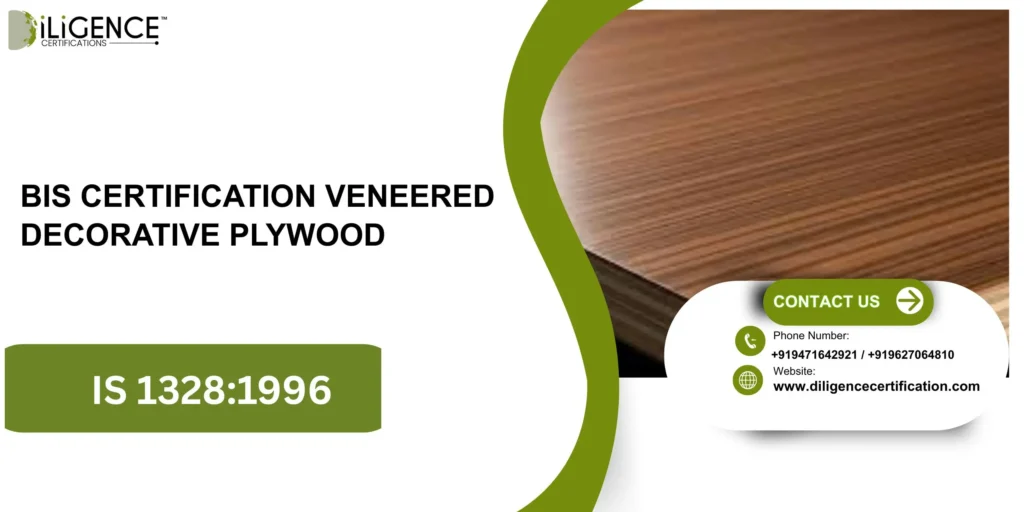
- Mandatory Compliance: Veneered decorative plywood produced or traded in India has to conform to the IS 1328:1996 standard as laid down by the Bureau of Indian Standards (BIS).
- Quality & Aesthetic Standards: The standard envisions setting of quality and aesthetic criteria through the specification for surface finish, veneer bonding, appearance, and uniformity.
- Strength & Durability: The document elaborates on the limitations and characteristics of the materials in terms of bonding strength, resistance to warping and overall structural stability of the plywood.
- Product Testing: The plywood undergoes testing for adhesion, moisture resistance, workmanship, and dimensional accuracy in labs accredited by BIS.
- ISI Mark Authorization: Manufacturers holding BIS license can put the ISI mark on their products which is an indication of quality assurance and acceptance by the market.
Introduction
BIS Certification to IS 1328:1996 for Veneered Decorative Plywood is a guarantee that the decorative plywood for interior use conforms to the prescribed Indian standards of quality, durability, and appearance. The certification mainly highlights the veneer bonding, surface finish, workmanship, and resistance to the defects such as blistering or delamination of the product. Veneered decorative plywood certified to IS 1328:1996 is the first choice of material for furniture, wall paneling, partitions, and decorative interiors, where the combination of aesthetic appeal and structural reliability is a must. Meeting the requirements of this standard under the Bureau of Indian Standards (BIS) supervision is a quality hallmark that consumers can trust for a product with a long service life.
What is IS1328:1996?
IS 1328:1996 defines the criteria for veneered decorative plywood primarily used for interiors and decorative purposes. The standard provides requirements that a decorative veneer plywood should have acceptable levels of quality, appearance, and performance. The standard covers quality of bonding of the veneers, surface finish, freedom from defects, dimensional stability, and workmanship. IS 1328:1996 standard ensures that plywood not only looks good but also has adequate strength and durability for such applications as furniture, paneling, partitions, doors, and interior fittings. In the Indian market, conformity to this standard is a guarantee of the uniform quality and dependability of veneered decorative plywood.
Key Points:
- Indian Standard: IS 1328:1996 is a reference point put out by the Bureau of Indian Standards (BIS) concerning veneered decorative plywood.
- Product Scope: The regulation specifies the characteristics of the plywood that is laminated with either natural or decorative veneers and is made for interior and decorative use.
- Quality Requirements: The standard specifies the criteria for the surface finish, appearance, veneer quality, and workmanship.
- Bonding & Stability: It outlines bonding strength, resistance to defects, and dimensional stability aspects.
- Assured Performance: Meeting the requirements makes decorative plywood products to be of consistent quality, durable and aesthetically reliable.
Why is BIS Certification Mandatory
BIS certification is required by law to make sure that the products sold in India meet the quality, safety, and performance standards set by the Bureau of Indian Standards (BIS). The compulsory certification helps keep the consumers away from low, quality products, encourages fair trade practices, and guarantees that the quality is the same everywhere in the market. For regulated products, conforming to the standards is necessary if one wants to produce, bring in, or sell in India.
Key Reasons:
- Consumer Safety & Protection: The main objective is to alleviate the danger of consumers being harmed by ensuring products meet at least the minimum safety and performance standards.
- Quality Assurance: Is made possible daily production quality is ensured through established standards and tests.
- Legal Compliance: It is mandatory for notified products; thus, non compliance may lead to penalties, seizure of goods, or prohibition of sales.
- Market Trust & Acceptance: The ISI mark serves as a trust builder, thus facilitating buyer confidence and acceptance in the market.
- Fair Competition: Prevents the supply of low, quality products, thereby giving manufacturers who abide by the rules equal opportunities.
Importance and Benefits of BIS Certification
| Importance | Benefits |
| Mandatory Compliance: BIS certification is a must for any product that has been notified if one wants to manufacture or sell it legally in India. | Verify that products meet the Indian Standards with regard to quality, performance and durability |
| Standardized Quality: It makes sure that products meet the Indian Standards in terms of quality, safety, and performance, and can be relied upon | Ensure consumers can have confidence in using your products |
| Testing & Inspection: Products undergo testing in laboratories recognized by BIS, and factories are regularly inspected | You will be able to legally produce, import and sell your products in India as an approved manufacturer |
| ISI Mark Authorization: It is only manufacturers who have been licensed by BIS that are allowed to put the ISI mark, which is an indication of quality certified. | Your certified products will be of greater interest to suppliers in tenders, government contracts and organised markets than non-certified products |
| Consumer & Market Confidence: Certification is a source of trust, brand credibility becomes stronger, and market acceptance gets facilitated. | Continuous testing and monitoring of your products will help to minimise the occurrence of product failure, defect reports and complaints from end users. |
Step-by-Step Process of BIS Certification
Step1:Documentation
- Collect required technical documents
- Prepare product specifications
- Gather company registration details
- Ensure documents follow BIS format
Step2:Product Testing
- Send samples to a BIS-approved lab
- Conduct safety and quality tests
- Receive test reports
- Confirm compliance with BIS standards
Step3:Application Submission
- Fill out the BIS application form
- Upload all required documents
- Attach valid test reports
- Pay the necessary BIS fees
Step4:Scrutiny and Inspection
- BIS reviews submitted documents
- Authority verifies test results
- Factory/product inspection may occur
- Clarifications requested if needed
Step5:Grant of License
- BIS approves the application
- License number is issued
- Product can carry BIS mark
- Renewal required before expiry
Documents Required for BIS Certification
| Category | Documents Required |
| Business Documents | Business license/registration, ISO certificate, organizational details |
| Manufacturer Details | Factory layout, process flow chart, machinery list, production details |
| Product Documents | Product specifications, component list, user manual, model details |
| Testing Documents | Test report from BIS-recognized lab, sample details, test request form |
| Legal & Compliance | Authorization letter, brand ownership proof, trademark certificate (if any) |
| Import/Foreign Manufacturer (If applicable) | AIR (Authorized Indian Representative) details, contract agreement, overseas manufacturer documents |
Timelines, Costs, Validity & Renewal
- Timelines: Usually from 20 to 30 days, with only 7-15 days for the testing.
- Costs: The cost of the government and the test varies depending on the product. There can be some additional charges though.
- Validity: The validity period is 2 years in most situations.
- Renewal: The renewal is done before the expiration; there should be updated documents/tests; the renewal
Why Choose Diligence Certifications
Diligence Certifications is a compliance and certification consultancy that businesses can rely on to achieve BIS and other mandatory certifications without any hassle. Diligence Certifications, with an extensive knowledge of regulations, a customer centric approach, and complete support, makes the most complicated certification processes easy while at the same time ensuring that Indian standards are fully complied with. The company, being a perfect example of accuracy, transparency, and timely execution, thus allows manufacturers and importers to gain access to the Indian market in a safe and trustworthy manner.
Conclusion
BIS certification is an essential instrument that is instrumental in maintaining quality, safety, and conformance to regulations for products sold in the Indian market. The certification is a consumer protective measure against inferior products and is a source of trust, credibility, and acceptance of the market for a long time, which manufacturers receive by BIS certification. Companies are able to employ the BIS standards as a means to access the market via legal compliance, maintain the quality of their products over time, and obtain a competitive advantage, hence certification becomes a prerequisite for sustainable growth and customer trust.
Frequently Asked Questions (FAQs)
What is the Importance of BIS Certification to Veneered Decorative Plywood?
BIS Certification on the basis of IS 1328:1996 is the evidence of the veneered decorative plywood item’s compliance with the required specifications of the nation with respect to its quality, looks, joint strength, and longevity
Is BIS Certification Compulsory for Veneered Decorative Plywood in India?
The standard applies to plywood with natural and decorative surfaces, which may be used for interior and decorative purposes only
What kinds of plywood are covered by IS 1328:1996?
The standard lays down the requirements for plywood that is faced with natural or decorative veneers and is essentially meant for use in the interior and for decorative purposes.
What tests are conducted for the certification of IS:1328:1996?
The standard applies to plywood with natural and decorative surfaces, which can be used for interior and decorative purposes only.
How long does it take to obtain BIS Certification?
The time period taken is generally around 20 to 30 days. This time period mainly depends on how prepared the documentation is, the time period taken for testing of the products, and also whether an inspection is required.
What is the validity of BIS Certification?
Typically, the BIS Certification is issued for a validity period of 2 years and a renewal is required if it is going to be used after that.
Can imported veneered decorative plywood get BIS Certification?
Yes, a foreign manufacturer may be certified by BIS through an Authorized Indian Representative (AIR) by complying with the requirements specified by BIS.
What would occur if a Product had been sold without a BIS Certification?
Selling an un-certified Good may incur Penalties, Goods Seized, Sales Cancelled or Legal Action taken against the seller by authorities.
What Benefits Are Associated With The Presence Of An ISI Mark On Veneered Decorative Plywood?
The ISI Mark gives Customers Confidence In The Certified Quality Of The Product, Improves Acceptance Due To Having A Third Party Certify It, Increases Trust & Provides A Competitive Edge For Both Sellers And Customers.
What are the benefits of the ISI Mark on veneered decorative plywood?
The ISI Mark signifies verified quality and conformity, builds consumer trust, improves market acceptance, and provides a competitive advantage in tenders and organized markets.