



 BIS Certification
 CDSCO
CDSCO
 CPCB
CPCB
 LMPC
LMPC
 WPC Approval
 Global Approvals
 TEC
TEC
 ARAI
ARAI
 BEE
BEE
 ISO Certification
 DGCA Certification
 NOC For Steel















 Business Registration














 Legal Services
 Trademark Registration
 Copyright Registration
 Patent Registration
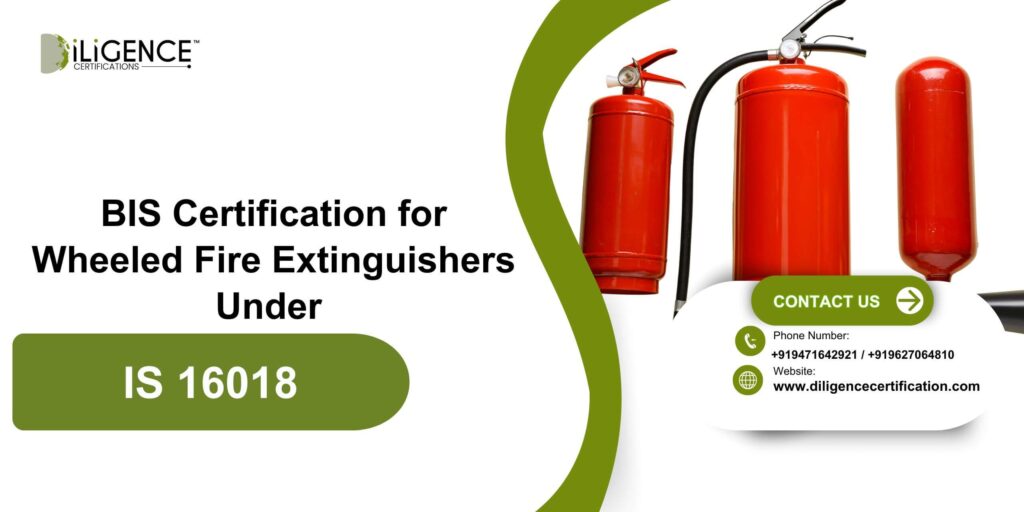
IS 16018 details the Indian Standard for wheeled fire extinguishers that are intended to be used in extreme and large-area fire cases like industrial plants, warehouses, airports, refineries, and commercial complexes. The standard describes the features related to the structure, fire extinguishing capacity, mechanical strength, resistance to pressure, discharge performance, mobility, and safety features of the device.
BIS certification serves as a guarantee of the quality, reliability, and safety of the wheeled fire extinguishers in the occurrence of an emergency fire situation. The ISI mark is compulsory for manufacturers who plan to produce and sell wheeled fire extinguishers in India to ensure their products conform to the national fire safety regulations. The BIS certification procedure is characterised by documentation, product testing, factory inspection, approval, and licensing. Certified products provide a safety cushion, garner user trust, and ensure a reliable means of fire protection over extended usage.

Introduction
Wheeled fire extinguishers are a vital instrument in the suppression of large fires that are beyond the scope of portable extinguishers. Such are the extinguishers that have been evolved for movement, greater extinguishing power, and speedy use in the industrial and commercial sectors where the risk of fire is high.
As wheeled fire extinguishers are the main means of saving lives, protecting assets, and complying with regulations, it is therefore necessary to follow IS 16018 strictly. BIS-approved wheeled fire extinguishers are the ones that can perform the desired functions during the time of need, can endure the pressure and environmental stress, and can uphold the safety standard as expected by the fire authorities, industries, and infrastructure projects all over India. Bureau of Indian Standards
What are Wheeled Fire Extinguishers – IS 16018?
Wheeled Fire Extinguishers IS 16018 is the Indian Standard that defines the specifications for a large-capacity fire extinguisher that is mounted on wheels for easy movement and fast fire suppression.
The standard specifies:
Construction & Design – The main body should be sturdy along with the hose, nozzle, and the valve system
Extinguishing Capacity – Sufficient discharge time and effective fire-fighting capability
Pressure Resistance – The capability of the extinguisher to hold the internal pressure without any risk
Mobility Requirements – Heavy-duty wheels and grips for simple transportation
Safety Features – Pressure gauges, discharge control, and leak prevention
Testing & Inspection Methods – Making sure that quality is consistent in different production batches
Compliance with IS 16018 keeps wheeled fire extinguishers in good working condition, they can be trusted and are of great use during their service life.
ISI Mark Certification for Wheeled Fire Extinguishers
Under the ISI Mark Certification Scheme, wheeled fire extinguishers must conform to IS 16018 to be legally manufactured and sold in India.
ISI certification assures:
- Reliable fire extinguishing performance
- Safe pressure containment and discharge
- Mechanical durability during handling and movement
- Consistent quality across production batches
- Compliance with national fire safety norms
Manufacturers are permitted to affix the ISI mark only after obtaining a valid BIS licence.
Why BIS Certification for Wheeled Fire Extinguishers IS 16018 Is Mandatory in India
As a result of the use of non-certified wheeled fire extinguishers, there can be a series of unfortunate events such as:
- Failure during fire emergencies
- Inadequate discharge or extinguishing capacity
- Leakage or bursting due to poor pressure resistance
- Non-compliance with fire safety regulations
- Rejection by fire departments and government authorities
BIS certification is instrumental in avoiding such risks through:
- Compliance assurance with IS 16018
- Operational reliability enhancement during emergencies
- Conforming to fire safety standards for industrial and commercial projects
- Helping the preservation of human life, property, and the environment
Importance and Benefits of BIS Certification
| Importance | Benefits |
| Compliance with IS 16018 | Ensures safe and effective fire suppression |
| Standardized manufacturing | Maintains consistent quality across units |
| Fire safety assurance | Reduces risk of equipment failure in emergencies |
| Regulatory compliance | Avoids legal penalties and project rejection |
| Brand credibility | Builds trust with safety officers and authorities |
Step-by-Step BIS Certification Process for Wheeled Fire Extinguishers
Step 1: Documentation
Gather company details, manufacturing process information, and product specifications as per IS 16018.
Step 2: Product Testing
Samples are measured in laboratories that are BIS accredited for performance of discharge, pressure resistance, mechanical strength, and safety parameters.
Step 3: Application Submission
Submit the BIS application along with the test reports and necessary documents through the BIS portal.
Step 4: Scrutiny & Factory Inspection
BIS officers visit the factory, inspect the quality control systems, and production processes.
Step 5: Grant of Licence
After the inspection and verification are satisfactory, BIS issues the licence which permits the use of the ISI mark on fire extinguishers with wheels.
Documents Required for BIS Certification
- Company Registration Certificates
- Details and layout of the manufacturing unit
- Technical specifications of wheeled fire extinguishers
- Test reports from BIS-recognized laboratories
- Quality control and testing procedures
- Brand authorization (if applicable)
Timeline, Validity & Renewal
- Certification Timeline: 20–30 working days
- Licence Validity: 1–2 years
- Renewal: Submission of current documents along with the proof of continuation of.
Conclusion
BIS certification for wheeled fire extinguishers according to IS 16018 is an extremely important measure to guarantee fire safety, product trustworthiness, and conformity with regulations in India. Those certified extinguishers are the ones that will deliver efficient performance in a critical situation of fire, thus making the environment safer for the living beings and the material resources, as well as pleasing the safety authorities and large scale infrastructural projects.
Adherence to IS 16018 standards is definitely not only a must by law but also a very considerate move towards the creation of safer industrial and commercial settings. The purchase of BIS-certified wheeled fire extinguishers is the way in which an individual/business can communicate their pledge to the standards of quality, safety, and durability of the fire protection system.
Frequently Asked for Questions
What is IS 16018 and why do I need to know about it?
IS 16018 is the Indian standard that defines the requirements for the safety of wheeled fire extinguishers in case of major fire emergencies.
Can I sell wheeled fire extinguishers in India without BIS certification?
Absolutely not! Obtaining a BIS certification along with an ISI mark is mandatory if you want to sell a wheeled fire extinguisher in India.
Who should request BIS certification under IS 16018?
The manufacturer who is producing industrial or commercial wheeled fire extinguishers should obtain this certification.
Why fire extinguishers on the wheel get a different treatment than the portable ones?
The reason is that the first ones are meant to be used in large fires covering big areas, therefore, they require stricter safety and performance standards.
What is at stake if a fire extinguisher doesn’t have a BIS certification?
Surely, the risk increases that it would fail to help during a fire situation, that it would leak if under pressure, or that it wouldn’t be accepted by the fire safety authorities when required.
How does an agreement with BIS help to prevent fires in real life?
It definitely does so by ensuring the extinguisher performing discharge correctly, is able to hold the pressure safely, and can be trusted to work in the emergency situation.
Is it hard to get a BIS certificate?
BIS certification involves a series of steps and activities such as testing, documentation, inspection of the factory, and obtaining the final approval, which is quite straightforward in nature although it takes some time.
What is the usual amount of time required to be able to get the BIS certification?
Normally, it takes 20 to 30 working days if all papers and test results are perfect.
What is the duration of the BIS license after it has been granted?
The license validity is from one to two years and can be extended by showing ongoing conformity.
Is it good to have a BIS certification from a marketing point of view?
Definitely, the certification is a huge positive signal for the company’s customer base and makes it easier to attract more clients such as the fire departments and government projects.