 BIS Certification
 CDSCO
CDSCO
 PESO
PESO
 CPCB
CPCB
 LMPC
LMPC
 WPC Approval
 Global Approvals
 TEC
TEC
 ARAI
ARAI
 BEE
BEE
 ISO Certification
 DGCA Certification
 NOC For Steel
 APEDA Registration























 Business Registration
 FSSAI Mark Certification












 (32).jpg)
 Legal Services
 Trademark Registration
 Copyright Registration
 Patent Registration
 By
By - Medical X-ray machines are imaging devices that utilize controlled radiation to create a picture of what lies beneath the skin surface on the human body.
- IS 7620 (Part 1):1986 sets safety standards for diagnostic medical X-ray equipment.
- BIS Certification is mandatory for manufacturing, importing, and selling such equipment in India.
- Certification ensures electrical, mechanical, and radiation safety.
- The process includes application, testing, inspection, compliance review, and license grant.
- Certification builds trust, compliance, and market access.
Introduction

Medical X-ray equipment is an essential equipment that can provide diagnosis for healthcare. Because medical X-ray equipment operates directly on patients and operators, its safety, reliability, and compliance must be monitored. In India, the Bureau of Indian Standards (BIS) has already developed IS 7620 (Part 1):1986 - Safety Requirements for Diagnostic Medical X-Ray Equipment (Part 1) which established mandatory standards for electrical, mechanical, and radiation safety.
There is a requirement that manufacturers and importers of diagnostic medical X-ray equipment go and obtain BIS Certification for Medical X-ray Equipment prior to sale or distribution of their product in the Indian market. BIS certification guarantees equipment that meets the rigorous safety and quality norms; which not only protects the healthcare operator but the patient as well.
What is Medical X-ray equipment?
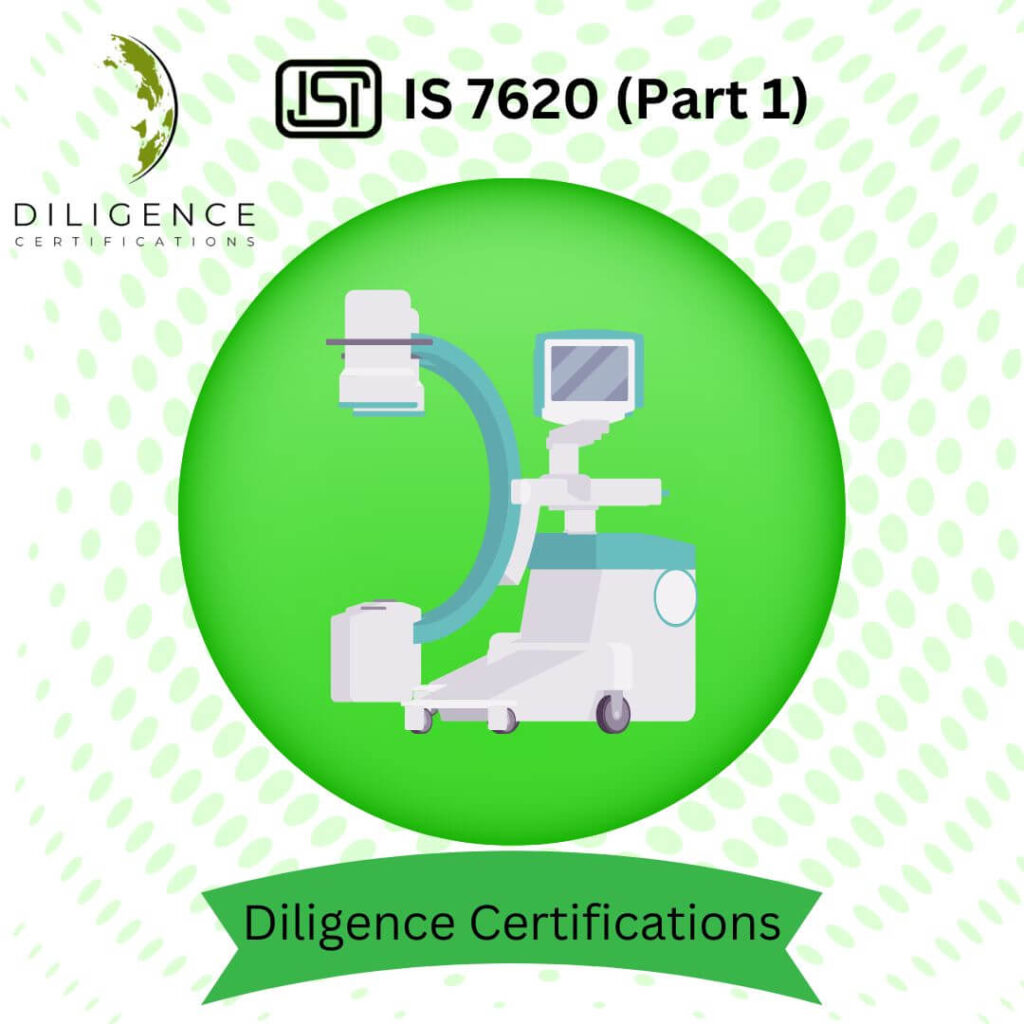
Medical X-ray apparatus refers to a type of diagnostic imaging device that generates images of the internal structures of the human body using controlled doses of X-ray radiation. Medical X-ray devices are utilized in hospitals, clinics, and diagnostic centers to image bones, lungs, joints and select soft tissues.
There are several different types, such as:
- Digital Radiography (DR) - Produces immediate images of reasonably good quality.
- Computed Radiography (CR) - Uses imaging plates that must then be scanned after exposure in order to produce images.
- Portable X-ray machines - Also mobile units that can be transported to ICUs, ambulances, or rural areas.
In India, the X-ray equipment must conform to the safety and performance standards under IS 7620 (Part 1) in order to have low radiation exposure and reasonably accurate results.
Understanding IS 7620 (Part 1) for Medical X-ray Equipment
This international standard specifies the safety requirements for X-ray diagnostic apparatus, with due consideration of protection against radiation, electrical safety, and mechanical safety. The Indian Standard prescribes the safety requirements for X-ray machines in hospitals and diagnostic centers as per international standards.
It concerns itself with aspects such as:
- Radiation shielding to minimize exposure
- Electrical insulation to prevent the risk of shock or failure
- Mechanical stability for safe functioning
- Performance standards for image quality and diagnostic accuracy
Importance of IS 7620 (Part 1)
Manufacturers are required to put an ISI Mark on their goods, certifying compliance with the BIS requirements. Customers and the medical community may feel secure knowing that the equipment satisfies the highest safety and performance requirements.
- Radiation Protection: Any X-ray machine produces radiation with ions, which can be dangerous if ignored. According to IS 7620, leakage radiation would have always been below acceptable bounds.
- Equipment Durability: To reduce the risk of failure, the standard establishes durability and reliability standards for X-ray equipment.
- Patient Safety: The standard protects the patient from unnecessary exposure by ensuring the correct functioning of X-ray machines.
- Regulatory Approval: To obtain regulatory clearance and provide market access, IS 7620 is a necessary compliance requirement.
What is IS 7620 (Part 1):1986?
IS 7620 (Part 1):1986 is the Indian Standard for safety requirements for diagnostic medical X-ray equipment. It defines:
- Electrical safety safeguards against shock or short circuit failures.
- Radiation safety rules designed to limit patient exposure to radiation.
- Mechanical design safety standards for safe operation and handling.
- Performance safety parameters for the diagnostic accuracy to be performed without compromising safety.
The standard verifies diagnostic X-ray machines will be safe, versatile, and performed according to internationally mandated safety requirements.
Benefits of BIS Certification for X-ray Equipment
BIS Certification for Medical X-ray Equipment under IS 7620 (Part 1) has various functions:
- Safety assurance for patients and medical staff.
- Market credibility with the ISI mark.
- Regulatory compliance with Indian laws.
- Reduced liability from equipment-related hazards.
- Competitive edge in both domestic and global markets.
- Trust-building among hospitals, clinics, and diagnostic centers.
Key Highlights of IS 7620 (Part 1)
| Feature | Description |
| Standard Code | IS 7620 (Part 1) |
| Product Category | Diagnostic Medical X-ray Equipment |
| Regulatory Body | Bureau of Indian Standards (BIS) |
| Certification Type | Mandatory BIS Registration |
| Compliance Mark | ISI Mark |
| Scope | Covers radiation safety, electrical safety, and mechanical stability |
| Applicable Entities | Manufacturers, Importers, Distributors of Medical X-ray Equipment |
| Market Requirement | Mandatory for selling and distributing X-ray machines in India |
| Testing Parameters | Radiation safety, electrical insulation, leakage current, performance efficiency |
| Certification Partner | Diligence Certification |
Documents Required for BIS Certification of Medical X-Ray Equipment
- Application form and product details.
- Technical drawings and specifications.
- Test reports from BIS/NABL accredited labs.
- Quality management system documents.
- Factory inspection reports (for manufacturers).
- Import-export license (for importers).
Certification Process for Medical X-Ray Equipment under IS 7620 (Part 1):1986
- Application Submission - Manufacturer or importer files application with BIS.
- Product Testing - Equipment is tested in a BIS-recognized NABL-accredited laboratory as per IS 7620 (Part 1):1986.
- Factory Inspection - BIS officials inspect the manufacturing facility to verify compliance.
- Compliance Review - Technical evaluation of documents and test reports.
- Grant of Licence - If compliant, BIS issues a licence to use the ISI Mark.
- Surveillance & Renewal - Regular inspections and periodic renewals ensure continuous compliance.

Cost, Validity & Timeline for BIS Certification of Medical X-Ray Equipment
1. Cost of BIS Certification
The cost for obtaining BIS Certification for Medical X-Ray Equipment depends on several factors:
- BIS Application & Licence Fee - Paid to the Bureau of Indian Standards.
- Testing Charges - Product must be tested at a BIS/NABL accredited laboratory as per IS 7620 (Part 1):1986.
- Inspection Charges - Factory audits conducted by BIS officials.
- Consultancy & Documentation Support - If using experts like Diligence Certifications.
2. Validity of Certification
- The initial BIS Licence for Medical X-Ray Equipment is granted for 2 years.
- After that, it can be renewed every 2-5 years, provided the manufacturer continues to comply with IS 7620 (Part 1):1986 and passes periodic audits.
- Renewal fees are lower than initial certification costs.
3. Timeline for Certification
The certification timeline depends on testing duration, document preparation, and BIS review process:
- Application & Document Preparation - 1-2 weeks.
- Testing at BIS/NABL Lab - 3-5 weeks (may vary depending on test slots).
- Factory Inspection by BIS Officials - 1-2 weeks.
- Final Approval & License Grant - 1-2 weeks after successful review.
Testing Parameters for Medical X-Ray Equipment
- Electrical safety tests.
- Mechanical stability tests.
- Radiation leakage and exposure testing.
- Imaging performance verification.
Role of Manufacturers, Importers, and Hospitals
- Manufacturers - must comply with design, testing, and factory audits.
- Importers - responsible for BIS certification before market entry.
- Hospitals/Diagnostic centers - should only procure BIS-certified machines.
Role of Compliance Consultants - Diligence Certification
Obtaining BIS Compliance seems to be very complex, especially for medical device manufacturers and importers. Diligence Certification is there to provide world-class consulting services in the area of BIS certification for businesses: application assistance, product testing, and document submissions form part of the hassle-free approval process that Diligence certification guarantees.
Here is How Diligence Certification Helps:
- End-to-end support: from documentation to factory inspection preparation.
- Faster Approvals: Process organization will lead to faster application processing.
- Expert advice: understands and walks clients through the main compliance requirements.
- Post-Certifications: Continues compliance with BIS.
If you’re looking for the best consultants for BIS Certification of X-ray Machines, Diligence Certification is your compliance partners.
Conclusion
The BIS Certification for Safety Requirements for Diagnostic Medical X-Ray Equipment based on IS 7620 (Part 1):1986 is not only a legislative obligation but a vital safety and quality guarantee. For manufacturers and importers, it helps build credibility and market access. For patients and practitioners, it guarantees safety and trust.
If you are being a manufacturer or an importer using the Equipment Certification process for Medical X-Ray Equipment, utilizing qualified consultants will make the process easier and therefore more compliant with Bureau of Indian Standards regulations.
Frequently Asked Questions
What is IS 7620 (Part 1):1986?
IS 7620 (Part 1):1986 is the Indian Standard that governs the safety requirements of diagnostic medical X-ray equipment that include protective radiation safety, electrical safety, and mechanical safety.
Is BIS Certification required for medical X-ray equipment in India?
Yes. BIS Certification of medical X-ray machines is included in the Compulsory Registration Scheme so it is mandatory.
Who provides the certification for the medical X-ray equipment?
The certification is provided by the Bureau of Indian Standards (BIS).
What types of hazards does IS 7620 (Part 1) cover?
It covers electrical hazards, mechanical risks, and controlling radiation exposures.
Can BIS Certification be obtained by importers?
Yes, both manufacturers and importers of X-ray equipment must have BIS certification before the sale and distribution of their medical X-ray equipment in India.
How long does BIS Certification take to complete?
Usually, 4-6 weeks if there is no delay in testing or documentary clearance.
What specific documents are needed for BIS Certification of medical X-ray machines?
Product documents, test reports, product technical specifications, factory inspection reports.
Does the BIS Certification have an expiration date?
The Certification is usually valid for 2 years, and has to be renewed for continued compliance.
What happens if a company sells medical X-ray equipment without a BIS Certification?
Selling medical X-ray equipment without a certification is illegal and could result in penalties, recalls, or market bans.
How does BIS Certification provide value to hospitals and patients?
BIS Certification provides confidence that hospitals will use safe and compliant X-Ray machines, which protects the patient and operator alike


