BIS Certification
 CDSCO
CDSCO
 PESO
PESO
 CPCB
CPCB
 LMPC
LMPC
 WPC Approval
 Global Approvals
 TEC
TEC
 ARAI
ARAI
 BEE
BEE
 ISO Certification
 DGCA Certification
 NOC For Steel
 APEDA Registration























 Business Registration
 FSSAI Mark Certification












 (32).jpg)
 Legal Services
 Trademark Registration
 Copyright Registration
 Patent Registration

 By
By - BIS Certification is compulsory for oil-immersed distribution transformers up to 2,500 kVA and 33 kV, as per the Electrical Transformers Quality Control Order (QCO), 2015.
- Compliance with IS 1180 (Part 1):2014 and IS 2026 series ensures safety, performance, and energy efficiency.
- The process includes design validation, lab type testing, MANAKonline application, factory audit, and licence issuance.
- BIS-certified transformers gain market trust, meet DISCOM and tender requirements, and avoid shipment rejections or penalties
- BIS licences are valid for 1-2 years, requiring timely renewal, annual marking fees, and periodic audits.
Introduction
The Bureau of Indian Standards (BIS) is mandated to look after the quality, safety, and efficiency of electrical equipment, such as power transformers and their components. BIS Certification for Transformers comes under BIS Scheme X Certification , which specifies the quality and safety standards for transforming manufacturing and importing transformers into India. Certification means that a transformer would be in accordance with the performance, safety, and environmental standards defined within the scheme, with the hope of minimizing incidences of faults or accidents with the use of transformers.
The expansion of the power sector in India has made the distribution system for power even more vital. Transformers are now becoming increasingly necessary with the growing trend of renewable energy integration. Hence, BIS certification would serve as a benchmark for quality, ensuring that substandard or poorly performing transformers do not find entry into the Indian marketplace.
Understanding Transformers and Their Importance
Transformers are vital electrical tools used in transferring electrical energy between circuits by direct induction. The application of transformers ranges widely between power transmission, industries, and domestic electrical systems. Transfer efficiency, reliability, and the safety of the transformers are needed to keep power distribution networks stable and secure. Modern power systems would not function well if there were no transformers, which would cause voltage fluctuations, energy losses, and possible dangers.
The Working Principle of Transformers
The Law of Transformation is based on the principle of electromagnetic induction discovered by Faraday. An alternating current flowing through the primary coil generates a magnetic field, which in turn induces a voltage in the secondary coil. Depending on the turns ratio of the coils, the induced voltage may be increased or decreased. Transformers are so designed that maximum power transfer occurs without loss of energy.
Types of Transformers Covered Under BIS Certification
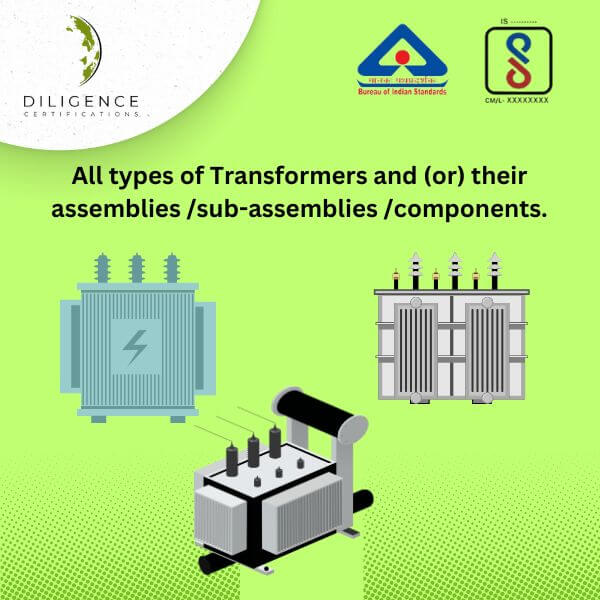
1. Power transformers are used in electrical transmission networks to change voltage levels according to requirement either up or down. It helps reduce power loss and provides for the best transmission of power at longer distances. Power transformers are mostly found in substations and high-voltage applications, where they will facilitate better supply assurance to cities and industries.
2. Distribution Transformer This is the transformer type we are familiar with using for domestic and commercial purposes to reduce the high transmission voltages down to usable levels. Safe and stable power consumption is made possible by residential and industrial settings, and their sizes are becoming smaller compared to power transformers. They are also designed for continuous operation.
3. Instrument Transformers Current Transformers (CT): To measure different levels of current receive isolation between high-voltage circuit and measuring instruments.
4. Voltage Transformers (VT): Also called potential transformers, these are voltage transformers used to convert high exponential values into reduced values of voltage for the purpose of metering and occasionally used for protection purposes. These transformer play a significant role in accurate measurement and control of electrical networks.
5. Auto Transformers Unlike its conventional transformer, an auto transformer contains a single winding that serves simultaneously as the primary and as the secondary winding, yielding highly efficient regulation of voltage. They are mostly applicable in industries where saving on space and cost is paramount.
6. Isolation Transformers Such transformers provide electrical isolation between circuits for safety and protection against electrical shocks and are, therefore, used largely in sensitive electronic equipment to avoid interference from electricity.
7. Special Purpose Transformers
8. Welding Transformers - To be used in arc welding applications.
9. Rectifier Transformers - Used in industrial applications of DC power drainage supply.
10. Furnace Transformers - Such transformers are meant to be used in high-temperature applications within steels and metals industries.
11. Traction Transformerse are that convert electric energy for the purposes of electrified train networks.
Assemblies, Sub-Assemblies, and Components Covered Under BIS Certification
1. Core Assemblies
A heart is one of the most salient parts of a transformer. It is the part that takes care of the magnetic transfer of flux. The BIS certification makes transformer cores fulfill the efficiency and safety standards.
2. Windings and Insulation Systems
Windings and insulation systems provide copper or aluminum-wound transformers with a bridge through which to transfer the electrical energy. The BIS certification determines the wired materials and insulation quality to enable durability and performance.
3. Cooling Systems
Oil cooling and air cooling are some of the cooling mechanisms that support transformer efficiency. A BIS certification ensures that cooling systems meet safety and operational standards.
4. Bushings and Terminals
Bushings give insulation and mechanical support to conductors. The BIS compliance confirms that the bushings and terminals comply with electrical safety norms.
5. Tap Changers
Tap changers are designed to stabilize voltage output and supply voltage supply. Tap changers are certified BIS for their reliability and efficiency.
6. Enclosures and Casing
Protective enclosures are barriers to transformers against environmental damage. The BIS certification ensures that these components qualify regarding safety and durability standards.
Benefits of BIS Certification for Transformers
1. Ensure Quality and Safety
With BIS Certification, transformers undergo rigorous testing and checks for quality compliance with all international and national safety standards.
2. Regulatory Compliance
Manufacturers and Importers must comply with BIS standards to sell transformers legally in the Indian market.
3. Enhance Market Credibility
Certified transformers win the faith of consumers and businesses leading to increased acceptance in markets.
4. Reduce Electrical Hazards
Minimization of the risks from electrical failure and short circuits, along with the hazards of fire, is attained under BIS-certified transformers.
5. Efficiency and Performance Optimization
BIS-certified transformers are designed for energy efficiency, reducing losses and costs in operation.
Future Trends in Transformer Certification and Development
These developments are continuously adapting transformer technology with increasing demand for electricity. Smart transformers, eco-friendly designs, and AI-based monitoring systems are some of those developments in transformer technology. All new developments will be taken up as new standards for BIS certification for energy efficiency and environmental sustainability.
How Diligence Certification Can Help
At Diligence Certification, we simplify the BIS certification process for manufacturers and importers.
Whether you are new to the market or expanding your product line, our team of industry experts will help you every step of the way, from start to finish.
Here’s how we can assist you:
- Complete Documentation and Application Support
We take care of all the paperwork for you and ensure that all the documentation is complete and compliant with BIS requirements.
2. Liaison With BIS Approved Laboratories
We help you connect with BIS recognized testing laboratories and ensure that the testing of your test samples of transformers is done in an efficient, effective manner.
3.Assistance With Factory Audits and Inspections
We support your operational preparedness for processes, compliance and the checklist for BIS factory inspections.
4. Fast and Cost Effective
With Diligence, we will help you save money and time in developing, gaining certification without delays, and paying excessive expense.
Conclusion
In India, the BIS certification of transformers is an absolute requirement for guaranteed safety and efficiency, as well as for compliance with regulations. As a manufacturer, importer, or distributor, obtaining a BIS certification adds credibility in the marketplace and increases consumer faith in you. Collaboration with compliance specialists such as Diligence Certification makes the whole process of obtaining a certification hassle-free and helps businesses in seamless acceptance of industry standards.
Get in touch with Diligence Certification for more details regarding BIS certification for transformers!
Frequently Asked Questions
What is BIS Certification for Transformers?
It is a government-approved license to confirm a transformer conforms to requisite Indian safety and performance standards e.g., IS 1180 or IS 2026.
Is BIS Certification obligatory for all transformers?
Yes, oil-immersed distribution transformers only, upto 2,500 kVA, 33 kV as required under QCO, 2015. Many tenders also require BIS certified, 3rd party inspected and tested transformers in higher ranges/value.
Which Indian Standards have relevance for transformers?
IS 1180 (Part 1):2014 for distribution transformers and the IS 2026 series for power transformers.
How long does it take to receive BIS certification?
Normally 8-20 weeks, depending on availability of lab tests and preparation of application documents.
What documents are necessary to apply for the BIS certification?
Technical drawings, lab test reports, certificates of raw materials used, quality assurance plans, and factory information are key.
How much are BIS certifications?
From ₹5 - 15 lakh for MSMEs, purely for any test done by a lab (the BIS fees and costs of any audit is also involved).
Can foreign manufacturers apply for BIS certification?
Yes, they need to use the Foreign Manufacturers Certification Scheme (FMCS) and have an Authorised Indian Representative (AIR).
What happens if a transformer does not have BIS certification?
Utility and customs will reject a shipment and may charge penalties or hold shipments during the uneven time of receiving a BIS certification.
How long is a BIS licence good for?
Typically 1-2 years and a mandatory renewal of the licence is required, periodic surveillance audits in further years are also mandatory (i.e., every two years)
Where can I apply for BIS Certification?
Applications are submitted online through the MANAKonline portal (www.bis.gov.in).